
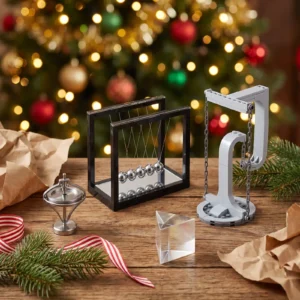
What is a Newton's cradle?
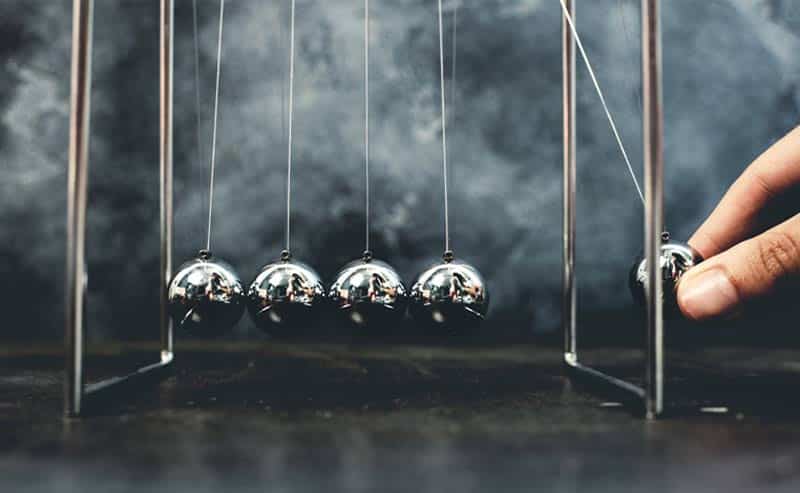
A Newton's cradle is a desk toy made of five (sometimes seven) metal balls hanging in a row from a frame. Lift the ball at one end and let it go: it strikes the row, and the ball at the far end swings out on its own while the middle ones stay still. It demonstrates two laws of physics, conservation of momentum and conservation of energy, and it was first built in the 1960s, named after Isaac Newton, whose laws it illustrates.
21 modelsFrom £15.99Chrome, wood, LED or giantNo batteries (except LED)Free UK delivery over £45
Who is this collection for?
🪀
For a desk that needs a rhythm
The original executive toy. One pull, minutes of click-clack, and a reason to stare at something other than a screen.
🎁
For a graduation, a promotion or an office move
Everyone recognises it, almost nobody owns one. Chrome for a modern desk, wood for a study, LED for a teenager.
🎓
For physics teachers and curious minds
Momentum and energy transfer in a demonstration you can repeat a hundred times. Ask why the middle balls stay still and you have a lesson.
How to choose a Newton's cradle
Four things decide whether a Newton's cradle will look right and swing well: the size, the base material, the number of balls and the extras. Here is how our range breaks down.
| Type | Best for | Size | Price |
|---|---|---|---|
| Classic desk cradle | A first cradle, any desk | 12 to 18 cm | £16 to £30 |
| Wooden base | A study, a warm interior | 17 to 23 cm | £20 to £83 |
| LED or coloured balls | Teenagers, gaming desks | 15 to 20 cm | £22 to £27 |
| 7 ball and metal frames | Collectors, longer swing | 20 to 25 cm | £77 |
| Large and kinetic sculptures | Reception desks, statement pieces | 30 to 45 cm | £112 to £182 |
A heavier ball and a stiffer frame swing longer and cleaner. Chrome steel balls on nylon lines are the standard; the giant and metal models use thicker lines and a machined frame, which is why they cost more and last longer.
The science in two lines
When the first ball hits the row, its momentum passes through the stationary balls as a compression wave and comes out the other end. Only one ball moves because momentum and kinetic energy must both be conserved, and one ball at the same speed is the only solution that satisfies both.
Air resistance and friction at the strings slowly drain the energy, which is why it stops after a few minutes.
Our three bestsellers
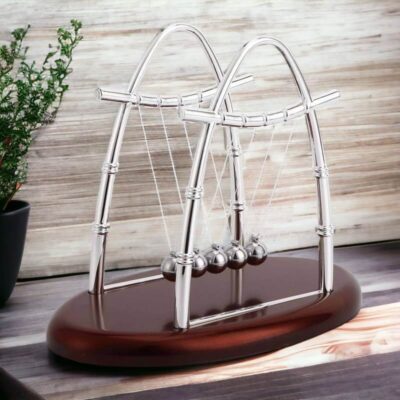
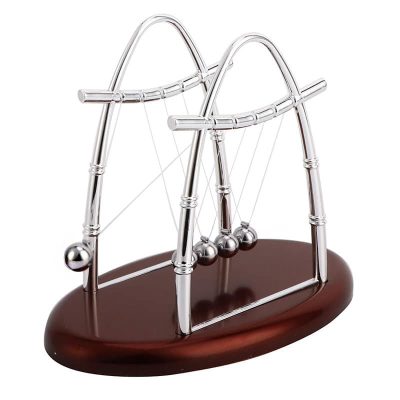
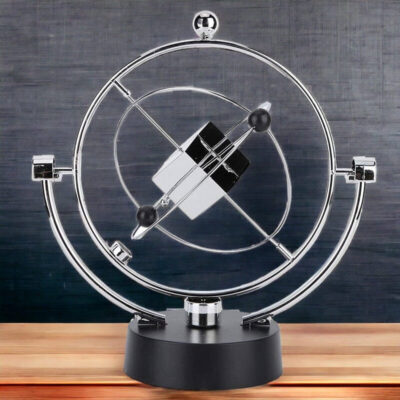
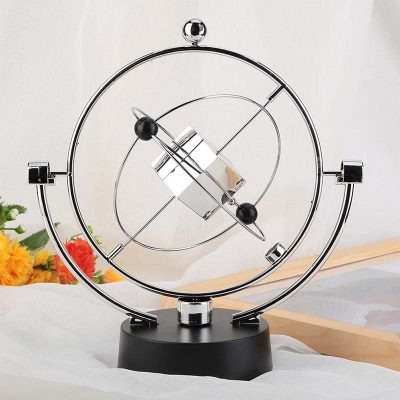
Newton's cradle: your questions, answered
How does a Newton's cradle work?
One ball strikes the row, and its momentum and energy travel through the middle balls to the far one, which swings out. The middle balls barely move because momentum and kinetic energy are both conserved.
Why does only one ball swing out?
Because it is the only outcome where both momentum and energy stay the same. Two balls swinging out at half speed would keep the momentum but lose energy, so physics does not allow it.
How long does a Newton's cradle swing?
A desktop model swings for two to five minutes per pull, longer for heavy metal frames. Air resistance and friction at the strings gradually stop it.
Which Newton's cradle is best as a gift?
The classic chrome desk cradle for a first one, the wooden base for a study, and the LED model for a teenager. All three are under £30.
Is a Newton's cradle suitable for children?
From about 8, as a desk object. The balls are heavy and the strings fine, so it is not a toy for toddlers. Our Newton's Cradle for Kids has a sturdier frame.
Does it need batteries?
No, except the LED models, which use a small battery pack or USB for the lights. The motion is always powered by your hand.
Free UK delivery over £45, and 30 days to return it. Prefer a slower, wilder motion? The Chaotic Double Pendulum and the gyroscopes are the next step.