
The essentials:
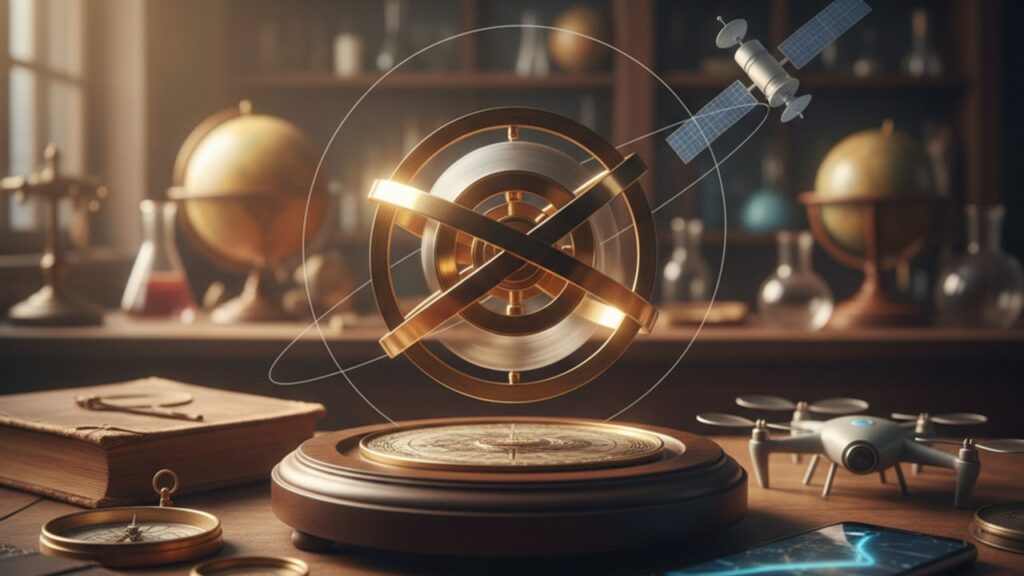
- A gyroscope is a spinning wheel or disc mounted so its axis can point in any direction, resisting changes to its orientation thanks to angular momentum.
- The word was coined in 1852 by French physicist Léon Foucault from the Greek for “turn” and “to see”.
- Modern gyroscopes hide inside smartphones, aircraft, ships, spacecraft such as Hubble, and even some wristwatches.
- A tabletop mechanical gyroscope makes a genuinely tactile, physics-based gift, no app or battery required, and is the closest most of us will ever come to holding real angular momentum in our hands.
Ask most people what a gyroscope is and you get a shrug, or a vague memory of a spinning top from a school science lesson. Yet this deceptively simple device quietly keeps aircraft level, points space telescopes at distant galaxies, and rotates your phone’s screen the instant you tip it sideways. As a museum science communicator turned curator of curious desk objects, I’ve watched more visitors light up over a spinning gyroscope than almost any other exhibit. There’s something wonderfully counterintuitive about a spinning disc that simply refuses to fall over.
📋 Table of contents
- What Is a Gyroscope? A Simple Definition
- How Does a Gyroscope Actually Work?
- A Brief History: From Foucault to Modern Sensors
- What Is a Gyroscope Used For?
- Mechanical, Optical or MEMS: What Types of Gyroscope Exist?
- Gyroscopes as Gifts: From Lab Instrument to Desk Toy
- Our Verdict
- Frequently Asked Questions
What Is a Gyroscope? A Simple Definition
A gyroscope is a device consisting of a spinning wheel or disc mounted on an axis, free to rotate in one or more directions, that resists any force trying to change its orientation. This resistance to change is called gyroscopic rigidity, and it is the direct consequence of angular momentum, the same physical quantity that keeps a thrown frisbee or a spinning bicycle wheel stable in flight. Think of it as inertia’s stubborn cousin: once a mass is spinning fast enough around an axis, it “wants” to keep pointing that axis in the same direction in space, regardless of what the frame around it is doing.
The classic image is a metal wheel inside a set of pivoting rings, known as gimbals, which let the outer frame tilt and turn while the spinning wheel inside stays pointed the same way. That’s essentially what Léon Foucault built to demonstrate the Earth’s rotation in his Paris laboratory in 1852, and it’s the same basic architecture found in navigation instruments used on ships and aircraft throughout the twentieth century.
💡 Did you know?
Did you know? Foucault coined the term “gyroscope” by combining the Greek words gyros (turn) and skopein (to see), essentially naming it “a device to see rotation”. He built his instrument specifically to make the Earth’s daily spin visible in a lab, without needing to watch the stars.
How Does a Gyroscope Actually Work?
A gyroscope works because a spinning mass generates angular momentum, and that momentum resists any torque trying to tilt its spin axis, instead causing it to move sideways in a phenomenon called precession. Push on the axis of a spinning gyroscope and, rather than simply tipping over as you’d expect, it swings off to the side at ninety degrees to your push. This is precession, and it’s the same reason a spinning top wobbles in slow, stately circles instead of collapsing the moment it starts to tilt.

Two properties matter most in practice:
- Rigidity in space, meaning the spin axis holds its direction relative to the fixed stars unless acted on by an external force, which is why gyroscopes are so useful for navigation.
- Precession, meaning any applied force produces motion perpendicular to that force, which engineers exploit deliberately in stabilisers and control systems.
⭐ Key takeaway
Precession feels genuinely odd the first time you experience it by hand. If you ever try nudging a fast-spinning gyroscope yourself, expect it to move in a direction you didn’t push, that’s completely normal physics, not a faulty toy.
A Brief History: From Foucault to Modern Sensors
Gyroscopic principles were observed long before Foucault gave them a name, but three dates define the device’s journey from curiosity to critical technology. The core physics predates Foucault by decades, yet it took his 1852 demonstration to turn an abstract idea about spinning bodies into a named, purpose-built scientific instrument.
🛍️ Our pick
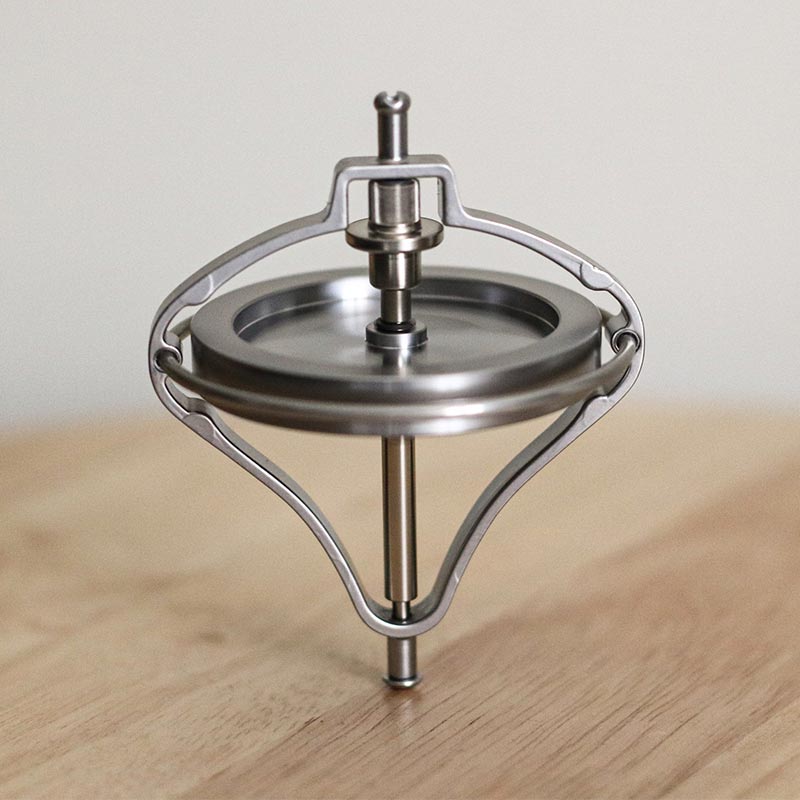
Antigravity Gyroscope
The antigravity gyroscope demonstrates the principles of angular momentum and stabilization, key concepts in modern gyroscopic applications.
44,99 £ · ★ 20 sold
- 1852: Léon Foucault builds and names the gyroscope in Paris to visually demonstrate Earth’s rotation.
- 1908: American engineer Elmer Sperry patents an active gyrostabilizer for ships, later fitted to vessels to reduce rolling in heavy seas, and his company goes on to pioneer aircraft gyroscopic instruments.
- 1960s onward: Ring laser and fibre-optic gyroscopes, which use light rather than a spinning mass, begin replacing mechanical versions in aircraft and missile guidance, offering greater durability with no moving parts to wear out.
What Is a Gyroscope Used For?
Gyroscopes are used to sense or maintain orientation, and today they appear in navigation systems, spacecraft, consumer electronics, vehicles and stabilisation equipment. Almost every device that needs to know which way it’s pointing, or needs to stay pointing the same way despite outside disturbance, relies on some form of gyroscope. Here are the main sectors where they earn their keep:
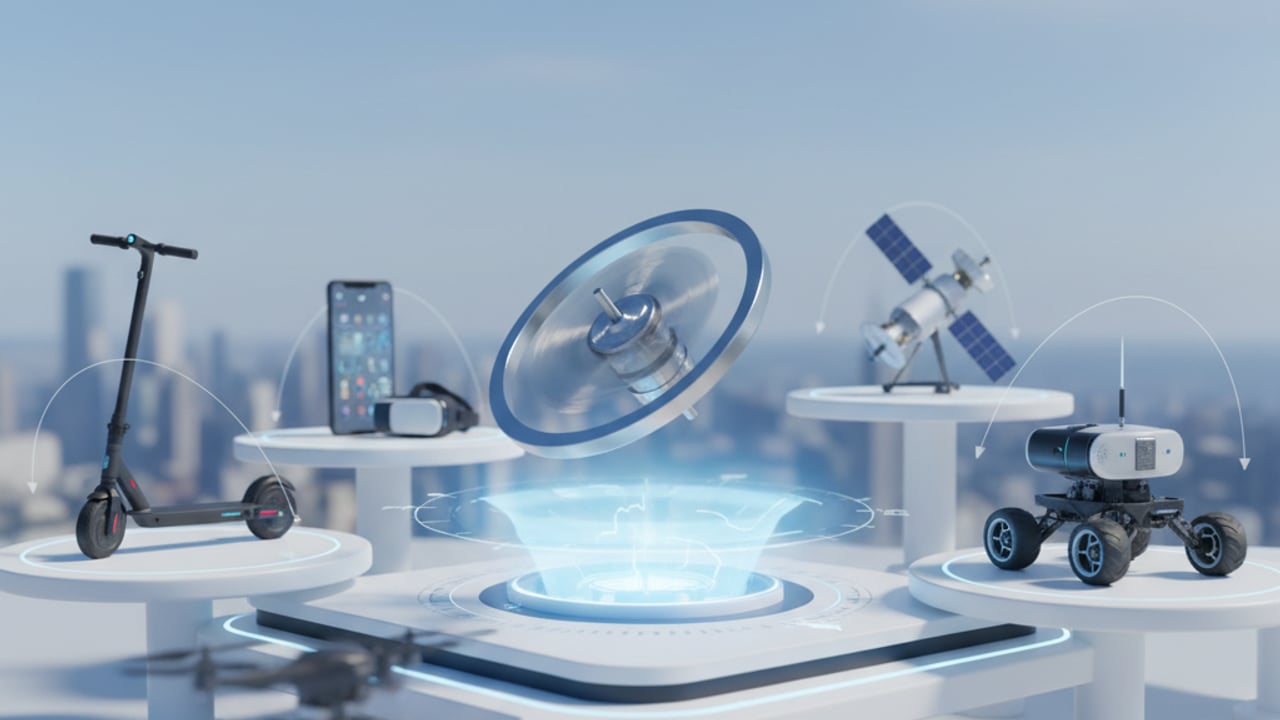
- Aviation and marine navigation: inertial navigation systems use gyroscopes to track an aircraft or ship’s orientation and heading without external references.
- Space telescopes: the Hubble Space Telescope carries six gyroscopes and, according to NASA, needs a minimum of three functioning units to point accurately at distant targets for extended observations.
- Ship stabilisation: large gyroscopic stabilisers reduce rolling on vessels ranging from ferries to superyachts, a direct descendant of Sperry’s 1908 patent.
- Consumer electronics: smartphones, drones and games controllers use tiny gyroscopic sensors to detect rotation and tilt.
- Vehicle safety systems: electronic stability control in modern cars combines gyroscope and accelerometer data to detect skids before the driver does.
- Virtual and augmented reality: headset head-tracking depends on rapid, precise gyroscopic readings to keep the virtual world steady as you turn your head.
What Is the Gyroscope in Mobile Phones?
The gyroscope in a mobile phone is a microscopic MEMS (micro-electromechanical system) sensor, typically only a few millimetres across, that detects rotation using vibrating structures rather than a spinning wheel. Instead of a physical disc spinning at speed, tiny vibrating elements shift slightly when the phone rotates, thanks to the Coriolis effect, and that shift is converted into an electrical signal telling the phone exactly how it’s oriented. This is what rotates your screen, stabilises your photos, and lets augmented reality apps track your movements in real time.
💡 Did you know?
Did you know? The MEMS gyroscope inside your smartphone is smaller than a grain of rice, yet it performs the same fundamental job, sensing orientation, as the far larger mechanical gyroscopes used in mid-twentieth-century aircraft cockpits.
What Is the Gyroscope in the Human Body?
The body’s closest equivalent to a gyroscope is the vestibular system in the inner ear, specifically three fluid-filled semicircular canals oriented roughly at right angles to one another. When your head rotates, fluid inside these canals lags slightly behind the bony structure surrounding it, bending tiny hair cells that send signals to your brain about the direction and speed of movement. It isn’t a spinning mass in the strict engineering sense, but it performs the same essential job as a gyroscope: telling you, moment to moment, which way you’re turning.
What Is the Gyroscope in a Watch?
In traditional watchmaking, the “gyroscope” people usually mean is actually the tourbillon, a rotating cage patented by Abraham-Louis Breguet in 1801 to counteract the effect of gravity on a pocket watch’s escapement when left in one position. Strictly speaking a tourbillon isn’t a true gyroscope, since it doesn’t rely on angular momentum for stability, but the visual of a constantly rotating mechanism has led to understandable confusion. Modern smartwatches and fitness trackers, by contrast, do contain genuine MEMS gyroscopes, used to detect wrist orientation and gesture-based controls like the twist-to-wake feature.
Mechanical, Optical or MEMS: What Types of Gyroscope Exist?
There are three broad families of gyroscope in use today, distinguished by how they sense rotation rather than by size or price alone.
- Mechanical gyroscopes: a physical spinning wheel or disc mounted in gimbals, the original design, still used in desktop demonstration models and some legacy navigation systems.
- Optical gyroscopes: ring laser and fibre-optic types that measure rotation by comparing light travelling in opposite directions around a loop, with no moving parts, favoured in modern aircraft and missiles for their durability.
- MEMS gyroscopes: tiny vibrating-structure sensors, cheap to mass-produce and small enough to fit in a phone, drone or games controller, though generally less precise than mechanical or optical versions for demanding scientific applications.
Gyroscopes as Gifts: From Lab Instrument to Desk Toy
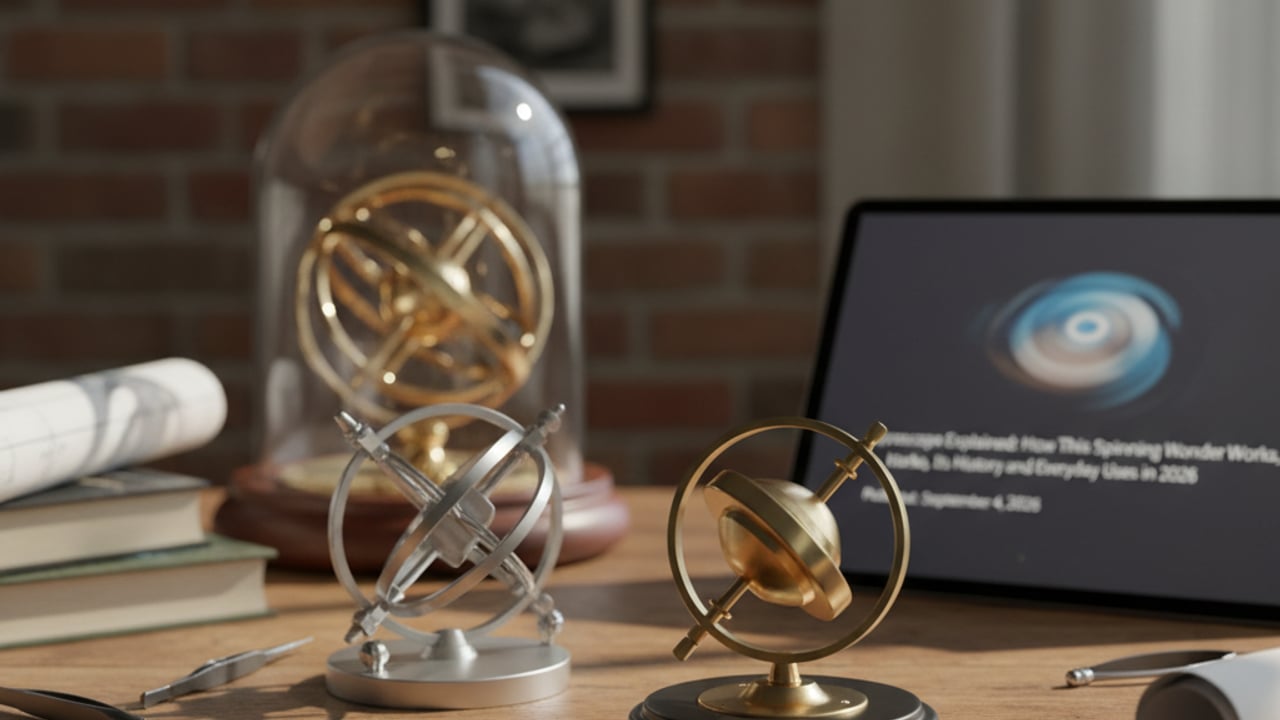
A well-made desktop gyroscope translates real physics, angular momentum, precession, rigidity in space, into something you can hold, spin and genuinely marvel at, which is exactly why it makes such a memorable gift for curious minds. Unlike a phone’s hidden MEMS sensor, a proper mechanical gyroscope lets you feel the physics working against your own hand, which is a far more visceral lesson than any diagram. If you’re shopping for a science-minded friend, parent or colleague, our Magic Spinner demonstrates gyroscopic balance in a beautifully simple form, and pairs nicely with other desk-based physics curiosities such as the Tensegrity Lego for anyone who enjoys objects that seem to defy gravity. Browse our full range of brain teasers or cool gadgets for more conversation-starting pieces that reward a closer look.
⭐ Key takeaway
When buying a gyroscope as a gift, favour a solid metal spinning disc over a lightweight plastic one, weight and balance quality directly affect how long and how smoothly it spins, and that spin time is exactly what makes the demonstration satisfying rather than fiddly.
Our Verdict
Having handled dozens of spinning demonstration pieces over my museum years, I still think a good mechanical gyroscope remains one of the most underrated science gifts available. It costs a fraction of a telescope, needs no batteries or app, and delivers an instant, visible “wait, what?” moment the first time precession kicks in. My honest advice: skip the flimsy plastic versions aimed purely at children under eight, and choose a metal, well-balanced model that adults will happily leave spinning on a desk between meetings, it holds up to repeated use far better and genuinely earns its place as a display piece rather than a drawer-dweller.
Frequently Asked Questions
Sources
- NASA, Hubble Space Telescope gyroscope and pointing system documentation
- ESA/Hubble, Gyroscopes technical overview
- Encyclopaedia Britannica, entry on Gyroscope