
The essentials:
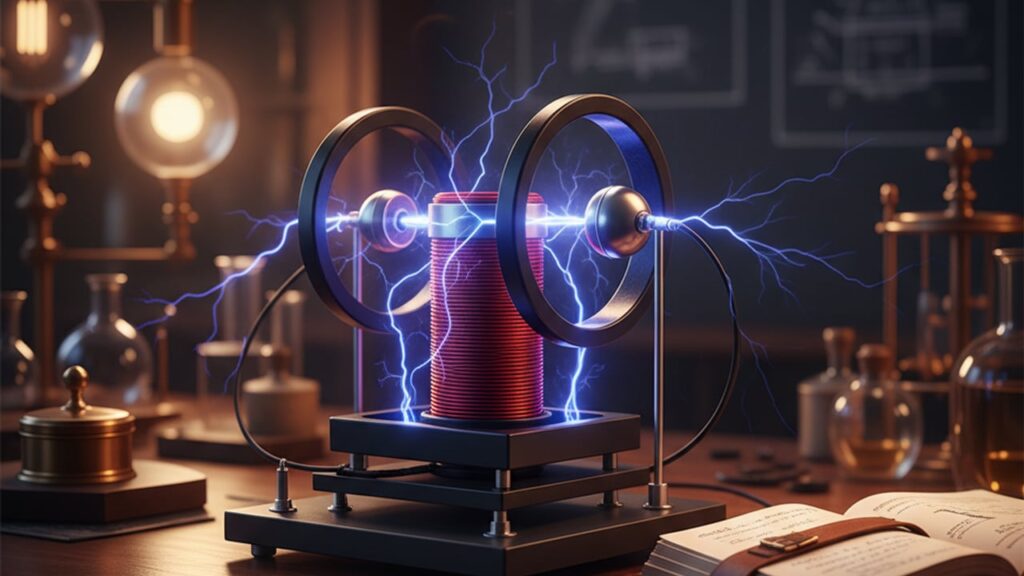
- A Tesla coil is a resonant transformer circuit that produces high-voltage, low-current, high-frequency alternating current, visible as dramatic arcing sparks.
- It was patented by Nikola Tesla in 1891 (US Patent 454,622) while researching wireless power transmission.
- Full-scale Tesla coils are rarely used for practical power delivery today, but smaller versions thrive in science museums, stage shows, and home décor as musical or decorative pieces.
- You can safely enjoy the spark-and-hum spectacle at home without any wiring skills, thanks to compact tabletop versions such as the Tesla Coil Music set.
Few inventions manage to look like pure magic while being entirely explainable by physics. The Tesla coil is exactly that: a hissing, crackling column of violet light that turns any desk or study into a mini electrical laboratory. As a former museum science communicator, I have watched more visitors gasp at a sparking coil than at almost any other exhibit, adults included.
📋 Table of contents
What Exactly Does a Tesla Coil Do?
A Tesla coil converts ordinary household current into high-voltage, high-frequency electricity that discharges as visible sparks, corona glow, or streamers of plasma in the air. The device does not generate new energy; it simply transforms low-voltage, high-current power into high-voltage, low-current power oscillating tens of thousands of times per second. That trade-off is what makes the sparks safe enough (in a properly built coil) to touch briefly without a lethal shock, since the current itself stays extremely low even as the voltage soars into the hundreds of thousands of volts.
The visual effect, sometimes called Tesla’s “lightning in a bottle”, comes from ionising the surrounding air. When voltage is high enough, air molecules lose electrons and become a conductive plasma, producing the crackling purple-white arcs associated with the device.
💡 Did you know?
Did you know? During his 1899-1900 Colorado Springs experiments, Tesla reportedly produced artificial lightning bolts up to 41 metres (135 feet) long, along with thunder heard from 15 miles away.
How Does a Tesla Coil Work?
A Tesla coil works through resonant inductive coupling between two circuits tuned to the same frequency. The primary circuit, a low number of thick wire turns connected to a capacitor and spark gap, charges up and discharges rapidly, inducing oscillations in a secondary coil made of many thin windings tuned to resonate at the exact same frequency. Because both circuits share this resonant frequency, energy transfers efficiently from primary to secondary, building voltage step by step until it discharges as a spark from the top terminal, usually a metal sphere or toroid that also helps shape the electric field.
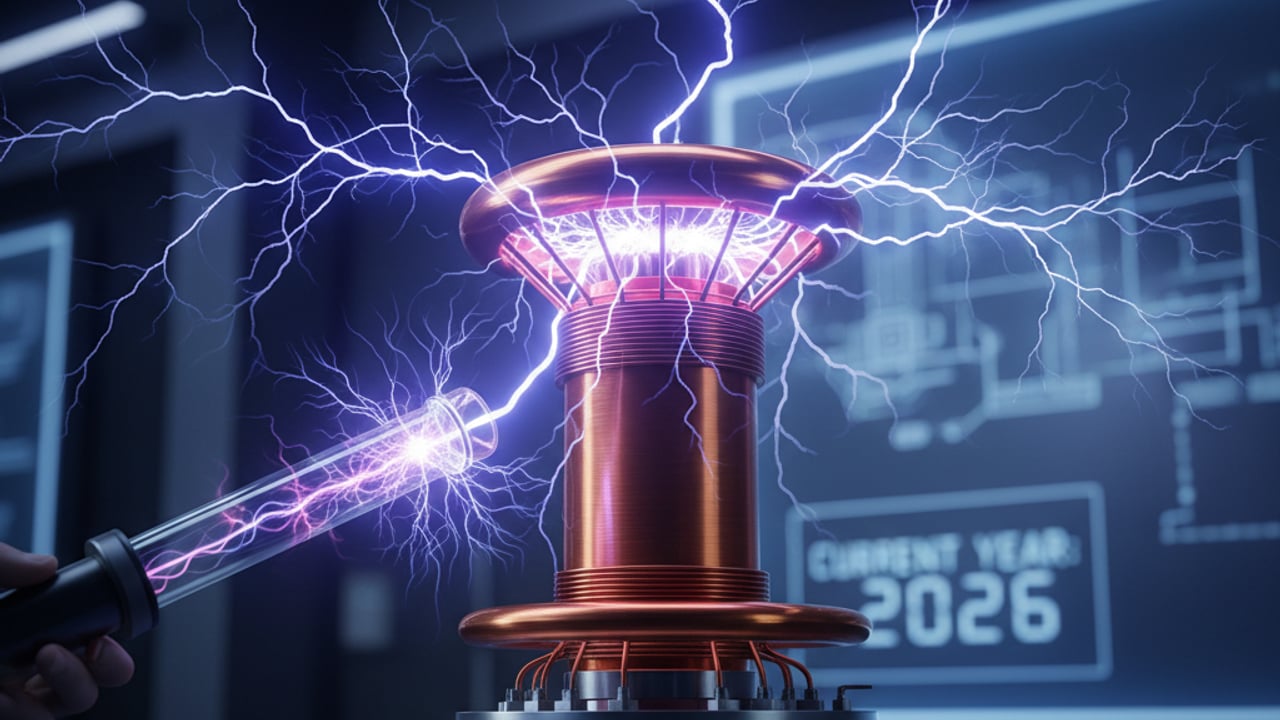
The core components are consistent across designs:
- Primary coil: few turns of heavy wire, handles high current.
- Secondary coil: hundreds or thousands of fine turns, handles high voltage.
- Capacitor and spark gap (or solid-state switch): control the oscillation and timing.
- Top terminal: shapes the field and determines where the spark launches.
⭐ Key takeaway
To remember: resonance is the whole trick. Just as pushing a swing at exactly the right rhythm builds height with little effort, matching the primary and secondary frequencies lets a modest input voltage snowball into a spectacular high-voltage output.
Who Invented the Tesla Coil, and Why?
Nikola Tesla developed the coil in 1891 while investigating wireless transmission of electrical energy, and the design remains one of his most enduring legacies. He filed for a patent that same year, granted in 1893 as US Patent 454,622, and went on to build increasingly ambitious versions, culminating in the Wardenclyffe Tower project on Long Island (1901-1906), a 57-metre structure intended for global wireless power and communication that was never completed due to funding collapse.
🛍️ Our pick
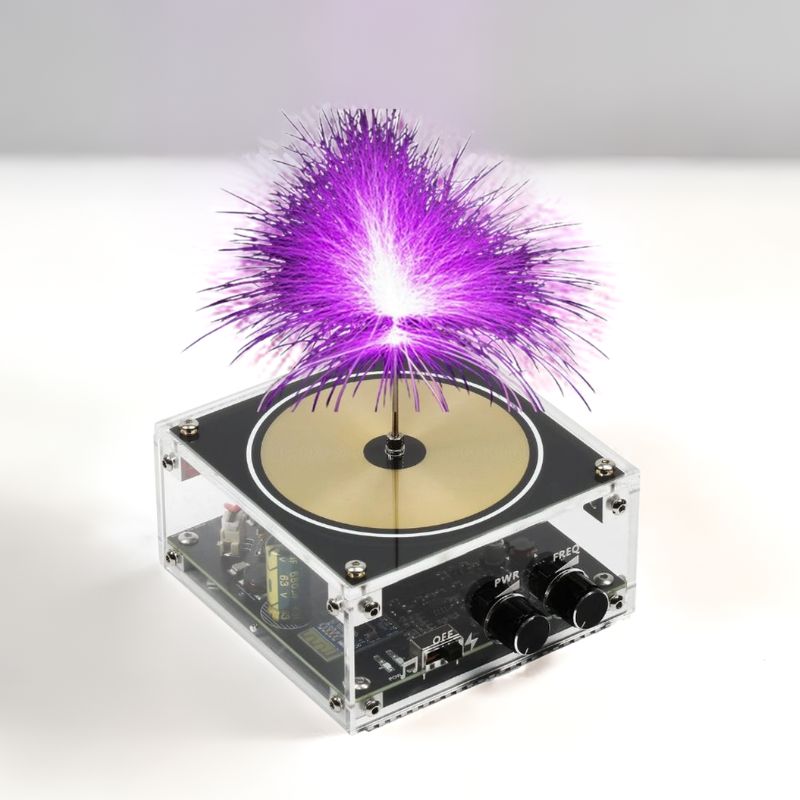
Tesla Coil Music
Tesla coil music demonstrates the device’s ability to produce controlled electrical arcs that can be modulated to play melodies, showing its artistic potential beyond pure science.
64,99 £ · ★ 28 sold
Shop now →Tesla’s rivalry with Thomas Edison over AC versus DC power is well documented, and the coil became something of a public symbol of his showmanship, since he would famously let high-voltage current pass harmlessly through his own body during demonstrations to prove the safety of properly designed high-frequency AC.
Is the Tesla Coil Still Used Today?
Yes, though not for its originally intended purpose of long-distance wireless power transmission. Modern applications include science education, entertainment, and niche engineering research rather than everyday electricity delivery. Science museums use them for spark demonstrations (the Science Museum Group’s Wonderlab in London runs live Tesla coil shows), and hobbyists build “singing” Tesla coils, sometimes called musical or plasma speakers, that modulate the spark discharge to play recognisable tunes through the crackle of ionised air, a technique popularised by performance groups since the mid-2000s.
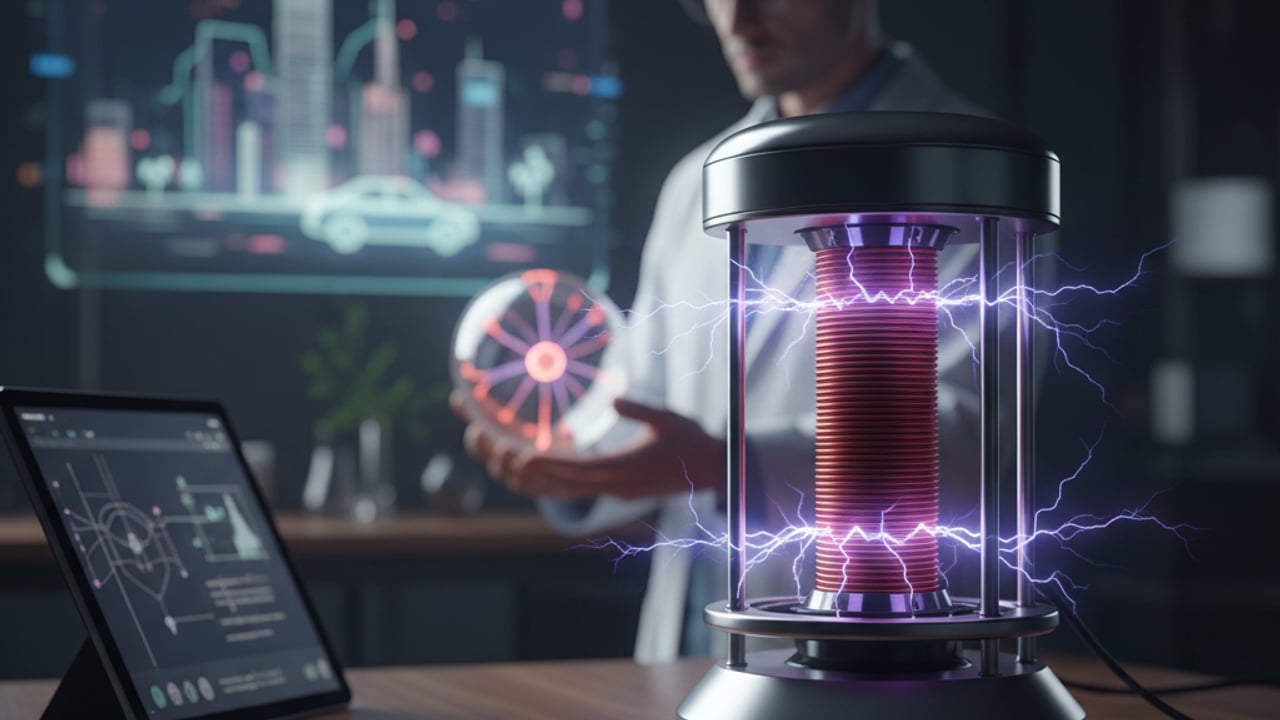
Small-scale coils have also found a home as design objects. A tabletop musical Tesla Coil Music unit brings that same crackling wonder into a living room or office, without requiring any electrical engineering knowledge to operate.
Why Don’t We Use Tesla Coils for Power Transmission?
Tesla coils are not used for practical power transmission because resonant wireless power at this scale is highly inefficient and impossible to direct precisely over long distances. Energy radiates outward in all directions rather than travelling to a specific receiver, meaning most of it is lost rather than delivered. Modern wireless charging (for phones and electric toothbrushes) uses a related but far more contained principle, inductive coupling over centimetres, not the open-air radiative approach Tesla envisioned across continents.
💡 Did you know?
Did you know? Despite Wardenclyffe’s failure, the underlying resonance principle Tesla explored underpins today’s short-range wireless charging pads, RFID tags, and even some near-field communication (NFC) technology.
Tesla Coil Types Compared
| Type | Switching method | Typical use |
|---|---|---|
| SGTC (Spark Gap Tesla Coil) | Mechanical spark gap | Classic hobbyist builds, loud and dramatic |
| VTTC (Vacuum Tube Tesla Coil) | Vacuum tube oscillator | Smoother continuous arcs, quieter |
| DRSSTC (Dual Resonant Solid State) | Solid-state switching | Efficient, popular for musical coils and shows |
Can You Safely Enjoy a Tesla Coil at Home?
Building a full-scale, high-voltage Tesla coil at home is a serious electrical project that carries genuine shock and fire risk, and should only be attempted by experienced hobbyists following certified safety guidance, never as a casual weekend build. For anyone who wants the spark-and-crackle experience without the wiring, soldering, or voltage risk, pre-built decorative and musical Tesla coil units offer a low-voltage, enclosed alternative designed for indoor display. These units are aimed at adults and older teens as a design piece or conversation starter rather than a children’s toy, and should still be kept away from young children and used according to the manufacturer’s instructions.
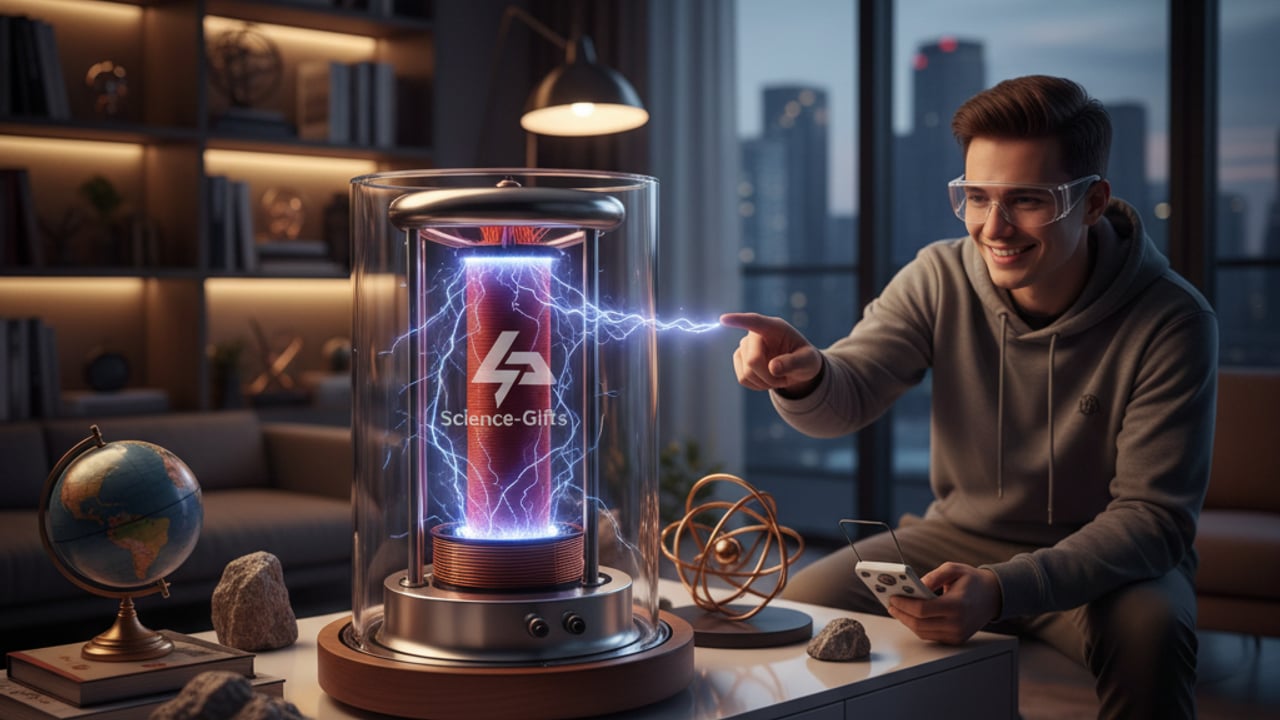
If you enjoy the resonance and mechanical elegance behind Tesla’s invention, it pairs beautifully with other physics-driven desk pieces, such as a DIY Stirling Engine Kit that turns heat differences into motion, or the wider range of cool gadgets built around visible scientific principles rather than screens and batteries alone.
Our Verdict
Having spent years explaining static electricity, plasma globes, and Van de Graaff generators to museum visitors, I find the Tesla coil remains one of the few devices that earns an audible “whoa” every single time, regardless of the viewer’s age or science background. For gift-buying purposes, I steer people firmly towards enclosed, musical tabletop versions rather than DIY spark-gap builds unless the recipient is a genuinely experienced electronics hobbyist. The Tesla coil category on our shelves exists precisely because it satisfies both the physics geek and the design-conscious buyer who simply wants a striking, story-worthy object for a shelf or desk.
FAQ: Tesla Coils Explained
If you’re fascinated by the electrifying history of Tesla coils, you’ll love exploring our geek watches guide featuring modern tech marvels for your wrist.
Sources
- United States Patent and Trademark Office, US Patent 454,622 (Nikola Tesla, 1893)
- Science Museum Group, Wonderlab+ Tesla Coil exhibit documentation
- Tesla Colorado Springs Notes, 1899-1900 experimental records