

The essentials:
- Small high-powered magnetic balls are genuinely dangerous if swallowed, because two or more magnets can attract each other through the bowel wall and cause life-threatening internal injuries.
- UK regulators (OPSS) and the NHS have issued formal alerts, and the US CPSC reports thousands of magnet-ingestion incidents linked to loose ball magnets.
- These products are intended strictly for adults and teenagers aged 14 and over, used as desk toys or fidget objects, never as children’s playthings.
- Safer magnetic gifts for families exist, including fixed, oversized, or encased magnetic products designed with no loose small parts.
As a former science communicator, I’ve spent years explaining why a fridge magnet sticks and why a compass needle points north. But there’s one magnetic product I get asked about more than any other, and it’s not for its physics: it’s for its safety. Small neodymium ball magnets, often sold as stress-relief or desk fidget sets, sit at the centre of one of the most serious consumer safety issues in the UK today. Here’s what the evidence actually shows, and how to enjoy magnetism responsibly at home.
📋 Table of contents
- Are Magnetic Balls Actually Dangerous?
- Why Do Small Magnets Pose Such a Serious Health Risk?
- What Do UK and US Safety Regulators Say About Magnetic Balls?
- Is It Safe for Kids to Play with Magnetic Toys?
- What Should I Do If My Child Has Swallowed Magnets?
- Is It Safe to Have Magnets Close to Your Body?
- What Are the Benefits of Magnetic Balls for Adults?
- How to Choose Safer Magnetic Gifts for Every Age
- Our Verdict
- Frequently Asked Questions
Are Magnetic Balls Actually Dangerous?
Yes, loose sets of small high-powered magnetic balls carry a real and well-documented risk, specifically when swallowed by children or teenagers. A single magnet passing through the digestive system is usually harmless, much like any small swallowed object. The danger appears when two or more magnets are ingested separately, because they can attract each other across loops of intestine, pinching the tissue between them and cutting off blood supply. This can cause perforation, sepsis, and permanent bowel damage within hours, often requiring emergency surgery.
💡 Did you know?
The savais-tu ? The best-known case study in magnet safety history is Buckyballs, the original neodymium ball magnet desk toy launched in the US in 2009. The Consumer Product Safety Commission forced a recall in 2012 after hundreds of ingestion injuries in children, and the product only returned to shelves in 2016 with mandatory adults-only warning labels and a minimum recommended age of 14.
Why Do Small Magnets Pose Such a Serious Health Risk?
The risk comes down to magnetic field strength combined with small, swallowable size. Neodymium magnets used in ball sets are typically only a few millimetres across yet exert a pull far stronger than a standard fridge magnet of the same size, because neodymium is one of the strongest permanent magnet materials known. A magnet small enough to fit inside a child’s nostril or throat, combined with a pull strong enough to clamp through tissue, is exactly the combination that safety regulators warn against. The US CPSC has linked more than 2,500 emergency department visits to magnet ingestion incidents over a recent multi-year period, and UK hospitals have reported comparable trends, particularly among primary-school-aged children and teenagers who use magnets to mimic tongue or lip piercings.

What Do UK and US Safety Regulators Say About Magnetic Balls?
Regulators on both sides of the Atlantic classify small high-powered magnet sets as a high-risk product category requiring strict labelling and age restrictions. The UK’s Office for Product Safety and Standards issued Product Safety Alert PSA1, explicitly warning that ingesting two or more small, high-powered magnetic products can present a risk of serious injury or death. In the United States, the CPSC introduced a mandatory federal safety standard limiting the size and magnetic flux of loose magnet sets sold as adult novelties. The European toy safety standard EN71-1 goes further for products aimed at children, setting a maximum magnetic flux index for any small part that could be swallowed by a child under 14. NHS England also issued a specific public warning after a rise in cases linked to a social media trend involving magnetic balls placed on the tongue or lips.
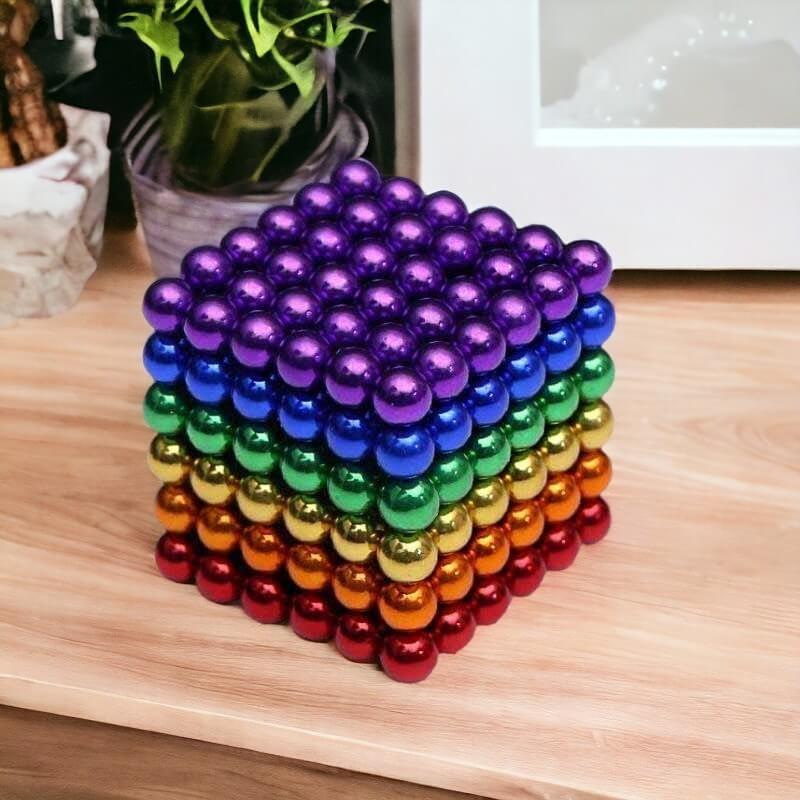
🛍️ Our pick
Rainbow Magnetic Balls
Les Rainbow Magnetic Balls, bien que divertissants, sont considérés comme dangereux pour les jeunes enfants en raison du risque d’ingestion en 2026.
22,99 £ · ★ 50 sold
⭐ Key takeaway
À retenir: any magnetic ball set sold as an adult desk toy should carry a clear 14+ or 18+ age recommendation on the packaging. If a product has no age warning at all, treat that as a red flag rather than reassurance.
Is It Safe for Kids to Play with Magnetic Toys?
Magnetic toys can be perfectly safe for children, but only when the design physically prevents small magnets being separated, swallowed, or put in the mouth. Products built around large, fixed, or securely encased magnets, such as a magnetic construction set with oversized pieces or a wall-mounted magnetic solar system, do not present the same ingestion pathway as loose ball magnets. The safety question is never really about magnetism itself, it’s about whether a small, detachable magnet can reach a child’s mouth. Our own Magnetic Solar System and Magnetic Perpetual Calendar use larger, securely fitted magnets designed for supervised family use rather than loose, swallowable spheres, though we still recommend adult supervision for children under 8, as with any small-parts product.

What Should I Do If My Child Has Swallowed Magnets?
Treat any suspected magnet ingestion as a medical emergency and seek immediate help, because symptoms can be delayed or mistaken for a stomach bug. Call NHS 111, go to A&E, or dial 999 if your child shows severe abdominal pain, vomiting, or fever, and always tell medical staff specifically that you suspect magnet ingestion so they can request the right imaging. Do not wait to see if symptoms improve and do not attempt to make your child vomit, since this will not remove magnets that have already passed the stomach. If possible, bring the remaining magnets or packaging with you so doctors can identify how many may be inside your child and assess magnetic field strength.
⭐ Key takeaway
À retenir: the UK charity Child Accident Prevention Trust and NHS England both recommend acting immediately rather than waiting, because bowel damage from attracting magnets can occur within just a few hours of ingestion.
Is It Safe to Have Magnets Close to Your Body?
For most healthy adults, keeping strong magnets near the body during normal use, such as on a desk or in a pocket, carries no established health risk beyond the ingestion and pinching hazards already described. The genuine precaution concerns implanted medical devices: people with pacemakers, implantable defibrillators, or certain other implants should keep strong magnets, including neodymium ball sets, at a safe distance, following the guidance of their device manufacturer or cardiologist. Strong magnets can also wipe data from magnetic stripe cards and interfere with sensitive electronics, so they’re best stored away from wallets, hard drives, and hearing aids. This is a practical, physical interaction rather than any biological or energetic effect on the body itself.

What Are the Benefits of Magnetic Balls for Adults?
Used responsibly by adults and older teenagers, magnetic ball sets offer a genuinely satisfying way to explore magnetism, sculpture, and fidgeting all at once. Many people find the tactile click-and-pull of building shapes with magnetic spheres a useful low-effort focus tool during phone calls or thinking time, similar to a stress ball with an added creative dimension. They also double as an accessible physics demonstration, letting you visualise magnetic field lines and polarity in a way that’s far more intuitive than a textbook diagram. Our Rainbow Magnetic Balls set, part of our wider magnetic balls collection, is designed and sold strictly as an adult desk toy, clearly labelled for ages 14 and above and kept well away from children and pets.
How to Choose Safer Magnetic Gifts for Every Age
- For adults and teens 14+: loose neodymium ball sets are fine as fidget or sculpture toys, always stored out of reach of younger children in the household.
- For curious kids 6 and up: choose fixed or oversized magnetic products such as a magnetic solar system model, where pieces are too large to swallow and are meant for display rather than handling small components.
- For a safe desk conversation piece: consider non-ingestible magnetic gadgets that demonstrate physics without loose small magnets, such as a magnetic perpetual calendar.
- Always check the label: a genuine safety-conscious magnetic product will state a minimum age, warn against ingestion, and specify it’s not a toy if that’s the case.
Our Verdict
I won’t pretend magnetic ball sets are risk-free, because they aren’t, and any reputable science gift shop should say so plainly rather than burying the warning in small print. What I will say, having handled dozens of these sets over the years, is that as an adult desk toy, used and stored sensibly, a well-made magnetic ball set remains one of the most quietly mesmerising objects in modern design, and one of the clearest ways to actually feel magnetic force rather than just read about it. Keep it firmly in the adults-only, out-of-reach category, and it earns its place on a desk rather than a worry list.
Frequently Asked Questions
Sources
- GOV.UK, Office for Product Safety and Standards, Product Safety Alert PSA1: Small, High-Powered Magnetic Products
- US Consumer Product Safety Commission (CPSC), Magnets safety guidance and federal magnet safety standard
- NHS England, public warning on the dangers of children swallowing magnets
- European toy safety standard EN71-1, magnetic flux index requirements for children’s toys