
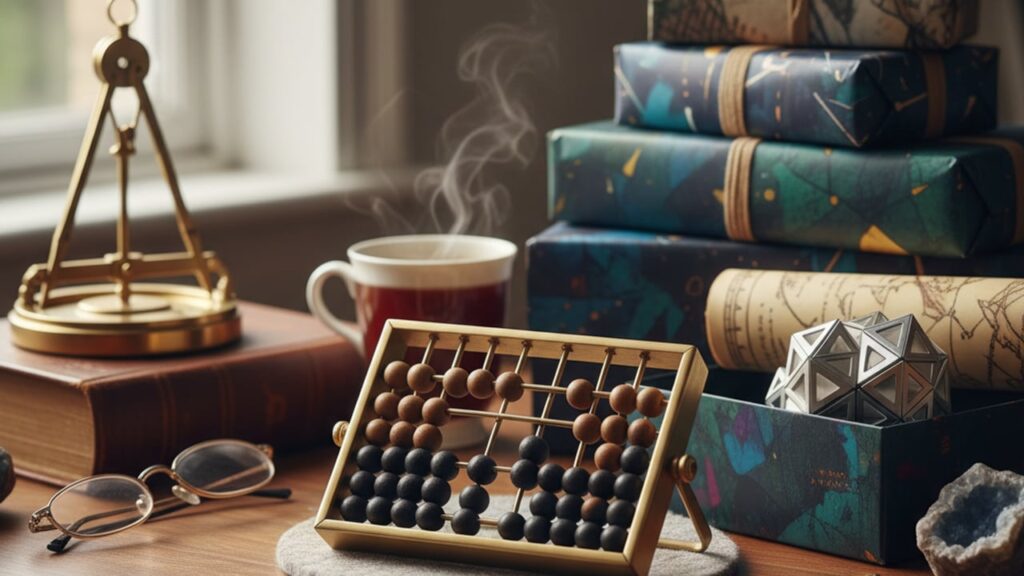
The essentials:
- The best maths gifts in 2026 combine genuine mathematical principles with strong design, not novelty t-shirts or clichéd pi puns.
- Budget ranges from under £20 (puzzles, magnets) to over £50 (kinetic sculptures, precision-engineered brain teasers).
- For children, age-appropriate maths toys (ages 6 to 14) build number sense through play rather than worksheets.
- UK buyers should check delivery times and materials, since well-made maths gifts (metal, glass, hardwood) last decades, unlike plastic novelties.
Across the UK, more than 700,000 students sit GCSE Mathematics every summer, and maths anxiety remains one of the most commonly reported academic worries among British schoolchildren, according to National Numeracy, the UK charity behind National Numeracy Day held every May. Yet plenty of us genuinely love maths, whether we teach it, studied it at university, or simply admire the elegance of a Fibonacci spiral on a Sunday morning. Finding a gift that celebrates that love, without descending into cheesy ‘I’m a nerd’ merchandise, is trickier than it sounds. As a former science communicator who now curates objects for the home, I’ve spent years testing which mathematical gifts genuinely spark conversation at a dinner party and which end up in a drawer by February. This 2026 guide sorts the real curiosities from the gimmicks.
📋 Table of contents
- What Makes a Genuinely Good Maths Gift?
- Maths Gifts by Budget: What Can You Get for £20, £50 or More?
- Best Maths Gifts for Adults and Mathematicians
- Best Maths Gifts for Kids Who Love Numbers
- Decorative and Desk Curiosities With Real Mathematical DNA
- How Do You Say ‘I Love You’ in Maths?
- Our Verdict
- Mini FAQ
What Makes a Genuinely Good Maths Gift?
A good maths gift demonstrates a real mathematical principle you can see, touch or manipulate, rather than simply referencing maths through slogans or symbols. The best mathematical gifts turn abstract concepts like geometry, symmetry or probability into something you can hold in your hand. Think of a Möbius strip sculpture that visually proves a surface can have only one side, or a set of magnetic balls that let you build platonic solids on your desk during a phone call.
In the UK gift market, this distinction matters because online marketplaces are flooded with pi-themed mugs and ‘maths joke’ cards that fade fast. Objects built from precision-cut wood, glass or magnetised steel tend to age far better than printed novelty items, both aesthetically and functionally. That’s why our curation leans toward physical curiosities: things like the Pyramid Brain Teaser, which hides genuine combinatorial puzzles inside a sleek geometric shape, rather than a printed slogan.
⭐ Key takeaway
Key takeaway: before buying, ask whether the object would still be interesting without any text or joke printed on it. If the answer is yes, it’s a maths gift with staying power.
Maths Gifts by Budget: What Can You Get for £20, £50 or More?
UK shoppers can find solid maths gifts across every price bracket, from a £12 puzzle to a £70 kinetic sculpture, and the sweet spot for most gift-givers sits between £25 and £45. Here’s how the market typically breaks down in 2026:
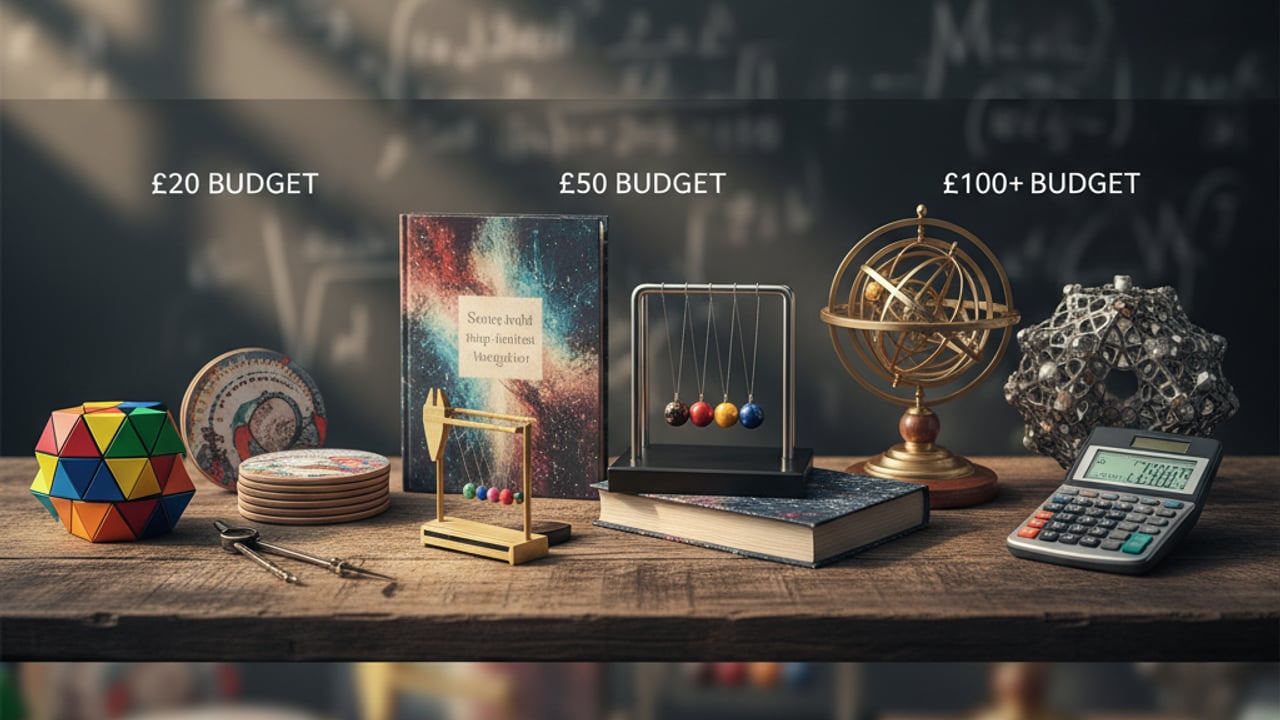
- Under £20: pocket puzzles, geometric brain teasers, pi or Fibonacci-themed stationery.
- £20 to £50: magnetic construction sets, desk sculptures, calendar or timepiece objects built on mathematical sequences such as the Magnetic Perpetual Calendar.
- £50 and above: engineered kinetic pieces like tensegrity structures, larger magnetic solar systems, or collector-grade brain teasers with multiple solving stages.
Bristol-based Maths Gear and London’s Present Indicative both cluster most of their catalogue in the £15 to £40 range, which confirms that thoughtful, well-made maths gifts don’t need to be expensive to feel special. What separates a memorable gift from a forgettable one is usually the story behind the object, not the price tag.
Best Maths Gifts for Adults and Mathematicians
Adults who studied maths at A-Level or university in the UK tend to respond best to gifts referencing structure, geometry and mechanical elegance rather than jokes about being ‘good with numbers’. The strongest gifts for mathematicians reward closer inspection, revealing a principle only once you start playing with them.

🛍️ Our pick
Robot Dog for Adults
Le Robot Dog pour adultes intègre des algorithmes mathématiques pour des mouvements complexes et autonomes, captivant les amateurs de logique.
119,99 £
- Tensegrity sculptures, such as the Tensegrity Lego, appear to float thanks to a balance of compression and tension first formalised by architect Buckminster Fuller in the 1960s. It’s structural engineering disguised as a desk toy.
- Geometric brain teasers, including the Pyramid Brain Teaser, draw on the same combinatorial logic that makes the Rubik’s Cube famous for its roughly 43 quintillion possible configurations, a number first calculated precisely in the 1980s.
- Magnetic geometric sets like Rainbow Magnetic Balls let adults build platonic solids and fractal-like patterns, a satisfying stress-relief exercise grounded in real geometry.
- Calendar and sequence objects such as the Magnetic Perpetual Calendar quietly reference modular arithmetic every time you flip the date.
💡 Did you know?
Fun fact: Isaac Newton, born in Woolsthorpe, Lincolnshire in 1642, developed much of his early calculus while Cambridge University was closed during the plague years of 1665 and 1666. Working from home clearly has a good track record for mathematical breakthroughs.
Best Maths Gifts for Kids Who Love Numbers
Children in the UK typically encounter formal number theory around Key Stage 2 (ages 7 to 11), which makes this the ideal window for maths gifts that turn abstract rules into hands-on play. The most effective maths toys for children let them discover a pattern themselves rather than being told the answer.
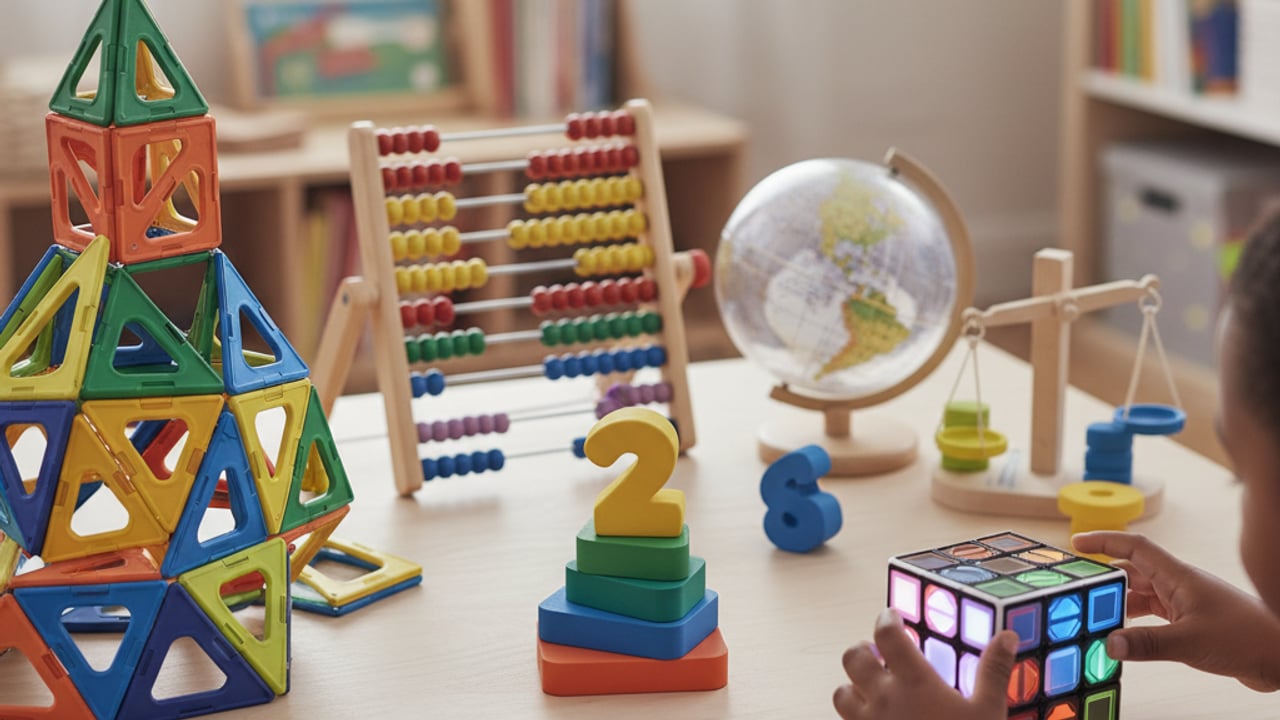
- Ages 6 to 9: simple magnetic building sets and shape puzzles that introduce symmetry and counting without pressure.
- Ages 9 to 12: multi-step brain teasers and orbital models such as the Magnetic Solar System, which quietly introduces ratios through relative planet sizes and distances.
- Ages 12 to 14: combinatorial puzzles and mechanical kits that reward patience and logical sequencing, bridging into GCSE-level thinking.
As with any gift for children, always check the manufacturer’s recommended age range and supervise use of any small magnetic or mechanical parts, since younger children may be tempted to put small components in their mouths. This isn’t medical advice, simply common sense backed by the age guidance printed on most UK toy packaging under the Toy Safety Regulations.
⭐ Key takeaway
Key takeaway: for children under 8, prioritise chunky, tactile pieces over intricate multi-part puzzles, which tend to frustrate rather than delight at that age.
Decorative and Desk Curiosities With Real Mathematical DNA
British desks and shelves in 2026 increasingly favour objects that double as decor and genuine science, rather than purely ornamental trinkets. A well-chosen kinetic or geometric object on a desk sparks more conversation than any framed pi symbol ever could. Items like the Magic Spinner demonstrate angular momentum and precession, principles that underpin everything from gyroscopes to satellite stabilisation, in a small object that fits in your palm.
For those who want to browse a wider range, our Brain Teasers category and Cool Gadgets section both include several pieces where geometry, mechanics and mathematics overlap directly, without needing a single pi symbol printed anywhere.
How Do You Say ‘I Love You’ in Maths?
Mathematicians commonly express affection using the equation for a cardioid curve, or through the number sequence 143, which stands for ‘I love you’ based on the letter counts (1 letter, 4 letters, 3 letters). Another popular version uses the phrase ‘you’re my sine, I’m your cosine, together we make tan-gent’, a playful nod to trigonometric identities taught in UK A-Level maths. These small in-jokes travel well on cards or engraved gifts, provided they accompany an object with real substance rather than replacing one.
Our Verdict
Having tested dozens of so-called maths gifts over the years, my honest verdict is that the ones with lasting appeal are almost always mechanical or geometric rather than textual. A joke wears off after one read; a tensegrity structure or a well-balanced spinner keeps rewarding attention for years. If you’re choosing between a pi-printed mug and a genuinely engineered kinetic object this year, the object wins every time, both as decor and as a gift someone will actually keep on display in 2026 and beyond.
Mini FAQ
Sources
- National Numeracy (UK charity), National Numeracy Day annual campaign data
- Joint Council for Qualifications, GCSE Mathematics entry statistics, England
- Toy Safety Regulations 2011 (UK), age labelling requirements for children’s toys