
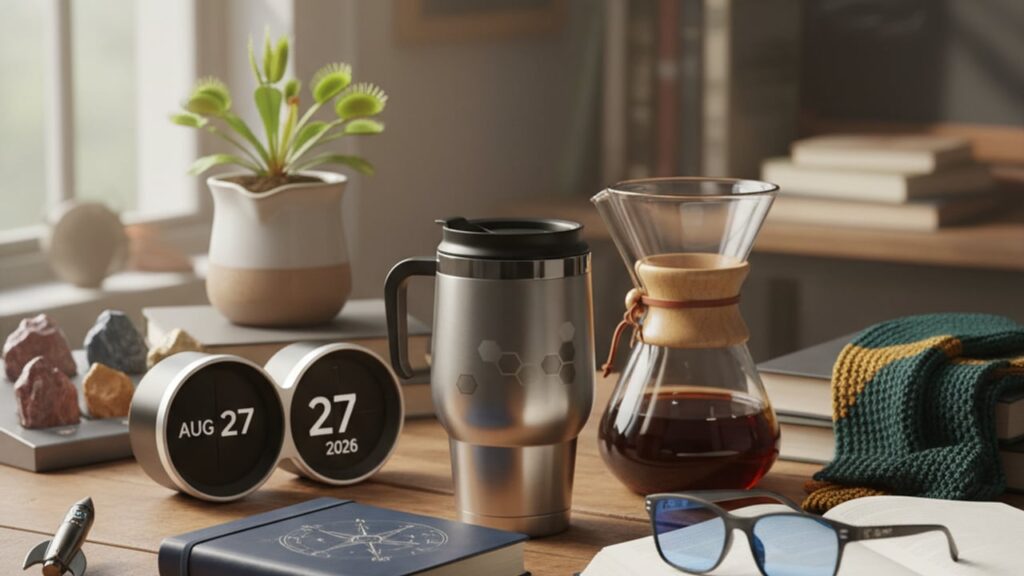
The essentials:
- The best teacher gifts are practical, personal, or genuinely curious objects, not another mug or scented candle.
- Science-themed desk pieces work brilliantly because they double as conversation starters and classroom teaching aids.
- Budget £15 to £40 for a thoughtful individual gift, or pool contributions for something more substantial at end of term.
- Match the gift to the subject taught where possible: a storm glass for geography, a prism for physics, real element samples for chemistry.
Every July, staffrooms across Britain fill up with an identical parade of candles, chocolate boxes and ‘World’s Best Teacher’ mugs. Kind gestures, all of them, but let’s be honest: most end up regifted, binned or gathering dust by September. A memorable teacher gift is one that survives past the school holidays and earns a permanent spot on a desk or windowsill. As someone who spent years in museum education before curating curious objects for the home, I’ve learned that teachers, more than almost anyone, appreciate a gift with a genuine story behind it.
📋 Table of contents
- What Actually Makes a Good Gift for a Teacher?
- Why Science-Themed Gifts Work So Well for Teachers
- Best Gifts for Teachers by Subject
- How Much Should You Spend on a Teacher Gift?
- Occasion Matters: Christmas, End of Term, or Retirement
- Our Verdict: What We’d Actually Buy a Teacher
- Frequently Asked Questions
What Actually Makes a Good Gift for a Teacher?
A good teacher gift respects the person behind the job title rather than the job itself. Teachers receive an enormous volume of generic tokens each year, so the gifts that stand out are the ones that feel chosen rather than grabbed off a supermarket shelf on the way to pick-up.
The strongest teacher gifts tend to share three qualities: they are useful or displayable, they spark a conversation, and they don’t scream ‘teacher cliché’. A well-made desk object that catches the light, demonstrates a scientific principle, or simply looks intriguing next to a stack of marking will get noticed by colleagues and pupils alike, which is exactly the kind of quiet flattery most teachers secretly enjoy.
⭐ Key takeaway
To retain: skip anything edible or scented unless you know the teacher’s preferences well. Allergies, dietary restrictions and simple taste differences make food and candles surprisingly risky gifts, whereas a well-chosen object has no such pitfalls.
Why Science-Themed Gifts Work So Well for Teachers
Science gifts work because they sit at the exact intersection of decorative and intellectually satisfying, which mirrors what good teaching itself tries to do. A Storm Glass Weather Predictor or a Triangular Glass Prism isn’t just decoration, it’s a small daily reminder of curiosity, which is precisely the quality most teachers try to instil in their pupils.

This is particularly true for STEM teachers, but it extends further than you might expect. A geography teacher will appreciate the historical weather-reading tradition behind a storm glass. An English teacher might enjoy the Newtonian backstory of a prism splitting light into a rainbow, a phenomenon Isaac Newton documented in his 1672 paper on the theory of light and colours. Even a headteacher’s office benefits from an elegant, science-adjacent object that signals intellectual seriousness without being dull.
💡 Did you know?
Did you know? Storm glasses were used by sailors long before modern meteorology existed, most famously aboard HMS Beagle during Charles Darwin’s 1831 to 1836 voyage under Captain Robert FitzRoy, who later became a pioneer of official British weather forecasting.
Best Gifts for Teachers by Subject
Matching a gift to a teacher’s subject shows you’ve paid attention, and it also guarantees the object gets used rather than shelved.
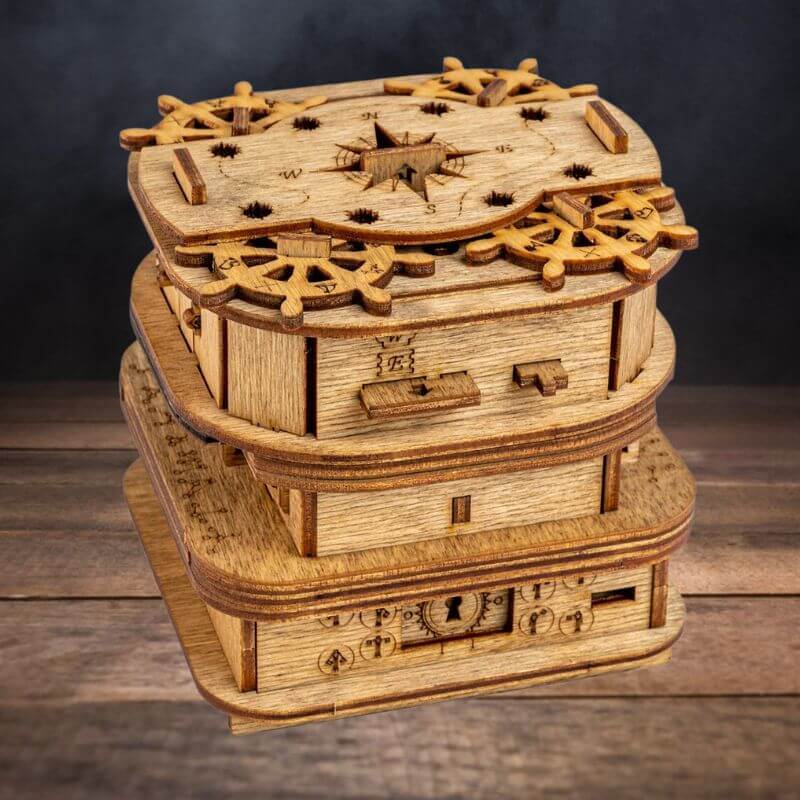
🛍️ Our pick
Brain Teaser for Adults Hard
Les casse-têtes pour adultes stimulent l’esprit et offrent une pause mentale bienvenue pendant les journées chargées des enseignants.
64,99 £ · ★ 10 sold
Shop now →- Chemistry teachers: a Periodic Table With Real Elements Samples turns an abstract classroom chart into a tangible collection they can point to during lessons.
- Physics teachers: a Triangular Glass Prism or a kinetic desk piece like the Magic Spinner demonstrates angular momentum and light refraction in seconds.
- Geography or environmental science teachers: the Storm Glass Weather Predictor ties directly into weather units and meteorological history.
- Maths teachers: a Pyramid Brain Teaser rewards logical thinking and looks sharp on a desk between lesson planning sessions.
- Primary or general classroom teachers: something visually striking and safe to handle, such as a Magnetic Solar System, works across nearly every year group.
If you’re buying for someone whose subject you don’t know well, browsing a broader category such as Cool Gadgets or Brain Teasers is a safe way to find something intriguing without needing specialist knowledge.
How Much Should You Spend on a Teacher Gift?
There’s no fixed rule, but most individual teacher gifts in the UK fall between £15 and £40, while class-pooled or leaving gifts often run higher. Many schools now discourage cash-equivalent vouchers over a certain value to avoid any appearance of favouritism, so a physical, thoughtful object often sidesteps that entire conversation.
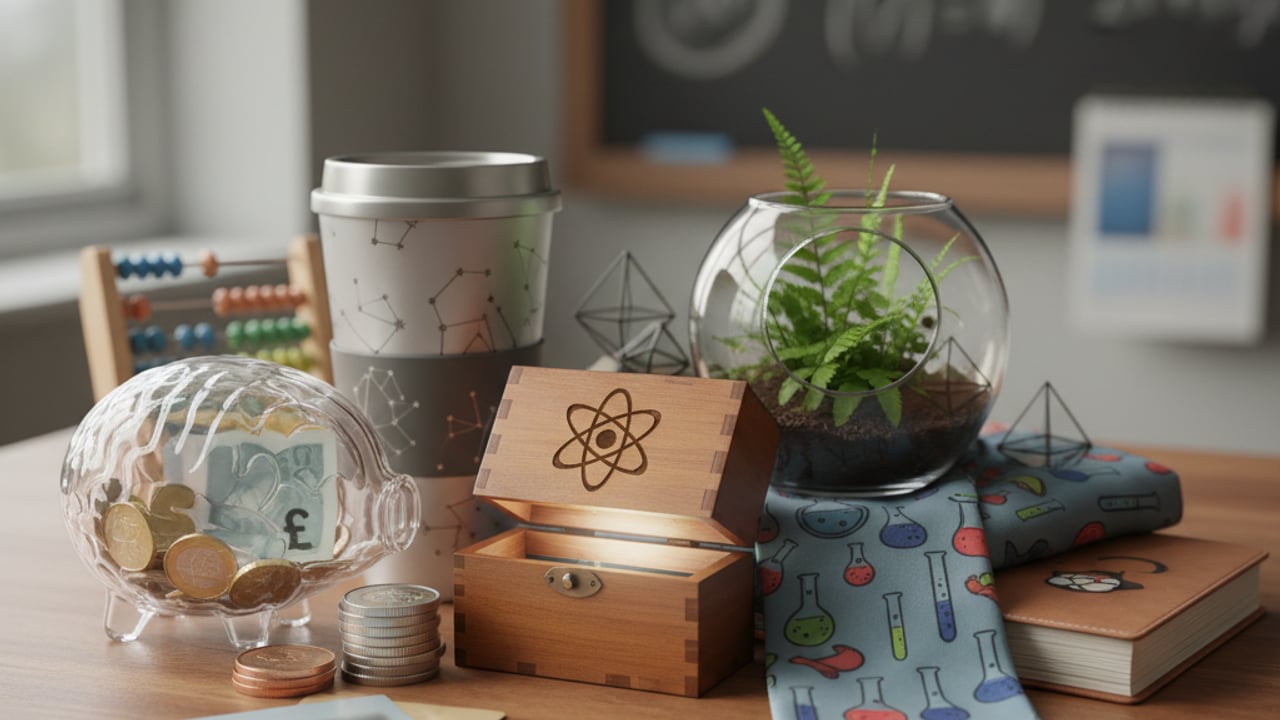
For an end-of-year thank you from a single family, £15 to £25 is generous and appropriate. For a class-wide collection marking a retirement or maternity leave, pooling towards a £50 to £80 item, such as a DIY Stirling Engine Kit or a Tesla-coil-based desk piece, gives a far more memorable result than a dozen small trinkets.
⭐ Key takeaway
To retain: if pooling money across a class, agree a spending cap early. It avoids awkwardness and lets everyone contribute comfortably regardless of budget.
Occasion Matters: Christmas, End of Term, or Retirement
The right teacher gift changes depending on the moment, not just the budget. A Christmas gift can be lighter and more playful, an end-of-term thank you tends to be warmer and more personal, and a retirement gift should feel like a genuine send-off rather than a token gesture.
For a retiring teacher who has spent decades in the classroom, something with real gravitas works best. A Magnetic Perpetual Calendar makes a lovely symbolic gift, marking the transition from term-time schedules to open-ended free time. For a younger teacher early in their career, something playful and conversation-starting, such as items from the Magnetic Balls range, tends to land better.
💡 Did you know?
Did you know? According to the Department for Education’s school workforce census, there were around 468,000 full-time equivalent teachers working in England’s state schools as of 2023, meaning millions of end-of-term gifts change hands across the country every single summer.
Our Verdict: What We’d Actually Buy a Teacher
Having spent years watching which museum shop objects people actually kept versus which ones vanished into a cupboard, my honest verdict is this: choose objects that do something. Static ornaments get admired once and forgotten. Kinetic, light-based, or slowly-changing objects, like a storm glass whose crystal formations shift with the weather, get looked at daily.
If I had to pick one universally safe option, it would be a Storm Glass Weather Predictor or a Triangular Glass Prism. Both are elegant enough for any staffroom or office, cross subject boundaries easily, and carry genuine scientific and historical weight rather than empty novelty.
Frequently Asked Questions
And if you’re looking for a thoughtful present for an educator who specialises in a particular science, you might find the perfect idea in our selection of thoughtful physics gifts.
If you’re looking for gifts that combine practicality with a love for numbers, check out our maths gifts guide for more inspired ideas.
Sources
- UK Department for Education, School Workforce in England census data
- Isaac Newton, “New Theory about Light and Colours”, Philosophical Transactions of the Royal Society, 1672
- Royal Museums Greenwich, records on Robert FitzRoy and HMS Beagle voyage, 1831 to 1836