
The essentials:
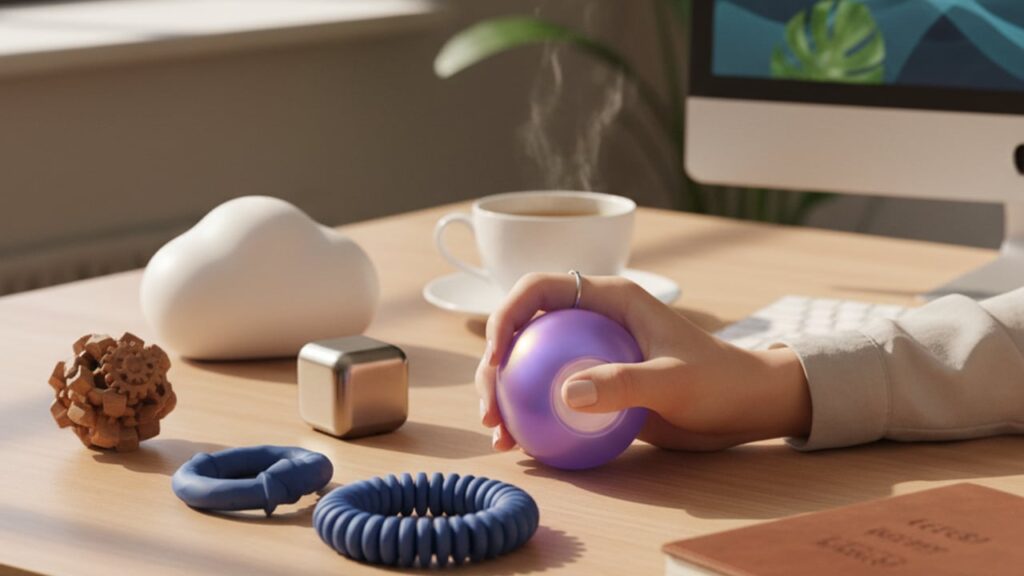
- The most effective office stress toys are quiet, one-handed, and visually absorbing, think spinning tops, magnetic balls, and tensegrity structures rather than clicky fidget spinners.
- Repetitive, low-effort hand movement can help channel restlessness during calls or focus work without demanding conscious attention.
- Noise is the number one office faux pas: anything that clicks, snaps or ticks will irritate desk neighbours faster than it calms you.
- Our top desk picks for 2026 are the Magic Spinner, the Pyramid Brain Teaser and Tensegrity Sculpture.
Open-plan offices are quieter than they used to be, which paradoxically makes every fidget-spinner click, pen tap and squeeze-ball squeak sound like a drum solo. As someone who spent years explaining physics to fidgety museum visitors before curating desk objects for Science Gifts, I’ve learned that the best stress toy for work isn’t the loudest or the cheapest, it’s the one that occupies your hands without occupying your colleagues’ attention. Here’s what actually works on a British desk in 2026, and why.
📋 Table of contents
What Makes a Stress Toy Effective for Office Use?
An effective office stress toy combines silent operation, one-handed use, and a satisfying physical principle to watch or feel. The best desk toys engage your hands through repetitive, low-cognitive-load motion while staying visually or tactilely interesting enough to hold attention during a dull conference call. Three practical criteria separate a genuinely useful desk companion from a drawer-filler:
- Silence: no clicking bearings, no popping buttons audible beyond arm’s length.
- One-handed operation: you’re often typing or holding a phone with the other hand.
- Durability: metal, glass or solid wood outlasts cheap plastic that cracks within weeks.
⭐ Key takeaway
At a glance: if a toy makes a sound you can hear from across a meeting room, it’s a home toy, not an office one.
Do Fidget Toys Actually Reduce Stress? What the Science Says
Fidget toys don’t eliminate stress, but the repetitive motion they provide can help some people maintain focus during long periods of sitting or listening. Occupational psychologists have long observed that small, automatic hand movements, doodling, pen-clicking, foot-tapping, can act as an outlet for excess nervous energy that would otherwise interrupt concentration. This is why fidget spinners became a cultural phenomenon after Florida inventor Catherine Hettinger filed her original spinning-toy patent (US 5,591,062) in 1993, decades before the 2017 craze that sold millions worldwide. The underlying idea, that a simple spinning object can absorb restless attention, is older than the branding suggests.
💡 Did you know?
The classic Newton’s Cradle, the clacking steel-ball desk toy named after Sir Isaac Newton (1642-1727), was actually invented in 1967 by English actor Simon Prebble, three centuries after Newton formulated the laws of motion it demonstrates.
It’s worth being honest here, as a scientist and not a wellness marketer: no stress toy is clinically proven to treat anxiety, and we’d never claim otherwise. What they genuinely offer is a small, legitimate excuse to pause, breathe, and reset attention between tasks, which matters more than people admit in back-to-back meeting culture.
The Best Stress Toys for Office Desks in 2026
The most effective office-friendly stress toys fall into three categories: kinetic spinners, magnetic manipulables, and structural puzzles. Here’s how the main contenders compare for desk use.

🛍️ Our pick
Fighting Robot Toys
These fighting robot figures offer a hands-on way to release tension, thanks to their moving joints and interactive design.
From £41.99 · ★ 11 sold
Shop now →Comparison Table: Office Suitability
- Magic Spinner: near-silent magnetic levitation spin, visually mesmerising, ideal for video calls, one-handed start-and-watch use. See the Magic Spinner.
- Pyramid Brain Teaser: silent, tactile puzzle manipulation, keeps hands busy during phone calls, compact footprint. Explore the Pyramid Brain Teaser.
- Tensegrity Sculpture: floating-block structure you can gently press and release in complete silence, a genuine conversation piece. Discover Tensegrity Sculpture.
- Rainbow Magnetic Balls: satisfying tactile reshaping, but can click softly when assembled fast, better suited to a private office or home desk. Browse Rainbow Magnetic Balls.
- Magnetic Solar System: more of a desk sculpture than a hands-on fidget, great for visual decompression between tasks without any noise at all. See the Magnetic Solar System.
For truly open-plan offices, kinetic spinners and tensegrity structures beat magnetic balls on noise control, while magnetic sets win for pure tactile satisfaction in private offices or home desks. If you’re buying for a colleague who shares a bank of desks, prioritise silence over tactile intensity.
Which Fidget Toy Is Quietest for Open-Plan Offices?
Magnetic levitation spinners and tensegrity structures are the quietest options because they rely on magnetic repulsion or elastic tension rather than mechanical clicking parts. Ball-bearing spinners and snap-together puzzles, by contrast, produce audible clicks that travel further than most buyers expect in a quiet room.
⭐ Key takeaway
Office rule of thumb: test any toy with your eyes closed from two metres away before gifting it to a desk-sharing colleague.
Are Fidget Toys Allowed at Work?
Most UK offices permit personal desk items like stress toys unless a specific policy states otherwise, since they’re treated the same as a mug or a desk plant. Some employers in client-facing or meeting-heavy roles ask staff to keep visible fidgeting to a minimum during video calls, which is another reason silent, compact options travel better than anything noisy or brightly animated on camera.
Should You Choose a Spinner, a Puzzle, or a Magnetic Toy?
Choose a spinner if you want something to glance at during calls, a puzzle if you want to occupy your hands during thinking time, and a magnetic set if you primarily work from a private office or home desk. The right choice depends less on the science behind the object and more on your actual working environment, open-plan desks reward silence, private offices reward tactile satisfaction. A cool desk gadget that doubles as decor, like a glass prism catching window light, can also serve the same decompression purpose without ever touching your hands.
Our Verdict
Having tested most of our own catalogue on my own desk through countless Zoom calls, my honest pick for pure office effectiveness is the Magic Spinner: it’s silent, mesmerising enough to reset a scattered mind in thirty seconds, and compact enough not to become a distraction object itself. For anyone drawn to a slower, more tactile fidget, the Pyramid Brain Teaser is the better long-term companion, it rewards patience rather than idle spinning.
Frequently Asked Questions
Sources
- United States Patent and Trademark Office, Patent US 5,591,062 (Catherine Hettinger, spinning toy, filed 1993)
- U.S. Consumer Product Safety Commission, recall notices concerning small high-powered magnetic ball sets
- Buckminster Fuller Institute, historical documentation on tensegrity structures and the work of Kenneth Snelson