
The essential:
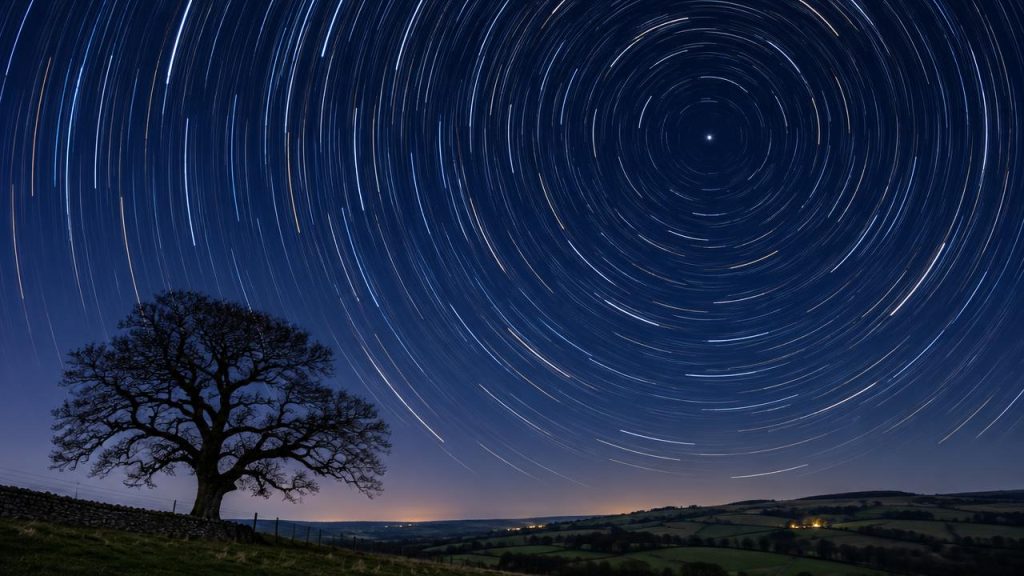
- The North Star, Polaris, sits less than a degree from the north celestial pole, so it barely moves while the sky turns around it.
- Follow the two pointer stars at the end of the Plough’s bowl, Merak then Dubhe, and the next fairly bright star is Polaris.
- Polaris is not the brightest star: at magnitude about 2 it ranks roughly 50th, far fainter than Sirius at magnitude -1.46.
- Its height above the horizon roughly equals your latitude, about 51° from London and about 56° from Edinburgh.
The North Star is the one star in the British sky that stays put: every other star wheels around it through the night, while Polaris hangs over the northern horizon at almost exactly the same height. Find it once and you have a permanent signpost to north, from Penzance to Shetland.
This guide shows how to find Polaris in a couple of minutes using the Plough, why it is much fainter than most people expect, how it reveals your latitude, and why it has not always been, and will not always be, the pole star. No telescope required, just a clear night and a view to the north.
📋 Table of contents
- What is the North Star?
- How to find the North Star using the Plough
- Is the North Star the brightest star in the sky?
- How high is Polaris above the horizon in the UK?
- How do you find the North Star when the Plough is hard to see?
- Can you use the North Star to navigate?
- How can you bring the night sky indoors?
- Our take: why the North Star is the perfect first target
- FAQ
What is the North Star?
The North Star is Polaris, the brightest star in the constellation Ursa Minor. It lies very close to the north celestial pole, the point in the sky directly above Earth’s North Pole, so it appears almost motionless. As Earth spins on its axis, the whole sky appears to rotate around two points: the north and south celestial poles. A star placed exactly on the north celestial pole would never move at all. Polaris is not quite there, but it is close, less than one degree away, about the width of a little fingernail held at arm’s length.
That is why it has been so valuable to navigators. Every other star in the northern sky traces a circle around Polaris during the night, while Polaris itself makes a circle so small that the eye cannot notice it.
Some key facts:
- Constellation: Ursa Minor, the Little Bear, where Polaris marks the tip of the bear’s tail.
- Distance: about 446 light years, according to measurements from the European Space Agency’s Gaia mission.
- Type: a yellow supergiant and a Cepheid variable, which means it pulsates and changes brightness slightly.
- System: Polaris is actually a triple star, with two companions too faint or too close to see without a telescope.
Royal Museums Greenwich describes Polaris as a pulsating supergiant many times larger than the Sun, which only looks modest because of its great distance.
How to find the North Star using the Plough
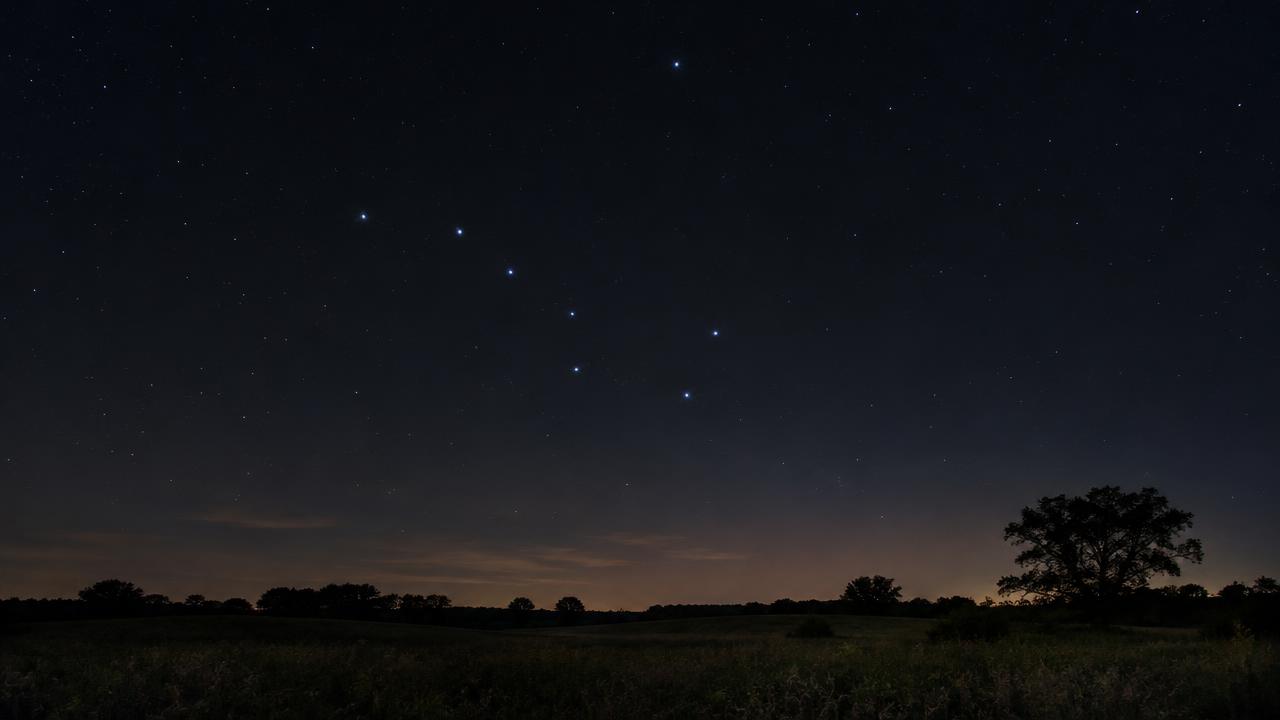
Find the Plough, take the two stars at the end of its bowl, Merak and Dubhe, and follow the line from Merak through Dubhe. The first fairly bright star along that line is Polaris. The Plough is the British name for the seven brightest stars of Ursa Major, the Great Bear. Americans call it the Big Dipper. It looks like a saucepan: four stars form the bowl and three form a curved handle.
- Face north. Use a phone compass once to check, then put it away so your eyes can adapt to the dark.
- Find the Plough. On November evenings it sits fairly low in the north. Later in winter it climbs higher in the north-east during the evening.
- Identify the pointers. The two stars on the side of the bowl furthest from the handle are Merak (at the bottom of the bowl) and Dubhe (at the rim).
- Draw the line. Run an imaginary line from Merak through Dubhe and keep going, away from the bowl.
- Stop at the first fairly bright star. That is Polaris, standing alone in a fairly empty patch of sky.
Polaris stands well clear of the Plough, in a part of the sky with few other bright stars, so you will not mistake it for a member of the pattern itself.
Give your eyes 15 to 20 minutes away from screens and bright lights. Polaris is easy to see from a town garden once you are dark-adapted.
⭐ Key takeaway
Merak to Dubhe, then keep going. The pointer stars always aim at Polaris, whatever the season and whichever way up the Plough appears.
Is the North Star the brightest star in the sky?
No. Polaris has an apparent magnitude of about 2, which places it roughly 50th in the list of brightest stars. The brightest star in the night sky is Sirius, at magnitude -1.46. This is the most common misconception about the North Star, and it causes a lot of failed searches. People look north, pick the most dazzling point of light they can see and assume it must be Polaris. Often it is a planet, or in winter evenings the brilliant star Capella, high in the north-east.
On the magnitude scale, smaller numbers mean brighter objects, and every step of one magnitude is about 2.5 times in brightness. Polaris averages about magnitude 2.0. Sirius, which rises in the south-east on winter evenings below Orion, is more than three magnitudes brighter.
Why, then, is Polaris famous? Because of its position, not its brightness. It happens to sit beside the celestial pole, and it is the brightest star in that particular patch of sky, which makes it easy to pick out once you know where to look.
Polaris is also slightly variable. As a Cepheid, it pulses in brightness over a cycle of roughly four days, though the change is far too small to notice with the naked eye.
If you enjoy pinning down which stars are which, the astronomy quiz is a good way to check your knowledge before heading outside.
| Star | Constellation | Apparent magnitude | Where to look from the UK |
|---|---|---|---|
| Sirius | Canis Major | -1.46 | Low in the south on winter evenings |
| Capella | Auriga | about 0.08 | High in the north-east on winter evenings |
| Dubhe | Ursa Major (the Plough) | about 1.8 | Rim of the Plough’s bowl, in the north |
| Polaris | Ursa Minor | about 2.0 | Fixed in the north, about 50° to 60° up |
How high is Polaris above the horizon in the UK?
Polaris sits at an altitude roughly equal to your latitude. From London, at about 51° north, it is about 51° above the horizon. From northern Scotland it is around 58° to 60° up. This is the neat geometry that made the North Star so useful to sailors. If you stood at the North Pole, Polaris would be almost straight overhead, at 90°. At the equator it would sit on the horizon, at 0°. Everywhere in between, its altitude matches your latitude to within about a degree.

Approximate heights across the UK:
- Cornwall: about 50° above the horizon.
- London and Cardiff: about 51° to 52°.
- Manchester and Belfast: about 53° to 55°.
- Edinburgh and Glasgow: about 56°.
- Shetland: about 60°.
You can measure this yourself. A fist held at arm’s length covers about 10° of sky. Starting at the horizon, count fists up to Polaris and you will land within a few degrees of your latitude. It is a lovely family activity, connecting a dot of light to a line on the map.
Historic navigators used quadrants, astrolabes and later sextants to measure the same angle precisely, which let them hold a course along a line of latitude across the ocean.
💡 Did you know?
Polaris has not always been the pole star. Around 2750 BC, the star closest to the pole was Thuban in Draco, and in about AD 14,500 the pole will lie near brilliant Vega, because Earth’s axis slowly wobbles like a spinning top.
How do you find the North Star when the Plough is hard to see?
Use Cassiopeia, the bright W or M shape on the opposite side of Polaris from the Plough. Polaris lies roughly halfway between the Plough and Cassiopeia. Both the Plough and Cassiopeia are circumpolar from the UK, meaning they never set. As the night turns, they swing around Polaris like the two ends of a see-saw. When the Plough is low and hidden behind trees or houses, Cassiopeia is high, and the other way round.
On November evenings, Cassiopeia is particularly well placed, high in the sky and easy to spot as five fairly bright stars in a zigzag. Polaris lies off the middle of the W, on the side facing the Plough, and roughly halfway between the two patterns.
Other tips when conditions are poor:
- Use the Little Bear: under dark skies, the faint stars of Ursa Minor curve away from Polaris like a small, dim version of the Plough.
- Use binoculars: Polaris is easy in binoculars, and the field around it is relatively sparse.
- Avoid streetlights: even stepping into the shadow of a wall helps your eyes adapt.
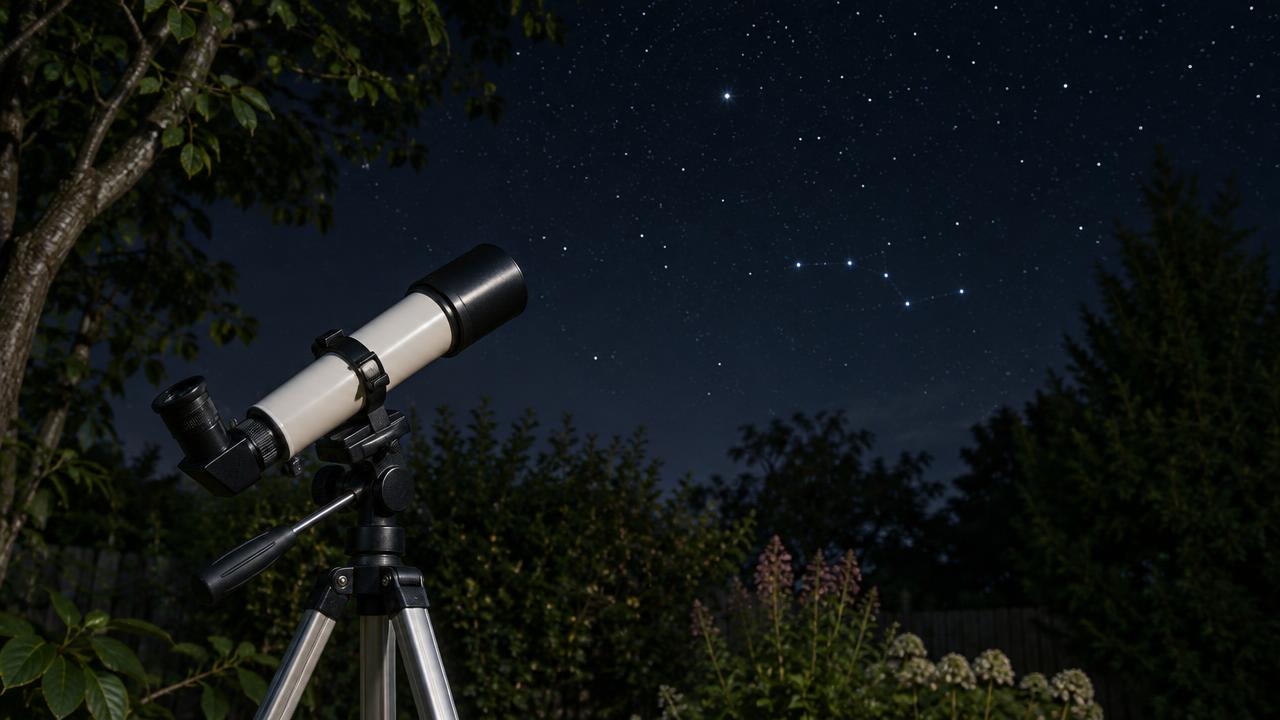
A Junior Telescope is a good next step for children who have mastered the naked-eye method. It will not make Polaris look bigger, since stars stay points of light, but Polaris B, its faint companion about 18 arcseconds away, can be resolved with a modest telescope, which young observers often find thrilling.

🛍️ Our pick
Junior Telescope
A beginner-friendly telescope that sets up quickly and shows lunar craters and bright planets clearly: an ideal first instrument for stargazing.
£121.49 Discover →
Can you use the North Star to navigate?
Yes. Polaris marks true north to within about a degree for UK observers, so facing it gives you north. Its altitude also gives your latitude, which navigators used for centuries. To find north on a clear night, locate Polaris, then drop an imaginary line straight down to the horizon. The point where it meets the ground is north. South is directly behind you, east to your right and west to your left.
Two details make Polaris better than a magnetic compass in one respect: it points to true north, the direction of Earth’s axis, whereas a compass needle points to magnetic north, which drifts over time. For walking, the difference rarely matters, but it is a lovely teaching point for children.
A few practical cautions:
- Polaris is useless south of the equator, where it stays below the horizon.
- Clouds can hide it suddenly, so always carry a map and compass on real hikes.
- Use it as a check on direction, not as a replacement for proper navigation tools.
Navigation is a good bridge into other branches of science. A child who enjoyed latitude and angles may well enjoy the field skills in the beginner’s guide to rocks and minerals, which uses the same habits of careful observation and record-keeping.
How can you bring the night sky indoors?
On cloudy nights, a constellation model or a star projector keeps children practising the shapes they need outside. The key is to link indoor play back to real stargazing on the next clear evening. The British weather is not always kind to stargazers, and November nights can bring long runs of cloud. Indoor practice keeps the shapes fresh, so that when the sky clears your family can find the Plough, the pointers and Polaris in seconds.
Ideas that work well:
- Draw it: sketch the Plough on paper from memory, mark the pointers and draw the line onward to Polaris.
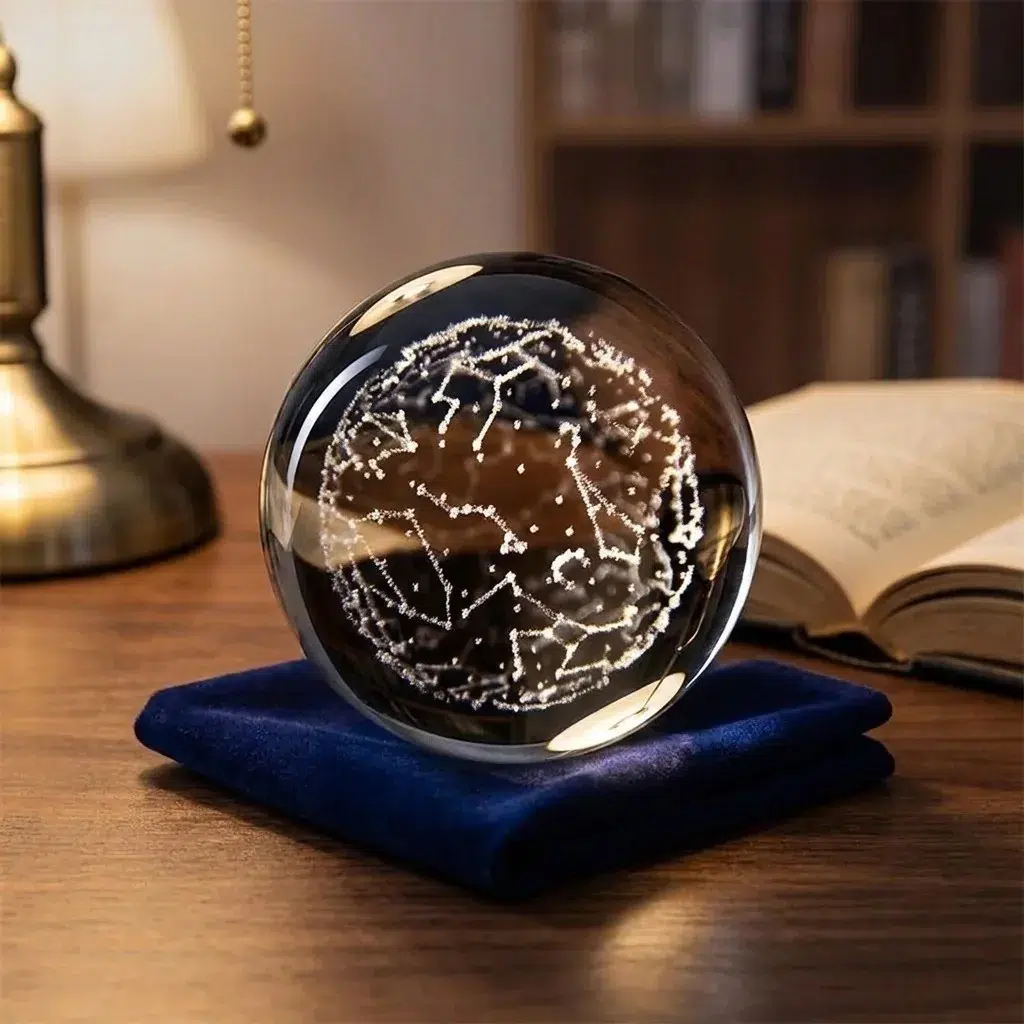
- Model it: an Engraved Constellation Crystal Ball shows constellations in three dimensions, which helps children understand that the stars sit on an imaginary sphere around us.
- Project it: a Galaxy Star Projector creates an atmospheric starry ceiling, good for bedtime conversations about the night sky, even if the patterns are decorative rather than accurate star charts.
You will find more ideas in the children’s telescopes range and among the galaxy projectors. For help choosing between a projector and a lamp, the projector versus star lamp comparison sets out the differences.
🛍️ Our pick
Engraved Constellation Crystal Ball, 60 mm
A glass sphere engraved with the night sky's constellations: a handy reference for spotting the Plough and Polaris, and a lovely desk piece.
£22.49 Discover →
Our take: why the North Star is the perfect first target
Polaris is the ideal first star to learn because it never moves, needs no equipment and teaches real astronomy: rotation, latitude and how the sky changes over thousands of years. When I ran stargazing evenings for families, the moment children found Polaris on their own was always the turning point. Suddenly the sky was not a random scatter of lights but a map with a fixed point. From there, everything else becomes a short hop.
My suggestion for a first session is simple. Go out on a clear evening, find the Plough, follow the pointers to Polaris and measure its height with your fists. Then look again two hours later and notice that the Plough has moved while Polaris has not. That single observation shows Earth’s rotation more vividly than any diagram.
Keep a simple observing log, with date, time, place and what you saw. Over a winter you will see the Plough swing around the pole, and you will have learned the northern sky without ever opening an app.
The North Star is not the brightest, and it is not eternal. But for the next few centuries it will remain the steadiest signpost in the British sky, and that is reason enough to get to know it.
Know a budding stargazer? Browse our space gifts for star projectors, moon lamps and astronomy gadgets.
FAQ
Sources
- Royal Museums Greenwich, Ursa Minor and Polaris
- BBC Sky at Night Magazine, How to find Polaris, the North Star
- European Space Agency, Gaia mission data releases
- Encyclopaedia Britannica, Polaris