
The essential:
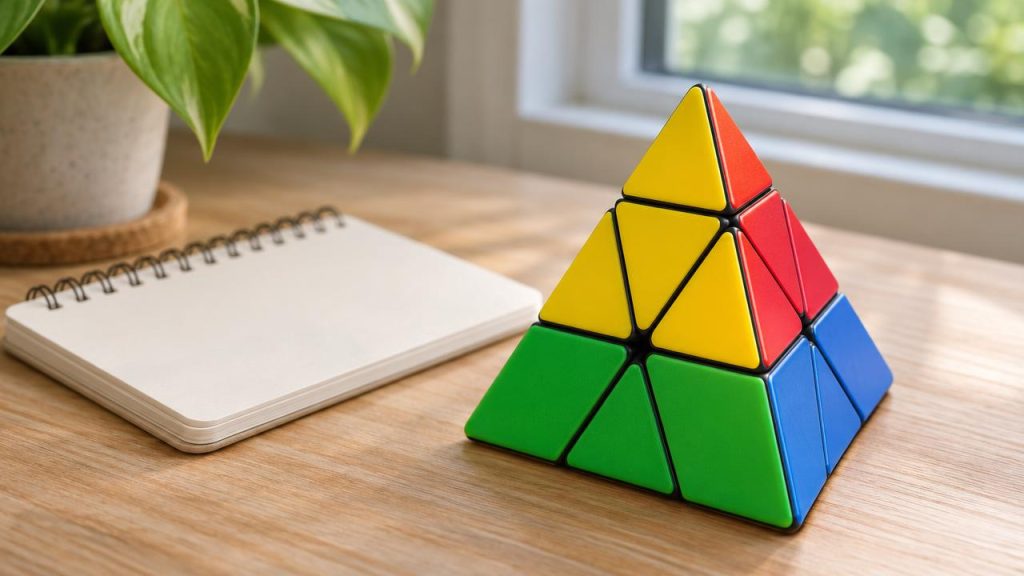
- A Pyraminx has 14 visible pieces: 4 tips, 4 axial centres and 6 edges.
- Ignoring the trivial tips, it has 933,120 possible positions, and any position can be solved in 11 moves or fewer.
- The beginner method uses 4 steps: tips, centres, bottom edges, then the last 3 edges with 3 short algorithms.
- The official world record single is 0.73 seconds, set by Simon Kellum in December 2023.
If you want to know how to solve a Pyraminx, you have picked the kindest puzzle in the twisty family. This little tetrahedron has only 14 visible pieces, and most beginners finish their first solve within an afternoon.
The method below works in four steps: line up the tips, set the centres, build the bottom layer, then finish the last three edges with short algorithms. Each sequence has been checked move by move on a simulated puzzle, so the notation you read here does exactly what it says.
📋 Table of contents
- What is a Pyraminx and how is it built?
- How do you read Pyraminx notation?
- How to solve a Pyraminx, steps 1 and 2: tips and centres
- Step 3: how do you solve the bottom edges of a Pyraminx?
- Step 4: which Pyraminx algorithms solve the last layer?
- Pyraminx vs Rubik’s cube: which is easier?
- What are the best Pyraminx tips for getting faster?
- Our take: is learning how to solve a Pyraminx a good start?
- FAQ
What is a Pyraminx and how is it built?
A Pyraminx is a tetrahedron-shaped twisty puzzle with four triangular faces. It has 4 tips, 4 axial centres and 6 edges, and each corner of the pyramid turns in thirds of a full rotation. The puzzle was patented by Uwe Mèffert and launched by Tomy in 1981, riding the wave of interest in the Rubik’s Cube. Its structure is simple once you see the three kinds of piece:
- Tips (4): the small pyramids at each corner. They turn on their own and never move position.
- Axial centres (4): the three-coloured pieces just beneath each tip. They also stay in place and only rotate, so they define the colour of each face.
- Edges (6): the two-coloured pieces between the centres. These are the only pieces that actually move around the puzzle.
Because the tips and centres are fixed in place, the real puzzle is just six edges. That is why this triangle puzzle is such a good first step into twisty puzzles. If you are building a collection, our Rubik’s Cube collection includes the classic shapes as well as pyramid and dodecahedron variants.
💡 Did you know?
Did you know? Ignoring the tips, a Pyraminx has 933,120 possible positions, and none of them needs more than 11 moves to solve. Adding the four tips, each with three orientations, multiplies that total by 81.
How do you read Pyraminx notation?
Hold the puzzle with one face towards you and one tip pointing up. U, L, R and B name the top, left, right and back corners. A letter turns that corner clockwise by one third; an apostrophe turns it anticlockwise. Notation follows the corner you are turning, viewed as if you were looking straight down at that corner from outside the puzzle.
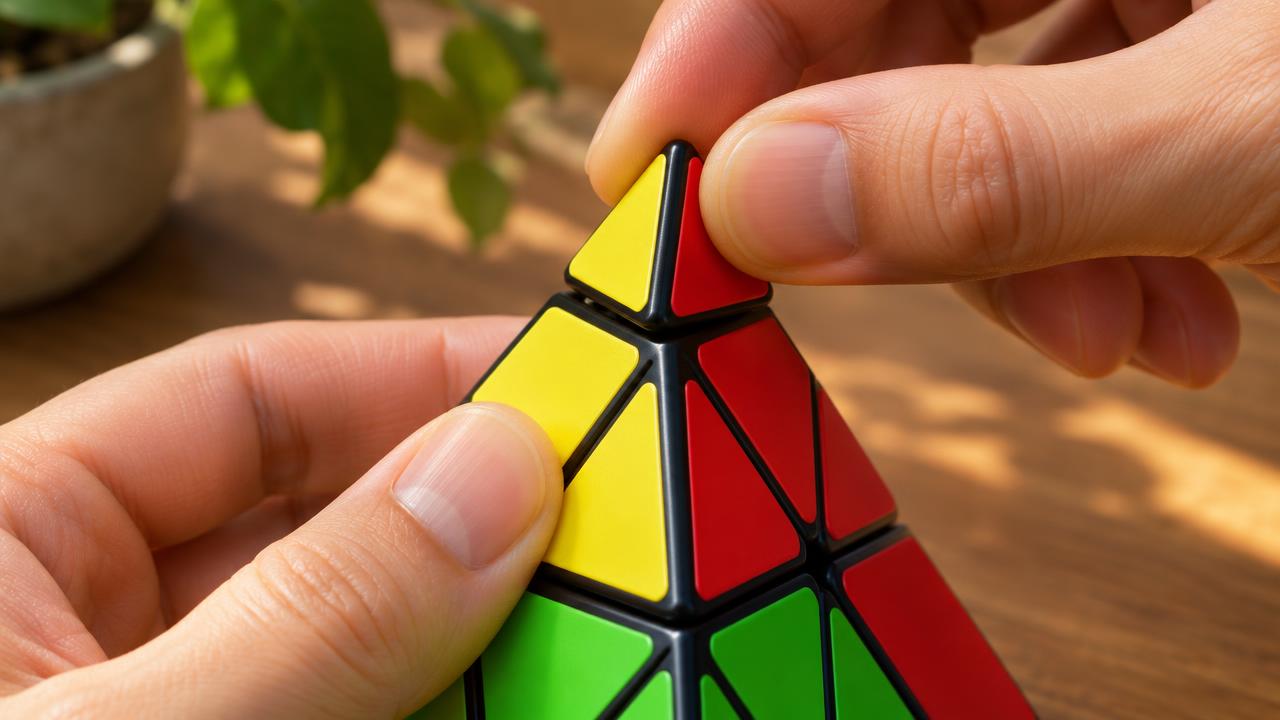
- U: the top corner, with the top two layers turning together.
- L and R: the bottom-left and bottom-right corners of the face towards you.
- B: the corner at the back.
- Lowercase u, l, r, b: turn only the tiny tip.
- Apostrophe: anticlockwise, so R’ undoes R.
A single turn is always one third of a full rotation, so two turns of the same corner equal one turn in the opposite direction. That is why Pyraminx algorithms never need a 2 after a letter.
One useful habit: keep the same face towards you for the whole of each algorithm. Rotating the puzzle midway is the most common reason a sequence seems not to work.
How to solve a Pyraminx, steps 1 and 2: tips and centres
Turn each tip so its colours match the axial centre below it. Then choose a bottom colour and turn each of the three lower corners until the bottom colour faces down on all three centres. Tips. This takes a few seconds. Each tip has three colours, and so does the centre piece directly under it. Twist the tip with u, l, r or b until its colours line up with that centre. Do this for all four corners.
Centres. Pick a colour for the bottom face, for example yellow. Hold the puzzle with the yellow face down. Each of the three lower corners (L, R and B) has an axial centre with one sticker on the bottom face. Turn L, R and B, one at a time, until yellow is facing down on all three.
- Once the centres are set, the colours of all four faces are fixed.
- Each side face now has a clear target colour given by its two lower centres.
- From here on, you never need to touch the tips again.
These two steps are completely intuitive and teach the puzzle’s geometry better than any diagram. Many people find it relaxing to set tips and centres several times just to get a feel for how the corners move.
Step 3: how do you solve the bottom edges of a Pyraminx?
Insert the three bottom edges one at a time. Hold the empty bottom slot at the front, bring its edge to the top-left or top-right, then use a four-move sequence to drop it in. Find an edge that has yellow on it and hold the slot it belongs to at the bottom of the front face. If the edge is in the top layer, turn U until its yellow sticker faces you: it will then sit at the top-left or top-right of the front face.
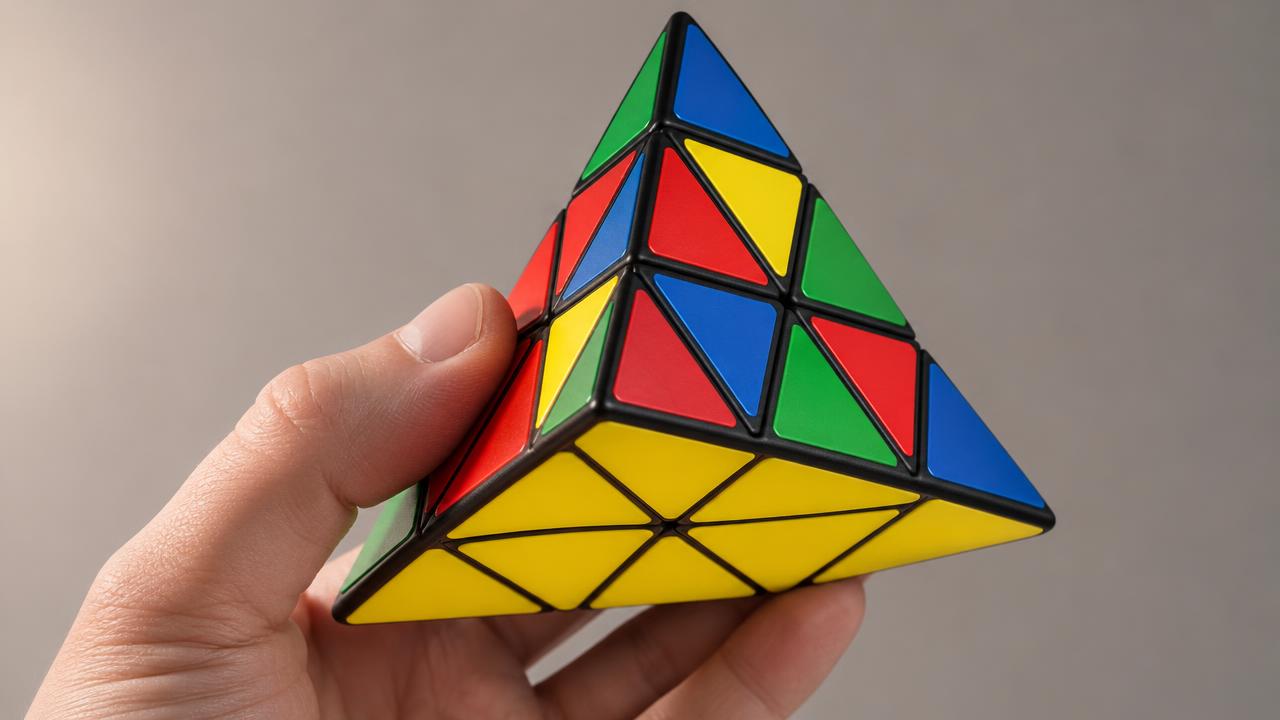
- Edge at top-right of the front face: U R U’ R’
- Edge at top-left of the front face: U’ L’ U L
In both cases, the sticker that faces you before the algorithm ends up on the bottom, and the other sticker ends up on the front, matching the front centres. If the edge you need is stuck in the wrong bottom slot, or in its own slot but flipped, hold that slot at the front and perform either algorithm once: this lifts it into the top layer, and you can then insert it properly.
Neither sequence disturbs the other two bottom edges or the tips, so you can solve the three slots in any order. Once the bottom face is complete, only three edges remain, all in the top layer around U.
⭐ Key takeaway
Key takeaway: in step 3, the colour facing you goes to the bottom. Remember that one rule and the two insertion algorithms become mirror images you can perform without thinking.
Step 4: which Pyraminx algorithms solve the last layer?
Three algorithms finish the Pyraminx: two eight-move sequences cycle the last three edges in opposite directions, and a third flips two edges in place. None of them disturbs the bottom layer. Hold the puzzle with the solved bottom face down. Look at the three remaining edges, at the front-left, front-right and back of the top layer.
- Cycle one way: R U R’ U R U R’ moves the front-left edge to the front-right, the front-right edge to the back and the back edge to the front-left.
- Cycle the other way: L’ U’ L U’ L’ U’ L moves them in the opposite direction.
- Flip two edges: with the two flipped edges at the front-left and front-right, use R’ L R L’ U L’ U’ L.
A practical approach: if all three edges are in the wrong places, try one cycle; if that makes things worse, undo it and use the other. If two edges are in the right place but flipped, use the flip algorithm. Sometimes a cycle leaves edges in place but flipped, so you may need a cycle followed by the flip.
All three sequences return the tips and centres exactly where they were, so your bottom layer stays intact.

🛍️ Our pick
Triangle Rubik's Cube
A triangular twisty puzzle in the Pyraminx family: four faces, few pieces and a quick, satisfying solve once you know the steps.
£10.49 · ★ 17 sold
Discover →Pyraminx vs Rubik’s cube: which is easier?
The Pyraminx is much easier. It has 6 moving edges against 20 moving pieces on a 3×3 cube, and around 933,120 positions against about 43 quintillion, so a beginner method needs far fewer algorithms. The comparison is useful for choosing a first puzzle or a gift.
- Learning time: a first Pyraminx solve often comes within an afternoon, while a first cube solve usually takes longer.
- Algorithms: this whole method uses 5 short sequences of 4 to 8 moves.
- Speed: top Pyraminx solves take well under 2 seconds, while 3×3 records are a few seconds.
That said, the Pyraminx is not trivial at speed. Expert solvers plan much of the solve during the 15-second inspection, which is a real test of spatial memory.
Once the Pyraminx feels easy, the logic carries over well to bigger puzzles. The Hexagon Rubik’s Cube Megaminx is a natural next challenge, and our guide on how to solve a Megaminx uses the same layer-by-layer thinking. If you prefer cubes, our walkthrough on how to solve a 4×4 Rubik’s cube is the next step up.
| Feature | Pyraminx | 3×3 cube |
|---|---|---|
| Shape | Tetrahedron, 4 faces | Cube, 6 faces |
| Moving pieces | 6 edges (tips and centres only rotate) | 20 (8 corners, 12 edges) |
| Positions | 933,120 (ignoring tips) | about 4.3 x 10^19 |
| Maximum moves needed | 11 | 20 |
| World record single | 0.73 s (2023) | 2.76 s (2026) |
What are the best Pyraminx tips for getting faster?
Learn the algorithms until they are automatic, solve the tips last instead of first, and start solving the bottom layer as a V shape. These three habits typically cut beginner times sharply. Once you can solve it reliably, a few changes make a big difference:
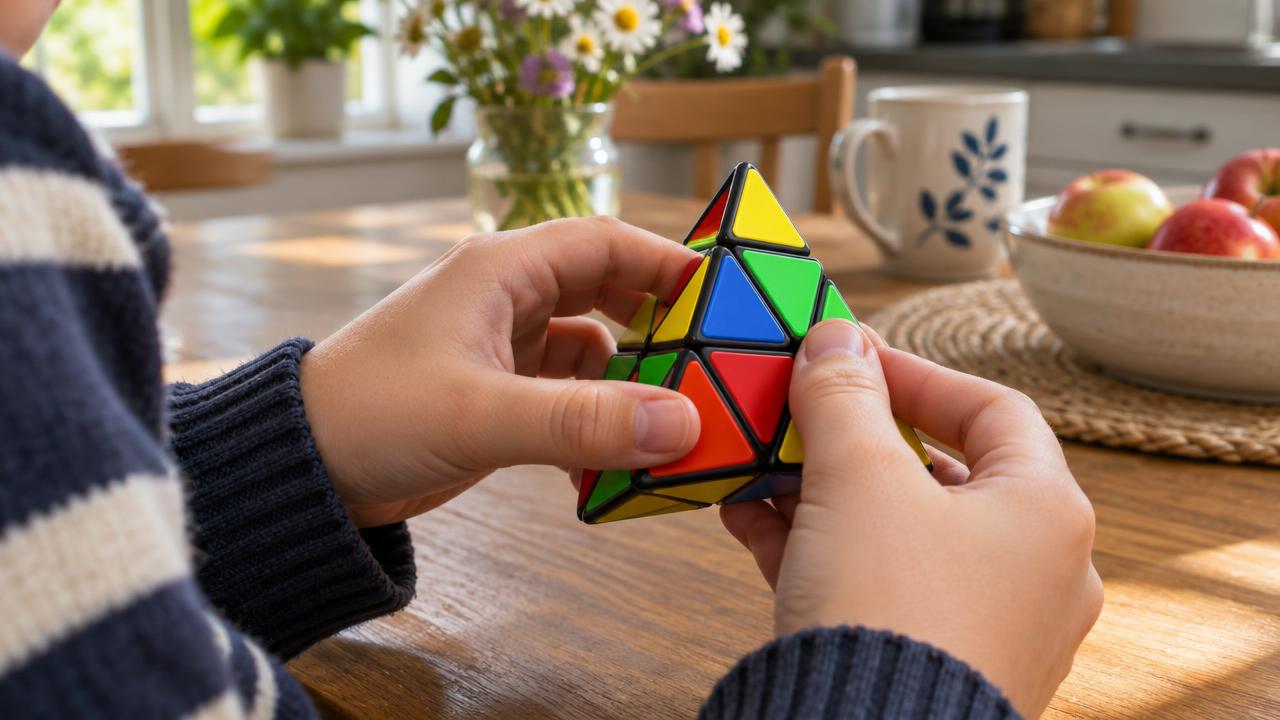
- Tips last: tips do not affect anything else, so experienced solvers often ignore them until the end and fix them in a second.
- Think in a V: instead of a full bottom face, solve two bottom edges with their centres to make a V shape, then finish the remaining three edges with algorithms. This is how many fast solvers approach it.
- Finger tricks: perform R and L turns with your thumbs or index fingers rather than turning your wrists. The movements become much smoother.
- Inspection: in competition you get 15 seconds to look before starting. Use it to plan your first edges.
Official competition has included the Pyraminx since 2003, when Andy Bellenir won the first world championship with a 14.09 second single. Today the record single is 0.73 seconds, set by Simon Kellum, and the record average stood at 1.14 seconds as of mid-2026.
For more puzzles that reward patience, browse our brain teasers, or check what makes a good puzzle in our guide on what to look for when buying a puzzle cube.
Our take: is learning how to solve a Pyraminx a good start?
Yes. It is the best first twisty puzzle for children and adults alike, because success comes quickly and every step teaches a real puzzle skill: setup moves, commutators and mirror algorithms. In workshops, the Pyraminx is the puzzle that converts sceptics. People who are sure they cannot do a Rubik’s Cube solve a Pyraminx in under an hour and leave asking what comes next. That confidence is worth more than any record.
- For children: the small number of pieces makes it ideal from around age 8, with adult help reading the notation at first.
- For maths lovers: the puzzle is a friendly introduction to permutations and symmetry. Our maths quiz is a fun companion.
- For gift ideas: pair a pyramid twisty puzzle with a printed copy of this method for a complete package.
And if the person you are buying for prefers mysteries to twisting, the Pyramid Brain Teaser offers a very different kind of pyramid challenge, based on hidden mechanisms and symbols. Finally, test your general puzzle reflexes with our brain teasers quiz.
Hunting for the next puzzle to give? Our maths gifts page collects twisty puzzles, geometric decor and number gadgets.

🛍️ Our pick
Pyramid Brain Teaser
A pyramid-shaped brain teaser that rewards spatial thinking: a good companion puzzle once the Pyraminx feels easy.
£22.99 · ★ 1445 sold
Discover →FAQ
Sources
- World Cube Association, official regulations and records
- Jaap Scherphuis, Jaap’s Puzzle Page: Pyraminx
- Uwe Mèffert, Pyraminx patent and Meffert’s puzzle archive
- David Singmaster, Rubik’s Cubic Compendium (Oxford University Press, 1987)