
The essential:
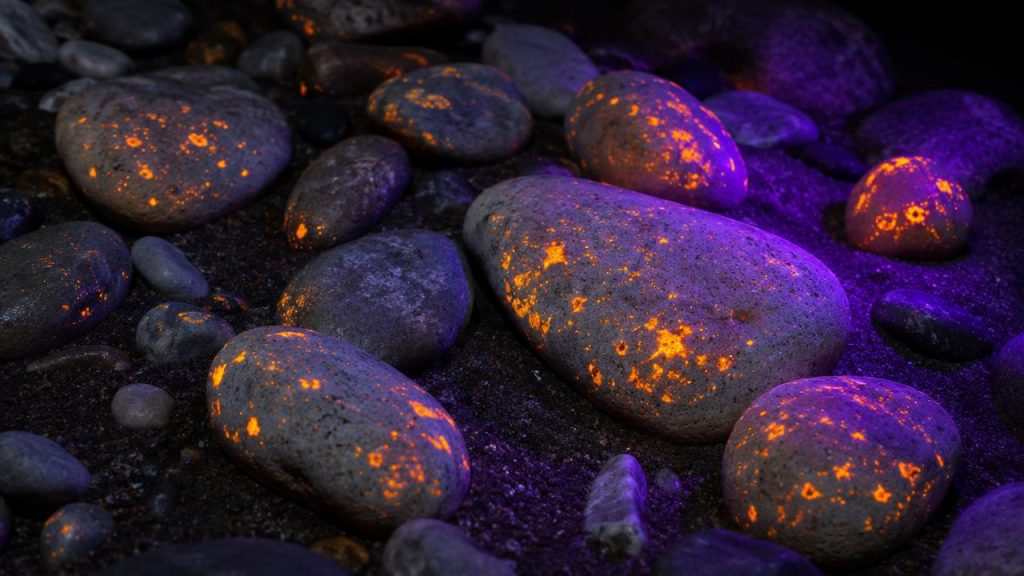
- Yooperlite is a trade name for syenite pebbles rich in fluorescent sodalite, found on the Lake Superior shores of Michigan’s Upper Peninsula.
- Erik Rintamaki is credited with identifying them in 2017 while searching the beach with a UV torch.
- The sodalite glows orange to yellow under longwave UV, usually around 365 nm, an effect linked to sulfur ions in its crystal structure.
- The source rocks are thought to be about 1.1 billion years old and were carried south from Ontario by Ice Age glaciers.
Yooperlite looks like an ordinary grey pebble until you shine an ultraviolet torch on it, and then it erupts into speckles and veins of glowing orange, like embers scattered through stone. Few rocks have gone from unknown to internet favourite so quickly.
Behind the glow lies some genuinely elegant physics and geology: a mineral called sodalite, a trace of sulfur trapped in its crystal cage, and an ice sheet that carried the rock hundreds of kilometres. This guide explains what yooperlite is, why it glows, where it is found and which fluorescent stones you can look for closer to home in the UK.
📋 Table of contents
- What is yooperlite?
- Who discovered yooperlite, and when?
- Why does yooperlite glow under UV light?
- What UV torch do you need to see yooperlite glow?
- Where to find yooperlite in Michigan
- Can you find yooperlite in the UK?
- Does yooperlite have healing properties?
- Our take: is yooperlite worth adding to a collection?
- FAQ
What is yooperlite?
Yooperlite is a syenite, a coarse igneous rock similar to granite but low in quartz, that contains fluorescent sodalite. Under daylight it looks grey; under longwave UV light the sodalite glows bright orange. The name combines Yooper, the local nickname for people from Michigan’s Upper Peninsula (the U.P.), with the ending of sodalite. It is a trade name rather than an official mineral species, and its discoverer has trademarked it. Geologists simply describe the material as sodalite-bearing syenite.
- Rock type: syenite, an igneous rock that cooled slowly underground from magma rich in sodium and potassium.
- Glowing mineral: sodalite, a sodium aluminium silicate containing chlorine, with a hardness of 5.5 to 6 on the Mohs scale.
- Appearance: grey to pinkish grey pebbles, often rounded by waves, with no obvious hint of what they hide.
Sodalite itself has been known since 1811, when it was described from Greenland. Most people know it as a royal blue stone used in carvings and jewellery. The yooperlite form is different: the sodalite grains are small, pale and scattered, and only reveal themselves under UV. To place syenite among the other major rock families, our guide to rocks and minerals explains how igneous, sedimentary and metamorphic rocks differ.
Who discovered yooperlite, and when?
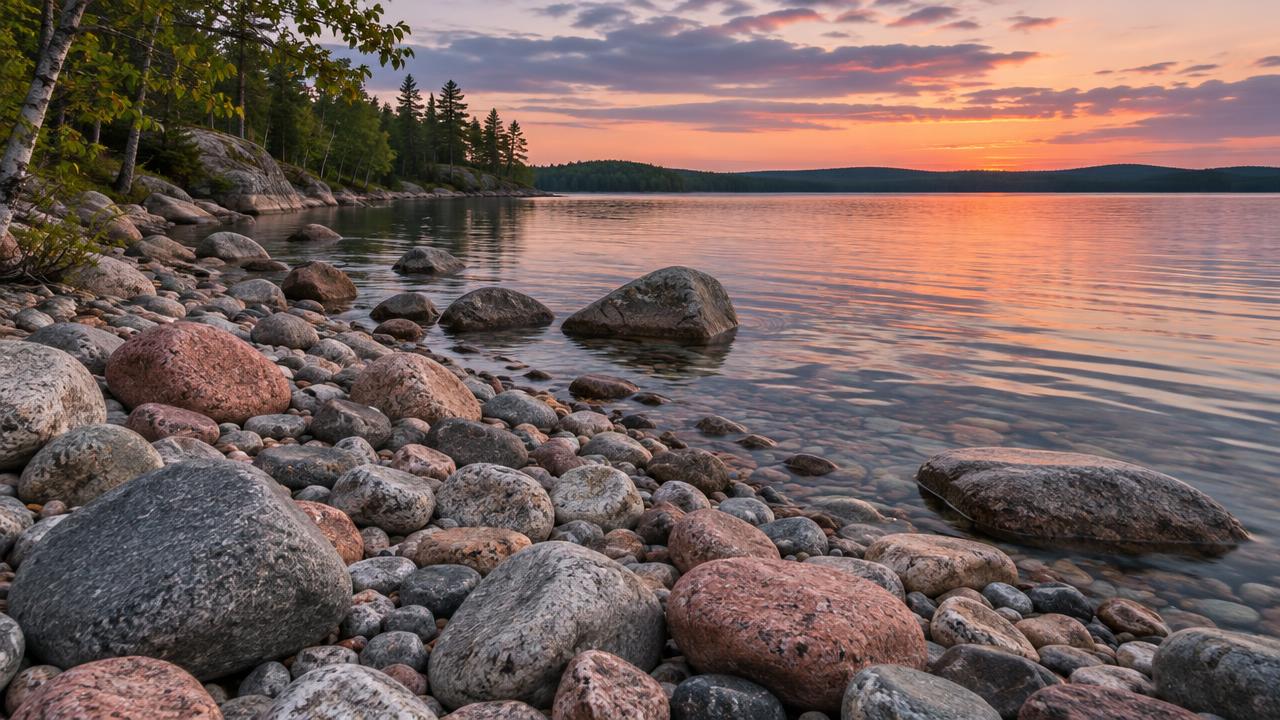
Michigan rockhound Erik Rintamaki is credited with identifying the glowing stones in 2017, after scanning a Lake Superior beach with a UV torch. Analyses by university geologists then confirmed them as sodalite-bearing syenite. Rintamaki was hunting for agates on the shores of Lake Superior in 2017 when he tried an ultraviolet torch and saw pebbles lighting up across the beach. Reports describe samples being analysed at Michigan Technological University and the University of Saskatchewan, which confirmed the glowing mineral as sodalite within syenite.
The find was surprising for a simple reason: sodalite had not been recorded in standard references on Michigan’s minerals. That is a good reminder that discovery does not always need a laboratory. Sometimes it needs a new way of looking at familiar things.
- 2017: glowing pebbles noticed under UV on Lake Superior beaches.
- 2018: the find is reported in the mineral collecting press and the name spreads quickly online.
- Since then: night-time UV hunting has become a popular pastime along the Upper Peninsula shoreline.
Fluorescence itself has a British connection: the word was coined in 1852 by the physicist George Gabriel Stokes, who named it after fluorspar, the mineral we now call fluorite.
💡 Did you know?
Did you know? The word fluorescence comes from fluorite. George Stokes coined it in 1852, and some fluorite from Weardale in County Durham glows blue so strongly that the effect is visible even in sunlight.
Why does yooperlite glow under UV light?
The sodalite absorbs invisible ultraviolet light and re-emits the energy as visible orange light. Research links this to disulfide ions, pairs of sulfur atoms trapped in the mineral’s crystal framework in place of some chloride ions. Fluorescence happens when a material absorbs light of one energy and releases it at a lower energy, which means a longer wavelength. Ultraviolet light, which you cannot see, goes in; orange light, which you can, comes out.
- The cage: sodalite’s structure is a framework of aluminium, silicon and oxygen forming tiny cages, each holding sodium and chloride ions.
- The activator: in fluorescent sodalite, some chloride is replaced by disulfide ions (two sulfur atoms carrying a negative charge). These absorb UV and emit visible light.
- The colour: people usually describe the glow as orange or yellow-orange; laboratory spectra show a broad emission band reaching into the red, peaking near 630 nm.
Sodalite can also show a brief afterglow, called phosphorescence, after the UV is switched off. A related variety, hackmanite, changes colour when exposed to light, a property called tenebrescence.
For more on how light interacts with matter, our optics quiz tests the basics of wavelengths, colour and absorption.
⭐ Key takeaway
Key takeaway: yooperlite’s glow is fluorescence, not radioactivity and not stored sunlight. Sulfur ions in the sodalite turn invisible UV into visible orange light, and the effect stops almost as soon as the UV torch goes off.
What UV torch do you need to see yooperlite glow?
Use a longwave UV torch with a peak around 365 nm and a filter that blocks most visible violet light. Cheaper 395 nm torches work less well because their purple glare drowns out the orange. Not all ultraviolet torches are equal. The orange of fluorescent sodalite stands out best against darkness, so the torch should emit as little visible light as possible.
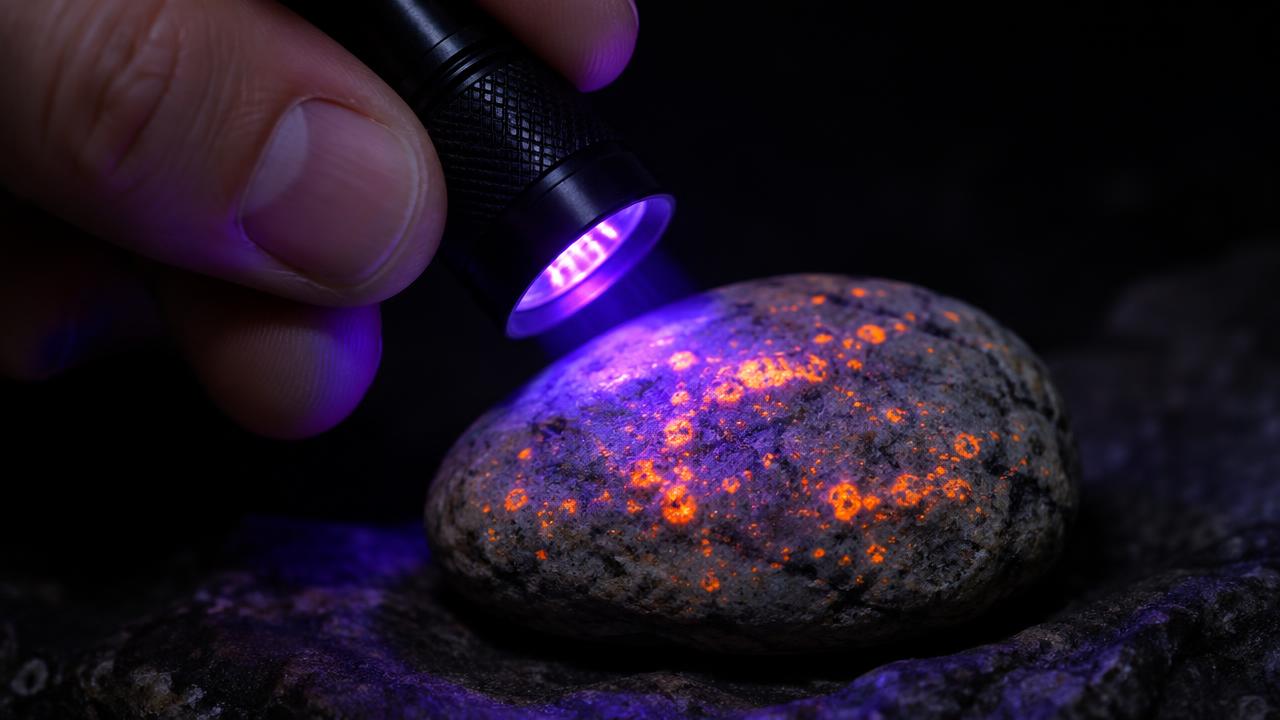
- 365 nm, filtered: the standard choice for yooperlite. The filter (often a dark glass lens) removes most visible purple.
- 395 nm: common in budget torches. Sodalite may still glow, but the strong purple light makes it harder to spot.
- Shortwave UV (around 254 nm): used by mineral collectors for other species, but it is more hazardous for eyes and skin and is not needed here.
Safety: never shine a UV torch into anyone’s eyes, and wear UV-blocking glasses for longer sessions. Children should only use UV torches under supervision.
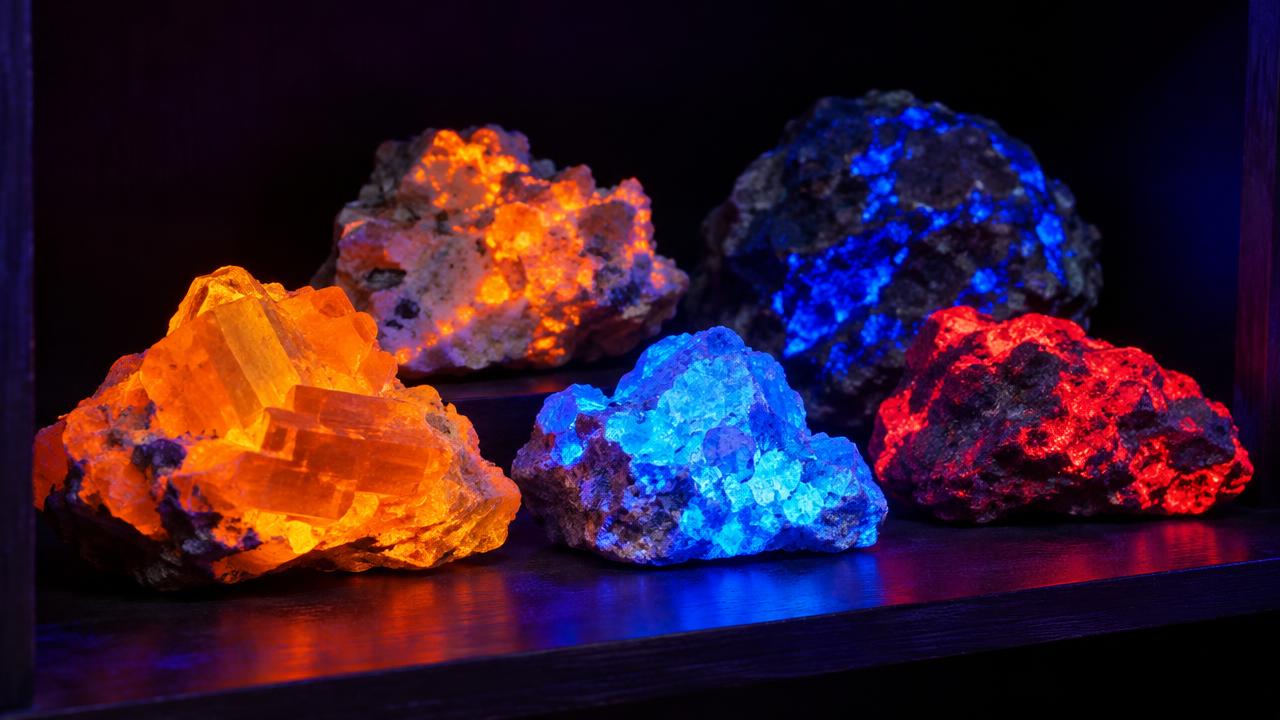
A UV torch is also a great way to explore your own collection. A Green Fluorite Crystal often shows a blue or violet response under longwave UV, depending on its origin, which makes a striking comparison with sodalite’s orange.
| Mineral | Typical longwave UV response | Where it is found |
|---|---|---|
| Sodalite (yooperlite) | Bright orange to yellow-orange | Lake Superior shores, Michigan; sodalite also in Greenland, Canada and elsewhere |
| Fluorite | Often blue to violet; varies by locality | Weardale and the North Pennines in England, among many sites |
| Calcite | Varies: red, orange, pink or none | Widespread worldwide |
| Hackmanite | Orange glow; also changes colour in light | Greenland, Canada, Afghanistan |

🛍️ Our pick
Green Fluorite Crystal
A green fluorite specimen, the mineral that gave fluorescence its name: try it under UV light and compare it with your Yooperlite.
From £25.49 · ★ 17 sold
Discover →Where to find yooperlite in Michigan
Yooperlite turns up mainly on Lake Superior beaches in Michigan’s Upper Peninsula. Collectors search at night with UV torches, after storms and waves have turned over fresh stones. The rocks are thought to come from syenite intrusions in Ontario, Canada, formed around 1.1 billion years ago when molten rock cooled deep underground. During the Ice Age, glaciers scraped up fragments of this rock and dragged them south, scattering them across what is now the Great Lakes region.
- Main shores: stretches of the Lake Superior coast in the Upper Peninsula, with Chippewa and Luce counties and the Keweenaw Peninsula often mentioned by collectors.
- Best time: dark, calm nights, especially after rough weather has moved the shingle.
- Rules: collecting rules vary between public, state and private land, and national lakeshores have their own regulations. Always check before taking anything.
Because the material travelled by ice, glowing pebbles can also turn up away from the main beaches, but the Upper Peninsula remains the classic hunting ground. For many people, the night-time search with a UV torch is as memorable as the find.
Can you find yooperlite in the UK?
Not in the strict sense: yooperlite is defined by its Lake Superior origin. The UK does have fluorescent minerals, though, notably the fluorite of Weardale in County Durham, famous for glowing blue. Britain was also shaped by glaciers, and they carried rocks great distances here too. But the specific sodalite syenite behind yooperlite comes from the Canadian Shield, so British beaches are not a realistic place to find it. Sodalite-bearing rocks do exist in a few European localities, but none produce the beach pebbles that made yooperlite famous.
- Weardale fluorite: some specimens from mines and quarries in the North Pennines fluoresce an intense blue under longwave UV, and a few even show the effect in daylight.
- Calcite: common in British limestone areas, and some specimens fluoresce under UV.
- Beach collecting: in England and Wales, removing material from beaches can be restricted under the Coast Protection Act 1949, and local byelaws apply, so check rules before you pocket anything.
The most reliable way to own a piece of yooperlite in the UK is a specimen sourced from Michigan. Our yooperlite specimens are natural sodalite syenite pebbles that light up under a 365 nm torch. You will find them alongside other natural specimens in our crystals and stones collection.

🛍️ Our pick
Yooperlite Crystal
A real Yooperlite stone: plain grey in daylight, glowing orange-yellow spots under a UV torch thanks to fluorescent sodalite.
From £15.99 · ★ 21 sold
Discover →Does yooperlite have healing properties?
No. There is no scientific evidence that yooperlite, sodalite or any other stone has healing or energetic properties. Its real value lies in geology and physics: it is a superb demonstration of fluorescence. Yooperlite is often sold with claims borrowed from crystal healing, sometimes called lithotherapy. These ideas have not been validated by scientific testing, and no mineral has been shown to change health, mood or energy through contact or proximity.
What yooperlite genuinely offers is just as interesting:
- A visible lesson in quantum physics: electrons absorb UV energy and fall back, releasing light of a specific colour.
- A record of deep time: rock formed around a billion years ago, moved by ice and polished by a lake.
- A lesson in observation: a mineral nobody noticed on a busy shoreline until someone looked with different light.
If you want a mineral that delights the eye without a UV torch, a lab-grown Bismuth Crystal shows a different phenomenon entirely: rainbow colours produced by a thin oxide layer interfering with light. And our article on tourmaline explores a mineral with remarkable electrical properties, from pyroelectricity to piezoelectricity.
Our take: is yooperlite worth adding to a collection?
Yes, as a teaching specimen it is hard to beat. A single pebble and a 365 nm torch demonstrate fluorescence, glacial transport and igneous geology in one memorable moment, for children and adults alike. In workshops, the reaction is always the same: polite interest at a grey pebble, then a gasp when the lights go down and the torch comes on. That moment opens questions about light, atoms and time far more effectively than a diagram.
- Start a fluorescence set: yooperlite, fluorite and calcite together show three different colours and three different activators.
- Experiment: compare a 365 nm and a 395 nm torch, and see how much the visible purple affects what you notice.
- Display it well: a small stand on a dark shelf, plus a torch nearby, invites visitors to try it themselves. Our science decor range has ideas for showing off specimens.
For a playful check on what you have learned, try our crystals quiz.
Shopping for a rock hound? Our geology gifts page gathers crystals, geodes and fossil kits in one place.
FAQ
Sources
- Michigan Technological University, Department of Geological and Mining Engineering and Sciences
- Mineralogical Society of America, Handbook of Mineralogy: Sodalite
- Natural History Museum, London: mineral collections and fluorescence
- George Gabriel Stokes, On the Change of Refrangibility of Light, Philosophical Transactions of the Royal Society (1852)