
The essential:
- Tourmaline is not one mineral but a group of boron silicates; the International Mineralogical Association recognises more than 40 species.
- Black tourmaline, the species schorl, may make up 95% or more of all tourmaline in nature.
- Tourmaline measures 7 to 7.5 on the Mohs scale, hard enough to scratch glass and wear well in jewellery.
- Its crystals are pyroelectric: a change in temperature makes opposite ends carry opposite electric charges, an effect Franz Aepinus described in 1756.
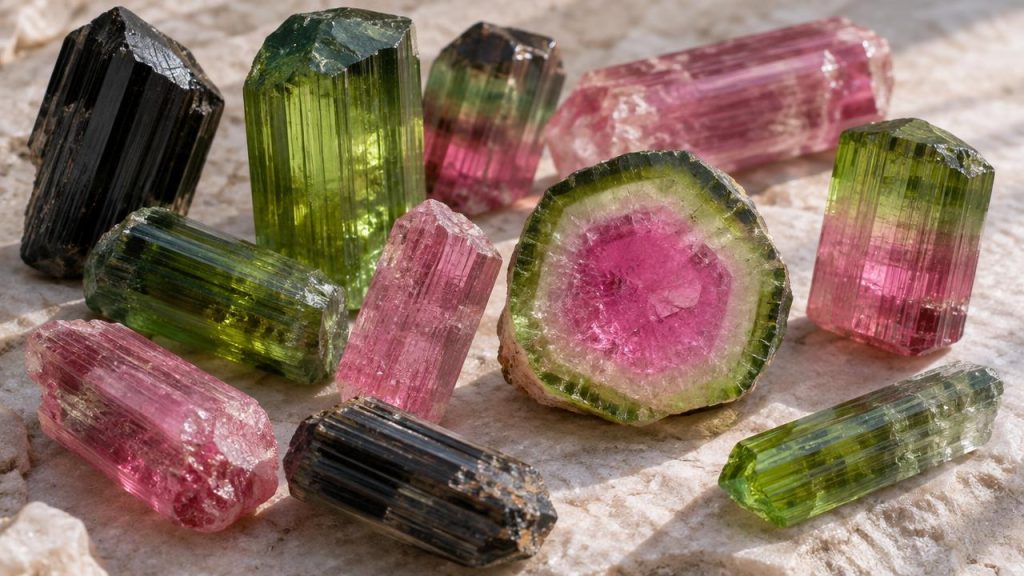
Tourmaline is the mineral world’s great colourist, found in black, brown, pink, red, green, blue, colourless and sometimes several of these in the same crystal. Behind that palette lies a remarkably complex chemistry and a physical party trick that puzzled 18th-century scientists: warm a tourmaline crystal and it starts to attract dust and ash.
As a former museum science communicator, I have always found tourmaline the perfect stone for showing that minerals are more than pretty objects. This guide explains what tourmaline is, its main types and colours, black and watermelon tourmaline, its pyroelectric and piezoelectric properties, how to identify it, and an honest word on the claims you may read about crystals.
📋 Table of contents
What is tourmaline?
Tourmaline is a group of complex boron silicate minerals that crystallise in the trigonal system, typically as long, striated prisms with a rounded triangular cross-section. It rates 7 to 7.5 on the Mohs hardness scale. Mineralogists talk about the tourmaline group rather than a single mineral, because many elements can swap places within the same crystal framework. The general formula looks intimidating, but the idea is simple: a ring of six silicon-oxygen units, boron in triangular groups, and a set of sites that can host sodium, calcium, lithium, magnesium, iron, aluminium, manganese and more. Change what sits in those sites and you get a different species with a different colour.
Some key physical features help you recognise it:
- Crystal shape: elongated prisms with fine lengthwise grooves (striations) and a rounded triangular section when viewed end on.
- Hardness: 7 to 7.5, enough to scratch glass, which makes it durable in jewellery.
- Density: around 3.0 to 3.3 g/cm³ depending on composition, slightly heavier than quartz.
- No cleavage: it breaks with an uneven or shell-like fracture rather than splitting neatly.
The name comes from the Sinhalese word tōramalli, used in Sri Lanka for coloured gem pebbles. Tourmaline mostly forms in granites and especially in pegmatites, coarse-grained veins where boron-rich fluids allow large crystals to grow. To place it among other gem minerals, see our introduction to rocks and minerals.
What are the main types of tourmaline?
The most common species are schorl (black, iron-rich), dravite (brown, magnesium-rich) and elbaite (lithium-rich, the source of most gem-quality colours). The International Mineralogical Association recognises more than 40 species in total. Most people will only ever meet a handful of tourmaline species, and three account for nearly everything you see in shops and museums:
- Schorl: the sodium and iron end member, opaque black. It is by far the most abundant, possibly 95% or more of all tourmaline in nature.
- Dravite: the sodium and magnesium end member, usually brown to dark yellow, often found in metamorphic rocks and marbles.
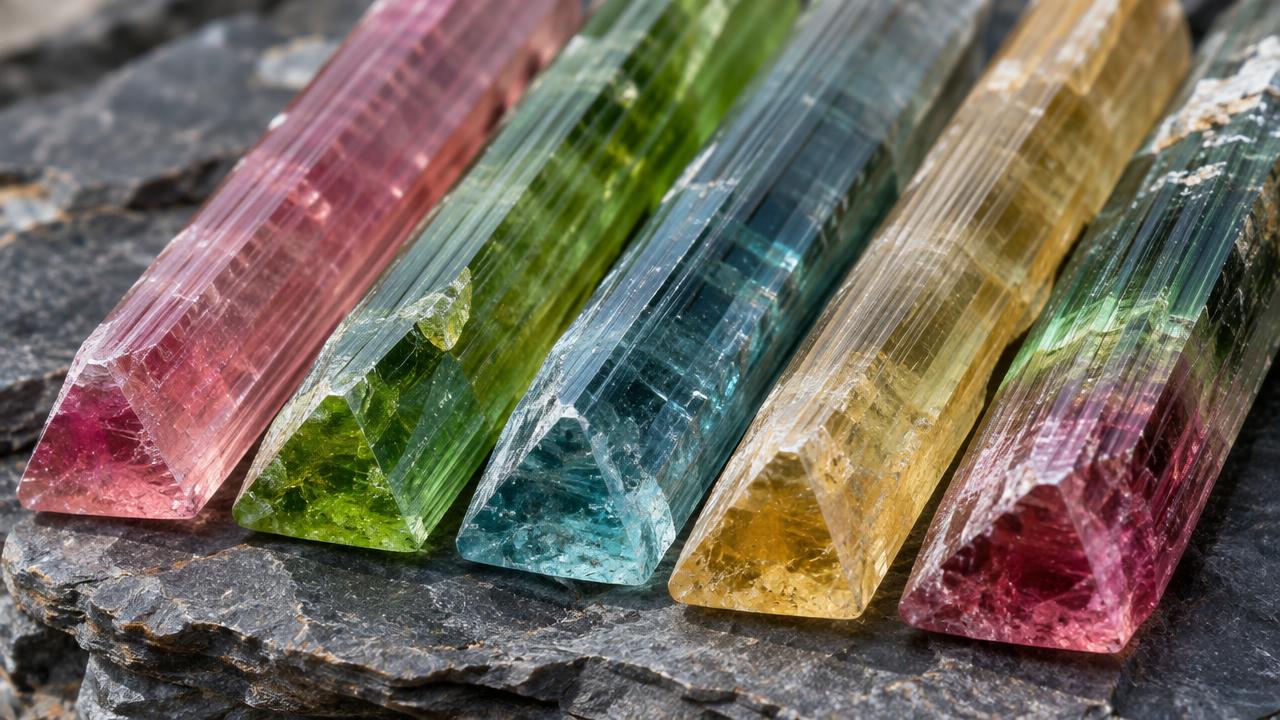
- Elbaite: rich in lithium, it is the source of most transparent gem tourmaline and covers almost the whole colour spectrum.
Rarer species include uvite (calcium and magnesium) and liddicoatite (calcium and lithium), the latter often strongly colour-zoned.
The jewellery trade adds colour names on top of the mineral names, mainly for elbaite:
- Rubellite: pink to red;
- Indicolite: light blue to blue-green;
- Verdelite: green, such as this green tourmaline crystal;
- Achroite: colourless, and genuinely rare.
| Species or variety | Key elements | Typical colour | Notes |
|---|---|---|---|
| Schorl | Sodium, iron | Black | Most common tourmaline in nature |
| Dravite | Sodium, magnesium | Brown to yellow-brown | Common in metamorphic rocks |
| Elbaite | Sodium, lithium, aluminium | Almost any colour | Source of most gem tourmaline |
| Liddicoatite | Calcium, lithium | Multicoloured zones | Famous colour-zoned slices |
| Paraíba-type elbaite | Copper, manganese | Neon blue to green | Named after a Brazilian state |

🛍️ Our pick
Green Tourmaline Crystal
A green tourmaline (verdelite) crystal showing the colour range of this complex borosilicate mineral.
From £14.99 Discover →
Why does tourmaline come in so many colours?
Tiny amounts of different elements absorb different parts of the light. Iron gives black, brown or blue, manganese gives pink and red, chromium or vanadium give vivid green, and copper gives the neon blues of Paraíba-type stones. Colour in minerals often comes from trace elements, called chromophores, that absorb some wavelengths of light and let others pass. Tourmaline’s flexible crystal structure accepts an unusually wide range of them, which explains why few gem families can match it for variety.
- Iron: in high amounts it makes schorl opaque black; in smaller amounts it contributes to blues, greens and browns.
- Manganese: responsible for pinks and reds. Natural radiation in the rock can deepen these colours over geological time.
- Chromium and vanadium: produce the intense green of so-called chrome tourmaline, a variety of dravite.
- Copper: gives the electric blue to green of Paraíba-type tourmaline, first found in the Brazilian state of Paraíba and later in Mozambique and Nigeria.
Tourmaline also shows strong pleochroism: the colour changes with viewing direction. Look down the length of a green crystal and it can appear much darker, almost black, than when viewed from the side. Gem cutters orient the stone carefully to show its best tone.
For a broader view of how trace elements colour minerals, compare tourmaline with the purple quartz in our guide to amethyst, whose colour comes from iron and natural irradiation.
⭐ Key takeaway
Tourmaline’s colour is a chemical fingerprint: the same crystal framework turns black with iron, pink with manganese, green with chromium and neon blue with copper.
What is black tourmaline?
Black tourmaline is usually schorl, the iron-rich species and the most abundant tourmaline on Earth. It forms opaque, glossy, striated prisms and is very common in granites and pegmatites. If you pick up a black, shiny, grooved crystal from a granite outcrop, there is a good chance it is schorl. Its iron content absorbs almost all visible light, giving it a deep, glassy black lustre on fresh faces and a slightly duller finish on weathered surfaces.
In Britain, Cornwall’s granites are a classic setting for it. Cornish miners even used the term “schorl rock” for a rock made largely of black tourmaline needles intergrown with quartz, formed when boron-rich fluids altered the original granite.
Black tourmaline is easy to distinguish from look-alikes once you know what to check:
- Striations along the length, unlike the smooth faces of most black glass.
- Triangular cross-section, unlike the six-sided prisms of black quartz varieties or the blocky crystals of hornblende.
- Hardness: it scratches glass easily, whereas obsidian is brittle and shows sharp conchoidal fractures.
An affordable natural specimen such as this unpolished black tourmaline stone is an excellent way to study striations and crystal shape with a hand lens. It also makes a good first piece for a collection displayed among other crystals and stones.

🛍️ Our pick
Raw Black Tourmaline
A raw black tourmaline (schorl) specimen with its typical striated, three-sided crystals: a key example for any mineral collection.
From £14.99 Discover →
What is watermelon tourmaline?
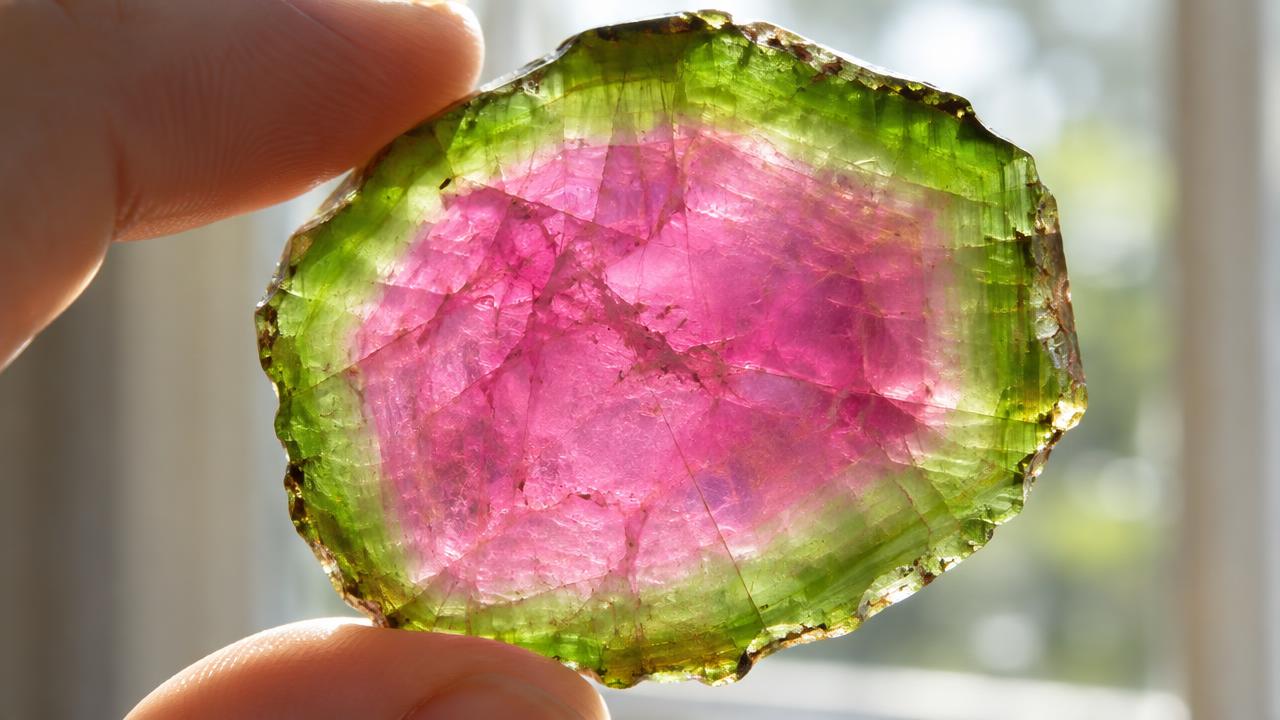
Watermelon tourmaline is a colour-zoned crystal, usually elbaite, with a pink or red core and a green rim. Sliced across, it looks strikingly like a slice of watermelon. Watermelon tourmaline records the history of its own growth. As a crystal grows in a pegmatite, the chemistry of the surrounding fluid changes. When manganese dominates, the crystal adds pink layers; when iron or other elements become more available, green layers follow. The result is a crystal with concentric colour zones.
There are two main ways the zoning appears:
- Across the crystal: a pink core wrapped in a green skin, revealed when the crystal is cut into thin slices.
- Along the crystal: one end pink, the other green, sometimes with a colourless band in between. These are often called bi-colour or parti-coloured tourmalines.
Slices are usually polished flat to show off the pattern, and fine examples come from Brazil, Madagascar, Afghanistan and the United States. Good watermelon colour with a clean, sharp boundary between pink and green is uncommon, which is why the best pieces are prized by collectors.
As a teaching object, a watermelon slice is unbeatable: it shows that a crystal does not appear all at once but grows outwards, layer by layer, like tree rings. Exploring the tourmaline colours in a single slice is a great way into geology for children, and our crystals quiz makes a fun follow-up.
💡 Did you know?
When tourmaline from Sri Lanka reached Europe with Dutch traders in the early 18th century, its habit of attracting and then repelling hot ash earned it the nickname Ceylon magnet, although the effect is electrical, not magnetic.
Why is tourmaline pyroelectric?
Tourmaline crystals lack a centre of symmetry, so their two ends are electrically different. When the temperature changes, positive and negative charges build up at opposite ends, attracting dust and light particles. In most crystals, the arrangement of atoms looks the same if you flip it end to end. Tourmaline’s structure does not: its two ends are chemically and electrically distinct. Even at rest, the crystal has a built-in electric polarisation. Normally this is quietly neutralised by stray charges from the air.
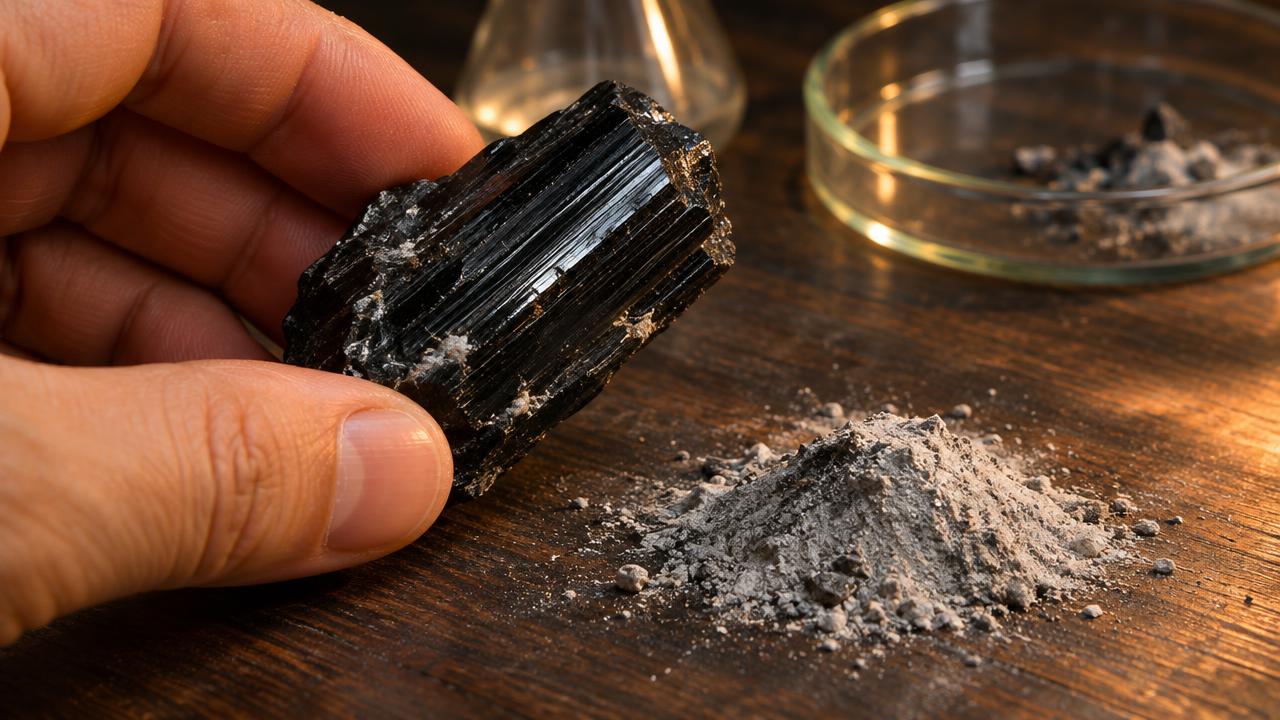
Change the temperature, and the polarisation shifts faster than the surface charges can rebalance. For a while, one end becomes positive and the other negative, and the crystal can attract small, light particles such as ash, dust or paper fragments. This is pyroelectricity, literally electricity from fire.
The history is a nice example of science moving from curiosity to explanation:
- Early 1700s: tourmaline from Sri Lanka reaches Europe, and its ability to attract ash becomes a curiosity.
- 1756: Franz Aepinus recognises the effect as electrical and shows that the two ends of a heated crystal carry opposite charges.
- 1759: John Canton shows that it is the change in temperature, not heat itself, that matters.
- 1824: David Brewster coins the term pyroelectricity.
A related effect, piezoelectricity, produces charge when the crystal is squeezed. Pierre and Jacques Curie demonstrated it in 1880 using crystals including tourmaline and quartz. If you enjoy invisible forces, pair this with our magnetism quiz.
How can you identify real tourmaline?
Look for elongated prisms with lengthwise striations and a rounded triangular cross-section, strong colour change with viewing angle, and hardness high enough to scratch glass. Gem identification needs a gemmologist’s instruments. For natural crystals, a few simple observations go a long way:
- Shape: long prisms, often with a rounded triangular outline when viewed from the end.
- Striations: fine parallel grooves running along the length of the crystal.
- Pleochroism: turn a transparent crystal; it often looks darker when viewed down its length.
- Hardness: 7 to 7.5, so it scratches window glass but not topaz.
- Weight: a little heavier in the hand than quartz of the same size.
For cut gemstones, home tests are not reliable. Glass imitations and other gems such as peridot, emerald or spinel can resemble tourmaline. A gemmologist measures the refractive index and double refraction with a refractometer and checks inclusions under magnification, which together identify tourmaline with confidence.
Collectors starting out often find it easiest to learn from labelled specimens. A mixed gemstones set lets you compare tourmaline with quartz, agate and other minerals side by side, and our nature and dig kits add the fun of uncovering specimens yourself. Test your eye afterwards with our volcanoes and geology quiz.
Our take: enjoying tourmaline for its science, not its myths
Tourmaline is fascinating enough on its own merits: a mineral family with a near-complete colour range and a genuine electrical property. Claims that it heals or protects people have no scientific support. You will often see tourmaline, especially black tourmaline, described as protective or energising in crystal-therapy circles. As science communicators, we prefer to be clear: lithotherapy has no scientific validation, and no controlled study has shown that wearing or holding a crystal affects health, mood or so-called energies. Enjoying a crystal for its beauty or as a personal ritual is entirely your choice, but it should not replace medical advice.
The real properties of tourmaline are more surprising than any myth:
- Electric charges that appear simply when the crystal warms or cools;
- A colour palette that maps directly onto chemistry;
- Growth zones that record the changing fluids in a pegmatite millions of years ago;
- Hardness and durability that let it survive erosion and turn up in river sands far from its source rock.
Tourmaline is also October’s birthstone, alongside opal, which makes it a thoughtful gift for an October birthday. Displayed on a shelf with other science decor, a crystal or a polished slice invites the question “how did this form?”, and that question is the start of every good geology conversation.
For more gift ideas around stones and crystals, see our geology gifts selection.
FAQ
Sources
- International Mineralogical Association, list of tourmaline-supergroup species
- Gemological Institute of America (GIA), tourmaline description and quality factors
- American Gem Society, tourmaline overview
- Mindat.org, schorl and schorl rock entries
- Lang, S. B., Sourcebook of Pyroelectricity (Gordon and Breach)