
The essential:
- Amethyst is a purple variety of quartz (silicon dioxide), rated 7 on the Mohs hardness scale.
- Its colour comes from traces of iron in the crystal lattice combined with natural irradiation, which creates colour centres.
- Many large Brazilian and Uruguayan specimens grew in cavities of lavas about 135 million years old, from fluids mostly below 80°C.
- Heating can turn amethyst yellow or brown, and long exposure to strong light can fade its tone.
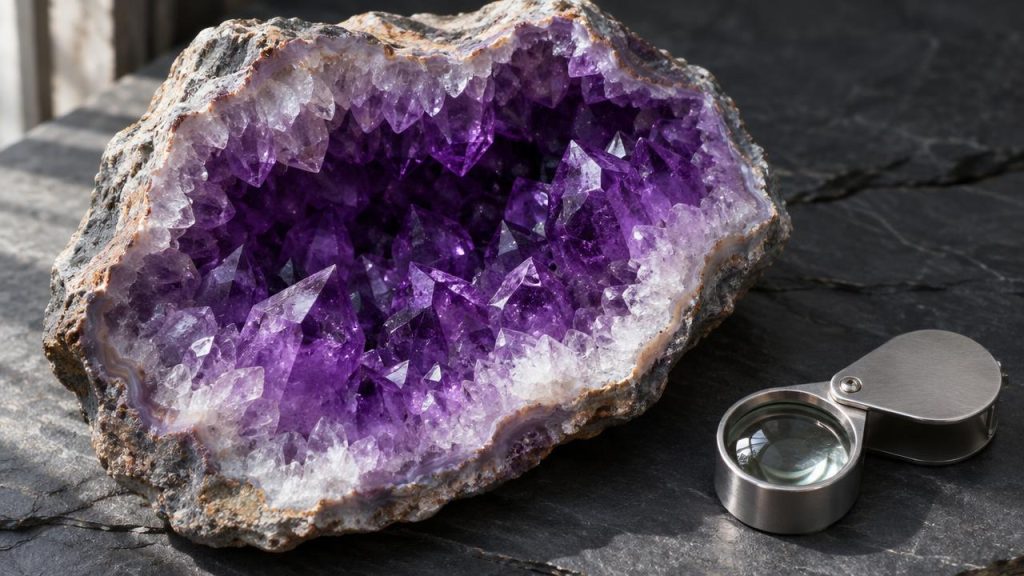
Amethyst is the most popular purple stone in the world, and also one of the most misunderstood. Behind the violet glitter is ordinary quartz, the same mineral as beach sand, transformed by a few atoms of iron and a dose of natural radiation over immense spans of time.
This guide explains what amethyst actually is, how those crystal-lined cavities form, why the colour is purple (and why it can fade), how hard the stone is in practice, and the simple checks that help you spot glass, dyed quartz and other fakes. No mysticism, just mineralogy you can test on your own specimens.
📋 Table of contents
What is amethyst?
Amethyst is the purple variety of quartz, with the chemical formula SiO2. It shares quartz’s crystal structure, hardness and density, and differs only in its colour, caused by trace iron and natural irradiation. Quartz is one of the most common minerals on Earth, and it comes in many varieties. Rock crystal is colourless, smoky quartz is brown to grey, citrine is yellow and rose quartz is pink. Amethyst is the violet member of that family.
Gemmologists at GIA, the Gemological Institute of America, list its key properties as:
- a refractive index of 1.544 to 1.553;
- a specific gravity (density relative to water) of about 2.66;
- a hardness of 7 on the Mohs scale.
The name has a famous origin. It comes from the ancient Greek amethystos, meaning “not drunk”, because the Greeks believed the stone protected its wearer from intoxication. That is folklore, of course, but it shows how long people have prized it. GIA notes that amethyst was once as expensive as ruby and emerald, until large deposits discovered in Brazil in the 19th century made it widely affordable.
If you are new to mineral identification, the beginner’s guide to rocks and minerals explains the scratch and streak tests used throughout this article. Amethyst is also the traditional birthstone for February.
How does amethyst form?
Most large specimens grow inside cavities in old volcanic rock. Silica-rich groundwater seeps into the hollows and, over very long periods, deposits layers of chalcedony and then quartz crystals pointing inward. The best-known deposits sit in the Paraná volcanic province of southern Brazil and northern Uruguay. Research published in the Anais da Academia Brasileira de Ciências dates these lavas to about 135 million years old. The cavities, often called geodes, started as hollows in the lava flows.
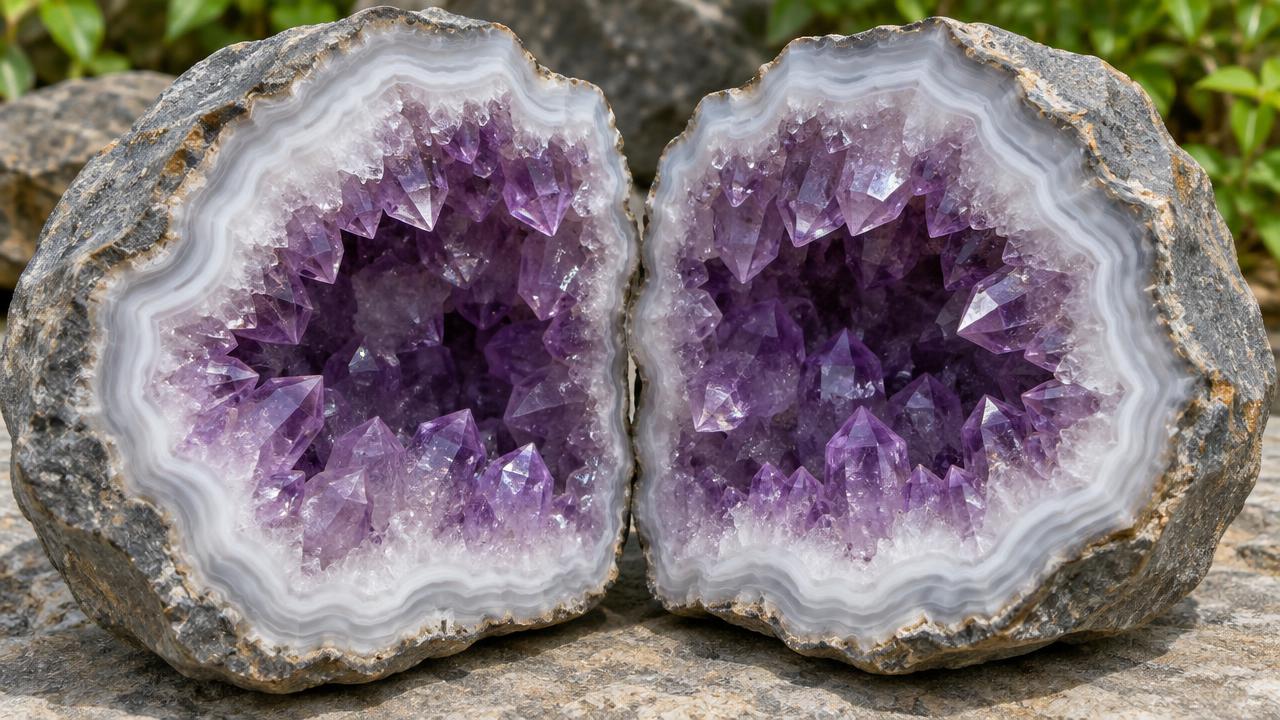
For a long time it was assumed the crystals grew from hot volcanic gases. More recent work points to a quieter story. Oxygen isotope studies indicate that the geode minerals mostly formed at low temperatures, commonly below 80°C, from silica-bearing water that rose from an aquifer beneath the lavas long after they had cooled.
The sequence inside a typical cavity is:
- a thin outer rind, often of altered rock or green clay;
- a layer of banded chalcedony (microcrystalline quartz);
- coarse quartz crystals growing toward the centre, which turn violet where iron is present.
Splitting a Break Your Own Geode is the most direct way to see that structure for yourself, rind, banding and crystals in one cross-section. Smaller crystal-lined cavities, like the sky-blue celestine of the Blue Geode, form by a similar process but with a different mineral.
💡 Did you know?
GIA once displayed a doubly terminated amethyst crystal weighing 164 pounds, about 74 kg, at its museum. A single crystal that size shows how long and stable the growing conditions must have been.

🛍️ Our pick
Break Your Own Geode
Unopened geodes to crack yourself: the moment you split one and see the crystals inside never gets old.
£26.49 · ★ 37 sold
Discover →Why is amethyst purple?
Amethyst is purple because iron atoms replace a few silicon atoms in the quartz lattice. Natural gamma radiation from surrounding rocks then knocks an electron from that iron, creating a colour centre that absorbs yellow-green light. Pure quartz is colourless. In amethyst, a very small amount of iron sits inside the crystal structure. On its own, that iron does not make the stone purple. The colour appears only after the crystal has been exposed to ionising radiation over geological time, usually from traces of radioactive elements in nearby rocks.
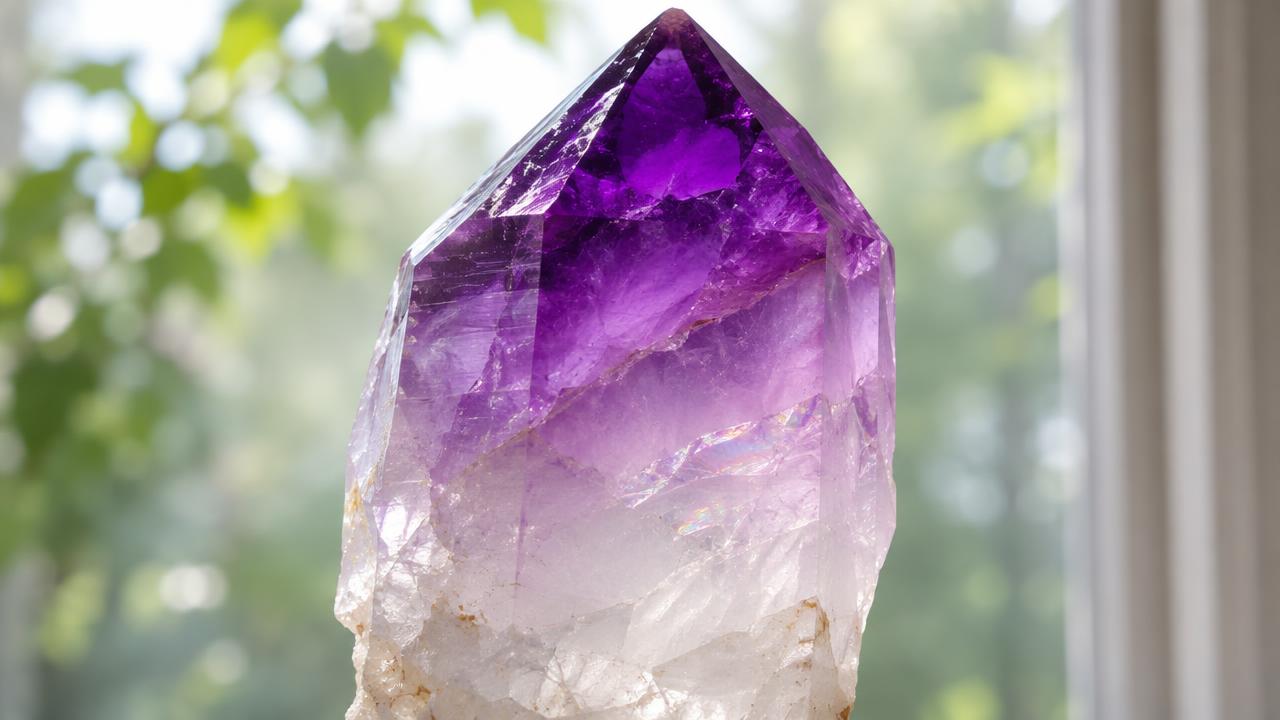
The radiation changes the electronic state of the iron, forming what physicists call a colour centre. This centre absorbs part of the visible spectrum, and the light that passes through looks violet to our eyes. The process can even be reproduced in the laboratory: irradiating iron-bearing colourless quartz can produce amethyst-like colour.
This explains three things collectors notice:
- Colour zoning: iron is not spread evenly, so many crystals have deeper purple tips and paler bases.
- Fading: strong light over long periods can gradually weaken the colour, so specimens are best kept away from bright sunny windows.
- Heat sensitivity: heating partly reverses the radiation effect, which is why heated amethyst can turn yellow or brown.
GIA describes the finest amethyst colour as a strong reddish purple to pure purple without visible zoning.
⭐ Key takeaway
The purple of amethyst is not a dye or a pigment. It is a defect in the crystal created by iron and radiation together, which is why heat and long, intense light exposure can change it.
Amethyst hardness: how durable is it?
Amethyst has a Mohs hardness of 7, the same as all quartz. It scratches window glass and steel but can be scratched by topaz, corundum and diamond, and by sand-laden dust over time. Hardness 7 makes amethyst tough enough for everyday rings and pendants, which is one reason it is so widely used in jewellery. Still, a few precautions help it keep its polish:
- store it separately from diamonds and sapphires, which are harder and will scratch it;
- clean it with warm soapy water and a soft brush;
- avoid sudden temperature changes, which can crack included stones;
- keep display pieces away from strong direct sunlight to protect the colour.
Hardness is also one of your best identification tools. A genuine amethyst point, pressed firmly across a scrap of glass, leaves a clear scratch. Many purple imitations made of glass are around 5.5 and will not. Test only on an unseen edge, never on a polished face you want to keep perfect.
A boxed Gemstones Set is handy here: comparing amethyst with labelled specimens of different hardness quickly trains your eye and your scratch technique.
| Property | Amethyst | Purple glass imitation | Synthetic amethyst |
|---|---|---|---|
| Composition | SiO2 (quartz) | Silica glass with additives | SiO2 (quartz) |
| Mohs hardness | 7 | About 5.5 | 7 |
| Internal structure | Crystalline, often colour-zoned | No crystal structure, may contain round bubbles | Crystalline, grown in an autoclave |
| Feel at room temperature | Cool for longer | Warms quickly | Cool for longer |
| How to confirm | Hardness, zoning, lens | Bubbles, swirl marks, scratch test | Gem laboratory testing |
Real vs fake amethyst: how can you tell?
Look for natural colour zoning, tiny natural inclusions and a hardness of 7. Glass imitations show round gas bubbles, swirl lines and a softer surface, while dyed quartz often has colour concentrated in cracks. There are four kinds of “not quite” amethyst on the market, and each has its own clue.
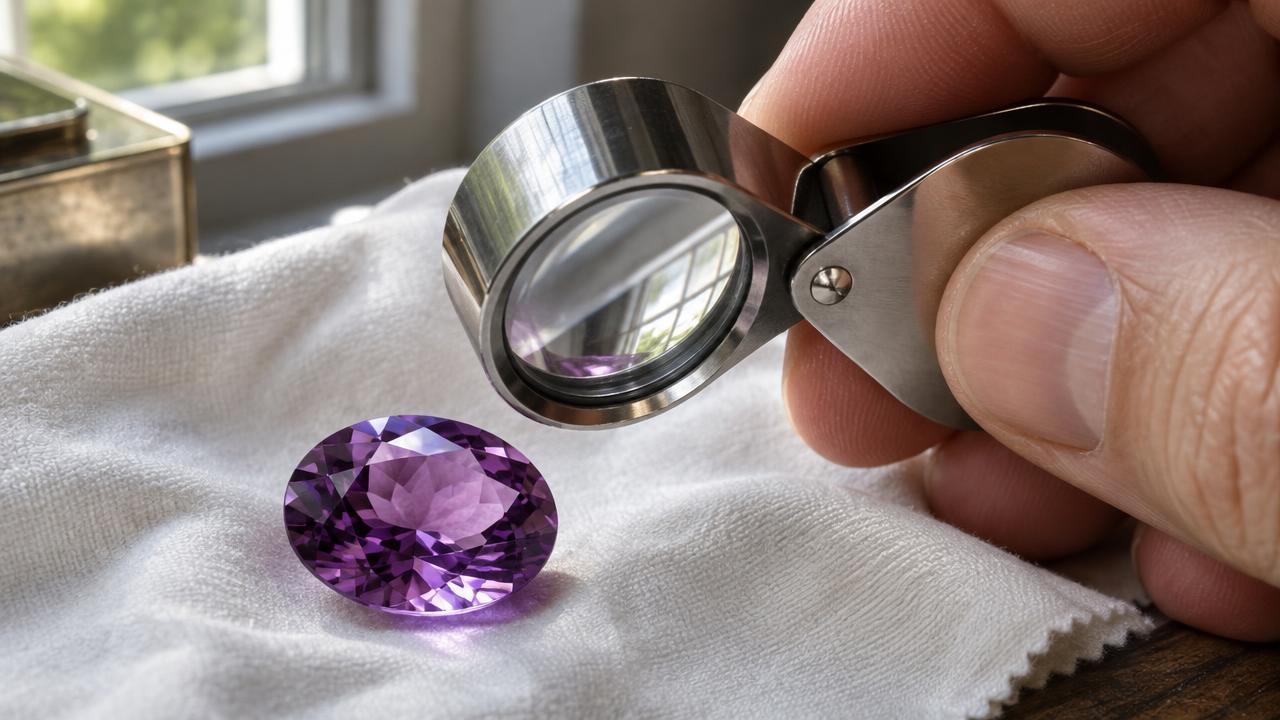
- Glass: under a ten-times hand lens, look for perfectly round bubbles and curved flow lines. Glass also warms in your hand faster than quartz and is easier to scratch.
- Dyed quartz: colourless or cracked quartz is sometimes soaked in dye. The colour gathers in fractures and on surfaces, and the inside looks paler. A cotton bud with a little acetone, used on a hidden spot, can lift some dyes.
- Synthetic amethyst: grown hydrothermally in high-pressure autoclaves, it has the same chemistry and hardness as natural stone. Separating it usually needs a gem laboratory, which can examine twinning patterns (Brazil-law twinning) inside the crystal.
- Heated amethyst sold as citrine: much commercial citrine is heated amethyst. It loses the dichroism, a subtle two-tone effect, that natural citrine keeps.
Perfectly even, intensely saturated colour at a very low price is a warning sign. Natural amethyst usually shows some variation, from paler bases to deeper tips.
Finally, buy from sellers who describe their stones honestly, including treatments. A clear label is worth more than any claim about energy or vibrations.
Where does amethyst come from?
Major sources include Brazil and Uruguay, which supply most large crystal-lined cavities, as well as Zambia, Bolivia and Mexico. Each locality tends to produce a recognisable colour and crystal habit. Brazil has been the dominant supplier since the 19th century, with famous production in Rio Grande do Sul in the far south and in Bahia further north. Across the border, the Artigas region of northern Uruguay is another major producer; a crystal-lined cavity from Artigas about 3.7 metres tall is displayed at the American Museum of Natural History in New York.
Other notable localities include:
- Zambia, now one of the world’s largest producers, with output of around 1,000 tonnes a year;
- Bolivia, home of ametrine, where purple amethyst and yellow citrine zones share a single crystal;
- Mexico, which produces smaller quantities prized by collectors;
- Canada and Morocco, studied by GIA for distinctive local material.
Britain is not a significant commercial source. The Natural History Museum in London holds world-class specimens if you want to see the variety in person.
At home, a crystal-lined cavity makes a natural centrepiece for a science shelf. The Amethyst Geode shows the full crystal lining, and you will find complementary specimens in the crystal specimens range and among the decorative pieces in Science Decor.

🛍️ Our pick
Amethyst Geode
A natural amethyst geode with intact purple crystal points, perfect for seeing quartz structure and iron-coloured hues up close.
From £47.99 · ★ 12 sold
Discover →Is there scientific evidence for crystal healing?
No. There is no scientific validation for crystal healing or lithotherapy. Controlled studies have not shown that holding or wearing a stone produces effects beyond what people expect to feel. Amethyst is surrounded by claims about calm, sleep and energy. As a science communicator I would rather be honest: none of these has been demonstrated in controlled testing, and there is no known physical mechanism by which a quartz crystal could produce them. Any good feeling comes from the beauty of the object and from expectation, which is real but is not a property of the mineral.
That does not make amethyst less interesting. Each crystal records the chemistry of groundwater, the slow trickle of radiation from surrounding rock and the cooling history of a lava field. That is a remarkable story, and it happens to be true.
If anyone you know is drawn to crystals for wellbeing reasons, the best gift may be curiosity: a hand lens, a scratch test, a look at colour zoning under a lamp. The crystals quiz is a friendly way to test what you have learned, and the volcanoes and geology quiz connects amethyst back to the lavas that host it.
Never use a crystal as a substitute for medical advice or treatment.
Our take: what makes a good amethyst specimen?
Choose by colour depth, crystal sharpness and honesty of description. A modest specimen with clearly stated origin and treatment teaches more than a dazzling stone with a vague label. When I chose minerals for museum handling trays, three questions guided every decision: can a visitor see the crystal shape clearly, is the colour natural, and do we know where it came from? The same questions work at home.
- Colour: a medium to deep purple with gentle zoning is typical of natural stone. Uniform neon violet deserves a second look.
- Crystals: sharp, undamaged terminations show the six-sided quartz form beautifully under a lamp.
- Description: locality and any treatment should be stated plainly.
Store specimens out of direct sunlight, dust them gently with a soft brush and enjoy them for what they are: purple quartz, coloured by iron and time. For children, a split-it-yourself cavity is often the moment geology clicks, because they see the crystals for the very first time.
Amethyst does not need invented powers. Its genuine science is a better story.
Looking for a present for a crystal lover? Our geology gifts page brings together geodes, mineral sets and crystal decor.
FAQ
Sources
- Gemological Institute of America (GIA), Gem Encyclopedia: Amethyst
- Anais da Academia Brasileira de Ciências, studies of amethyst geode deposits in the Paraná volcanic province
- Natural History Museum, London, mineral collections
- Encyclopaedia Britannica, Mohs hardness