

L’essentiel :
- A levitating globe uses an electromagnetic base with a Hall effect sensor to hold a lightweight sphere in mid-air, continuously correcting for gravity thousands of times per second.
- Static magnets alone cannot achieve stable levitation, this is a physical law known as Earnshaw’s theorem (1842), which is why every genuine floating globe hides active electronics inside its base.
- Most models float a globe weighing between 140g and 580g, spin gently thanks to a small motor or airflow, and run on a 12V adapter costing pennies a day.
- For a UK buyer, the real differentiators are build quality of the coil, noise level, and whether the LED colours are true RGB or a fixed set.
There is something quietly theatrical about a small world hovering above its own base, turning slowly with no visible support. As someone who has spent years explaining physics to museum visitors and now curates objects for people’s homes, I still find myself pausing every time I switch one on. It is not magic. It is a rather elegant piece of nineteenth and twentieth century physics dressed up as a desk ornament.
📋 Table of contents
- What Is a Levitating Globe?
- How Does a Levitating Globe Work?
- How to Make a Levitating Globe?
- What Are Levitating Lamps?
- What Is a Rotating Globe With Light?
- Is a Levitating Globe Good for STEM Learning?
- Our Verdict: Is It Worth Buying?
- Troubleshooting Common Levitation Problems
- Mini FAQ
- A Small Piece of Physics for the Living Room
What Is a Levitating Globe?
A levitating globe is a decorative sphere, usually a miniature world map, that floats and rotates above a magnetic base without any physical contact. The floating effect comes from an electromagnetic coil hidden in the base, not from static magnets glued inside the globe, which is the detail most listings gloss over. The globe itself contains a small permanent magnet, and the base uses a sensor to constantly adjust the strength of an electromagnet so the two forces stay in perfect balance.
The category exploded in popularity through Amazon and Etsy listings promising ‘anti-gravity’ desk decor, but the underlying technology dates back much further than the current wave of geography-themed novelty gifts.
How Does a Levitating Globe Work?
A levitating globe works through active magnetic levitation, meaning an electronic feedback loop rather than passive magnets holds the object in the air. In 1842, mathematician Samuel Earnshaw proved that no arrangement of static magnets can produce a stable equilibrium in a magnetic field, a result now known as Earnshaw’s theorem. In plain terms, fixed magnets alone will always either snap together or fly apart, they cannot simply hover.

To get around this, engineers add a Hall effect sensor, a small component that measures the distance between the globe’s internal magnet and the base. This sensor feeds data to a microcontroller roughly a thousand times per second, which increases or decreases current to the electromagnet coil to keep the globe suspended at a fixed height, typically between 1.5 and 3cm above the base. This constant micro-correction is precisely why the globe never sits perfectly still, it trembles almost imperceptibly, which is actually a sign the electronics are working correctly rather than a fault.
💡 Did you know?
Maglev trains in Japan and China use the same core principle, active electromagnetic feedback, to hover millimetres above their tracks, reaching speeds over 600 km/h according to Central Japan Railway Company’s own test records. Your desk globe is essentially a tabletop maglev demonstration.
Rotation is usually generated separately, either by a tiny motor turning the base’s magnetic field or, in some designs, by the airflow from the globe’s own cooling fan. That second method is why some cheaper globes spin erratically depending on room temperature.
How to Make a Levitating Globe?
You cannot reliably build a stable levitating globe from static magnets alone, you need an active electromagnetic base with a feedback sensor, which is why most hobbyist attempts fail or wobble uncontrollably. DIY kits exist for enthusiasts comfortable with basic electronics, typically involving:

🛍️ Our pick
Levitating Globe
The levitating globe uses magnets to float in mid-air, illustrating the magnetic principles explained in this guide.
£50.49 Shop now →
- An electromagnet coil wound around a ferrite core
- A Hall effect or infrared distance sensor
- A microcontroller such as an Arduino to run the feedback loop
- A neodymium magnet embedded in the object to be levitated
For most people, buying a finished unit is far more practical and considerably safer than winding your own coils. If you enjoy the tinkering side of things, our DIY Stirling Engine Kit offers a similarly hands-on introduction to physics you assemble yourself, without the risk of a wobbling globe crashing off a shelf.
⭐ Key takeaway
À retenir : if a seller markets a globe as levitating but the listing never mentions a power adapter, be suspicious. Genuine magnetic levitation always requires mains or USB power for the electromagnet, there is no battery-free version that actually floats stably.
What Are Levitating Lamps?
Levitating lamps are the same core technology applied to light fixtures rather than globes, typically a floating LED bulb or moon-shaped orb hovering above a wooden or acrylic base. They share the identical electromagnet-and-sensor mechanism described above, simply swapping the geography theme for ambient lighting. Fans of the floating effect but less interested in world maps often prefer these, and the same buying advice applies: check for genuine active levitation electronics rather than a static magnet gimmick.
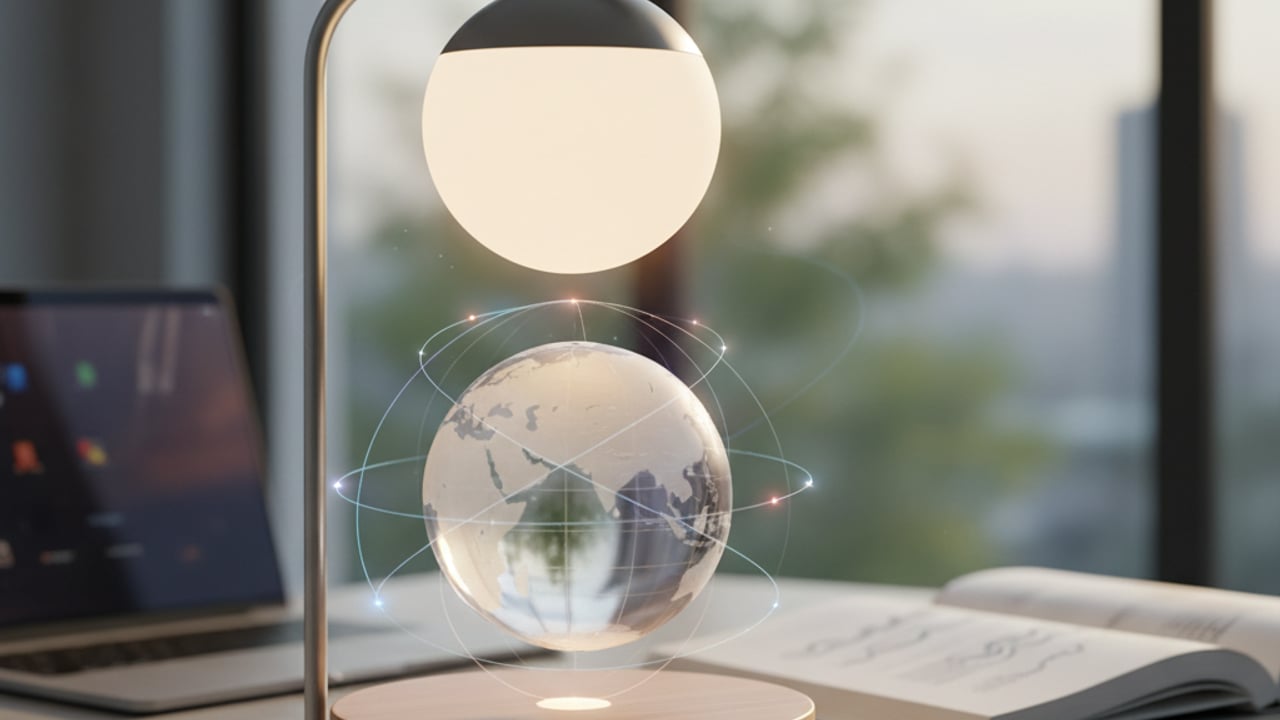
If you like the idea of magnetism as a design language rather than just a floating trick, our Rainbow Magnetic Balls and Magic Spinner both explore magnetic forces in a tactile, sculptural way that pairs nicely on a shelf alongside a floating globe.
What Is a Rotating Globe With Light?
A rotating globe with light is a levitating globe fitted with LED elements inside its base or the sphere itself, usually offering between one and seven colour modes. Most models on the UK market in 2026 use RGB LEDs that cycle automatically or can be fixed to a single tone via a touch button on the base. The light serves two purposes: it makes the floating effect more visible in a darkened room, and it turns the object into a genuine night light for a bedroom or study.
Comparing the main types available
| Feature | Standard LED (single colour) | 7-Colour RGB | Illuminated map detail |
|---|---|---|---|
| Best for | Subtle desk decor | Statement gift, kids’ rooms | Geography enthusiasts |
| Typical price (UK) | £25 to £40 | £35 to £60 | £45 to £80 |
| Power draw | Low | Slightly higher | Moderate |
Is a Levitating Globe Good for STEM Learning?
Yes, a levitating globe is a genuinely useful, hands-on way to introduce children and teenagers to concepts of magnetism, gravity, and feedback systems, not just geography. Rather than simply telling a curious child that opposite poles attract, you can point to the very object hovering in front of them and explain why it needs constant electronic adjustment to stay up. This makes it a stronger conversation piece for STEM-minded families than a purely decorative ornament.

Recommended age is generally 8 and above given the small magnetic components and mains adapter, and adult supervision is advised when younger children handle the base. For a broader magnetism-based educational display, our Magnetic Solar System extends the same principle to an entire orbiting system, while a Magnetic Perpetual Calendar makes a nice, calmer desk companion for anyone who prefers gentler physics-inspired decor.
💡 Did you know?
Nikola Tesla experimented with electromagnetic fields for wireless power transmission in the 1890s at his Colorado Springs laboratory, work that indirectly laid groundwork for the feedback principles used in today’s levitation electronics.
Our Verdict: Is It Worth Buying?
Having tested several units over the years, my honest view is that a well-made levitating globe earns its place on a desk far more than most tech gadgets do, provided you buy from a source that specifies the coil wattage and sensor type rather than just showing a floating photo. Cheaper units under £20 tend to have noisy coils and inconsistent rotation, while mid-range models between £30 and £60 offer noticeably smoother, quieter levitation. It remains a decorative object first, not a precision instrument, and treating it as a fun conversation piece rather than a scientific measuring tool keeps expectations realistic.
Troubleshooting Common Levitation Problems
- The globe won’t float: check the adapter voltage matches the base’s rating, and ensure the globe’s magnet is correctly aligned, usually marked with a small dot or arrow.
- It floats but doesn’t spin: gently give it a manual spin to start, some models rely on initial momentum rather than a built-in motor.
- It drifts to one side then falls: the base may be on an uneven or tilted surface, magnetic levitation is sensitive to a level base within a few millimetres.
⭐ Key takeaway
À retenir : always place a levitating globe away from other strong magnets, speakers, or magnetic phone stands, external fields can interfere with the sensor and cause the globe to drop unexpectedly.
Mini FAQ
A Small Piece of Physics for the Living Room
Part of the appeal of a levitating globe, at least for me, is that it refuses to be just decor. Every time a guest asks how on earth it stays up, you get to explain Earnshaw’s theorem, Hall sensors, and a little slice of the same engineering behind maglev trains, all from a five-inch sphere on a bookshelf. For browsers exploring the wider world of physics-inspired objects, our Cool Gadgets collection gathers several other pieces that turn a real scientific principle into something you can actually enjoy looking at every day.
While magnetic levitation defies gravity in fascinating ways, you might also be intrigued by the latest projection technology advances that create stunning holographic displays.
Sources
- Samuel Earnshaw, ‘On the nature of the molecular forces which regulate the constitution of the luminiferous ether’, Transactions of the Cambridge Philosophical Society, 1842
- Central Japan Railway Company, public technical data on SCMaglev test speeds
- Tesla Science Center at Wardenclyffe, historical archives on Nikola Tesla’s Colorado Springs experiments