
The essential:
- All 10 Christmas science experiments here use household items such as vinegar, bicarbonate of soda, salt, raisins and red cabbage.
- Table salt dissolves at about 35.7 g per 100 ml of water at 20°C, which is why hot water helps you make a saturated crystal solution.
- Red cabbage juice turns red in acids and green to yellow in strong alkalis, giving you a ready-made Christmas colour palette.
- Every activity needs an adult nearby, and anything involving hot water, button batteries or cleaning products needs an adult in charge.
Christmas science experiments are the easiest way I know to fill a December afternoon with genuine curiosity: a jar of vinegar, a spoon of bicarbonate of soda and a curious child will out-fizz any shop-bought toy. In museum workshops, the question I heard most often in December was not “how does it work?” but “can I do that at home?”, and the honest answer is almost always yes.
Below you will find ten festive experiments, sorted from the quickest to the slowest, each with a shopping list from the kitchen cupboard, a short explanation of the science and a supervision note. There is also a plan for turning them into science advent activities, plus a comparison table to help you choose by age and time.
📋 Table of contents
- What are the best Christmas science experiments for kids at home?
- How do you make fizzing snow and a mini volcano?
- Why do raisins dance in fizzy water?
- How can red cabbage make Christmas colours?
- Do candy canes dissolve faster in hot or cold water?
- How do you grow salt crystal snowflakes for Christmas?
- Which festive STEM experiments explore physics?
- How do you turn Christmas science experiments into science advent activities?
- Our take: which experiments are worth your December afternoons?
- FAQ
What are the best Christmas science experiments for kids at home?
The best ones are quick, cheap and visibly dramatic: fizzing snow, dancing raisins, a colour-changing cabbage indicator and homemade salt crystals all work with kitchen ingredients and deliver a clear result in minutes or days. Good festive experiments share three qualities. They use things you already own, they show a change you can see, and they lead naturally to a “why?” question. Here are the ten ideas covered in this guide:
- Fizzing snow: bicarbonate of soda and vinegar, a classic acid and base reaction.
- Dancing raisins: carbon dioxide bubbles lifting dried fruit in fizzy water.
- Red and green cabbage indicator: a natural pH test in Christmas colours.
- Melting candy canes: how temperature speeds up dissolving.
- Salt crystal snowflakes: growing crystals on a pipe cleaner.
- Ice fishing with salt: lifting an ice cube with a piece of string.
- Floating satsumas: density and trapped air in the peel.
- Jumping tinsel: static electricity from a balloon.
- Pine cone weather station: a cone that opens and closes with humidity.
- Light-up Christmas card: a first electrical circuit.
If you want ready-made versions with proper equipment, the Science Kits collection covers chemistry, physics and engineering for most ages, but everything below can be done with no special kit at all.
⭐ Key takeaway
Choose experiments by the reaction your child will see, not by the ingredient list. A visible change in under five minutes keeps younger children engaged; slow experiments such as crystal growing suit children who enjoy checking on something every day.
How do you make fizzing snow and a mini volcano?
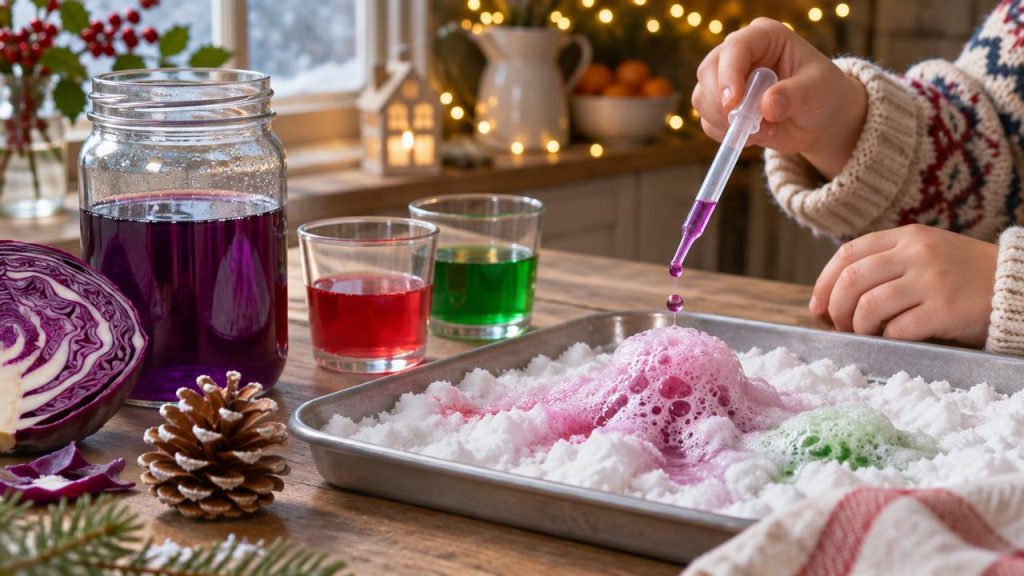
Mix bicarbonate of soda with a little cold water or hair conditioner to make mouldable snow, then pour on vinegar. The acid reacts with the bicarbonate and releases carbon dioxide gas, which makes the fizz. For fizzing snow, stir about two cups of bicarbonate of soda with enough cold water to make it clump like real snow. Pack it into small snowballs or a snowman shape on a baking tray. Hand your child a pipette or teaspoon of vinegar (add a drop of food colouring for drama) and let them drip it on.
The science: vinegar contains acetic acid, and bicarbonate of soda is a base. When they meet, they react to form water, a salt (sodium acetate) and carbon dioxide. The gas escapes as bubbles, which is why the snow foams and slowly collapses.
Shape the same mixture into a cone around a small cup and you have a winter volcano. Add a squeeze of washing-up liquid to the vinegar and the foam becomes thicker and slower, much closer to a real lava flow. For a bigger build with a paintable crater, the Volcano Science Kit takes the same reaction and turns it into a proper modelling project.
Supervision note: vinegar stings in the eyes. Keep a cloth nearby, work on a tray, and do not let children taste the mixture.

🛍️ Our pick
Volcano Science Kit
Build and paint your own volcano, then make it erupt with a safe acid and base reaction: a classic chemistry demo kids can repeat again and again.
£33.49 Discover →
Why do raisins dance in fizzy water?
Carbon dioxide bubbles cling to the wrinkled surface of each raisin until it becomes buoyant enough to rise. At the surface the bubbles pop, the raisin sinks again, and the cycle repeats for several minutes. You need a tall clear glass, fizzy water or clear lemonade, and a small handful of raisins. Pour the drink, drop in five or six raisins, and watch. At first they sink, because a raisin is denser than the liquid. Within a minute, tiny bubbles gather in the folds of the skin.
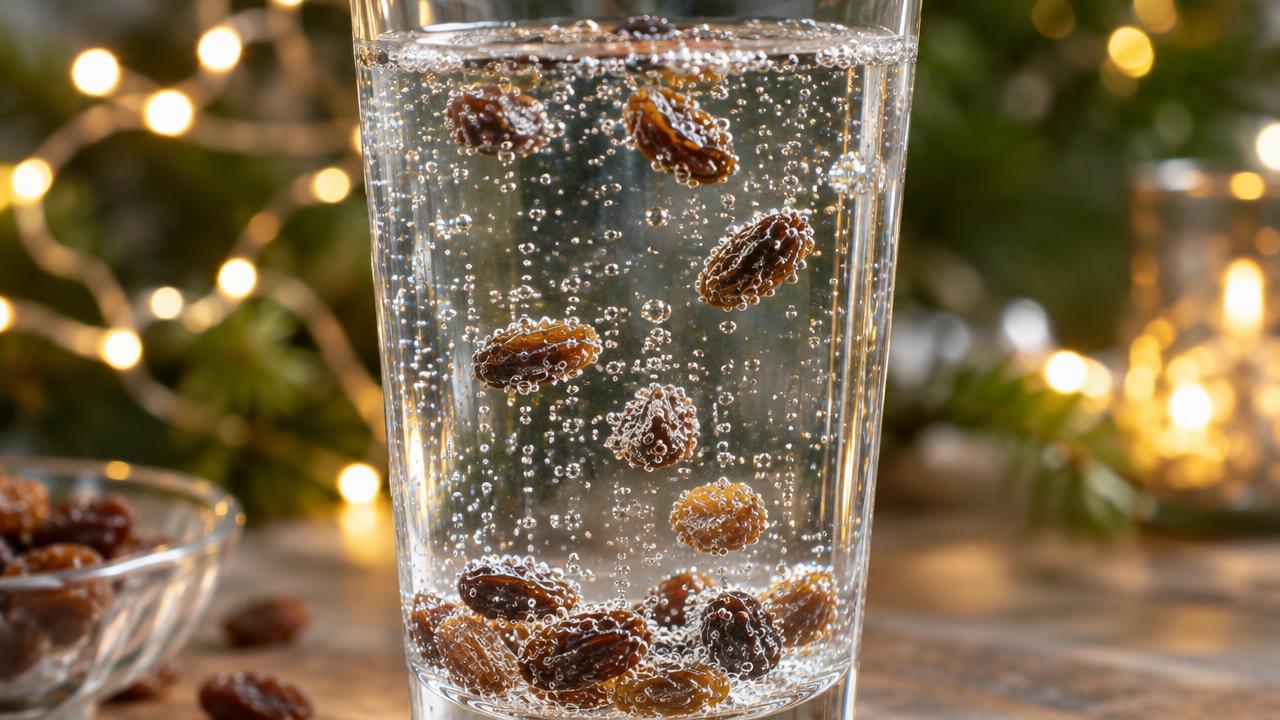
Each bubble adds volume without adding much mass, so the average density of “raisin plus bubbles” falls below that of the drink. Up it goes. At the surface the bubbles burst into the air, the raisin becomes dense again and drops back down. Children love calling it a Christmas disco.
Try these variations to turn the trick into a proper investigation:
- Swap raisins for dried cranberries, sultanas or a piece of uncooked pasta and compare.
- Use a freshly opened bottle and one opened the day before: which makes the raisins dance longer?
- Try still water as a control, so your child sees that the gas is doing the work.
Supervision note: very safe, though small children should not eat raisins that have been handled and dunked repeatedly.
💡 Did you know?
Christmas and science have a long shared history in Britain. The Royal Institution Christmas Lectures for young people began in 1825, and Michael Faraday gave them nineteen times, including his famous series The Chemical History of a Candle in 1848.
How can red cabbage make Christmas colours?
Red cabbage contains pigments called anthocyanins that change colour with pH. The purple juice turns red in acids such as vinegar and green to yellow in alkalis such as bicarbonate of soda solution. Chop a quarter of a red cabbage, cover it with hot water from the kettle and leave it for about 20 minutes. An adult should handle the hot water and the straining. Once cool, strain the deep purple liquid into a jug. That is your indicator.
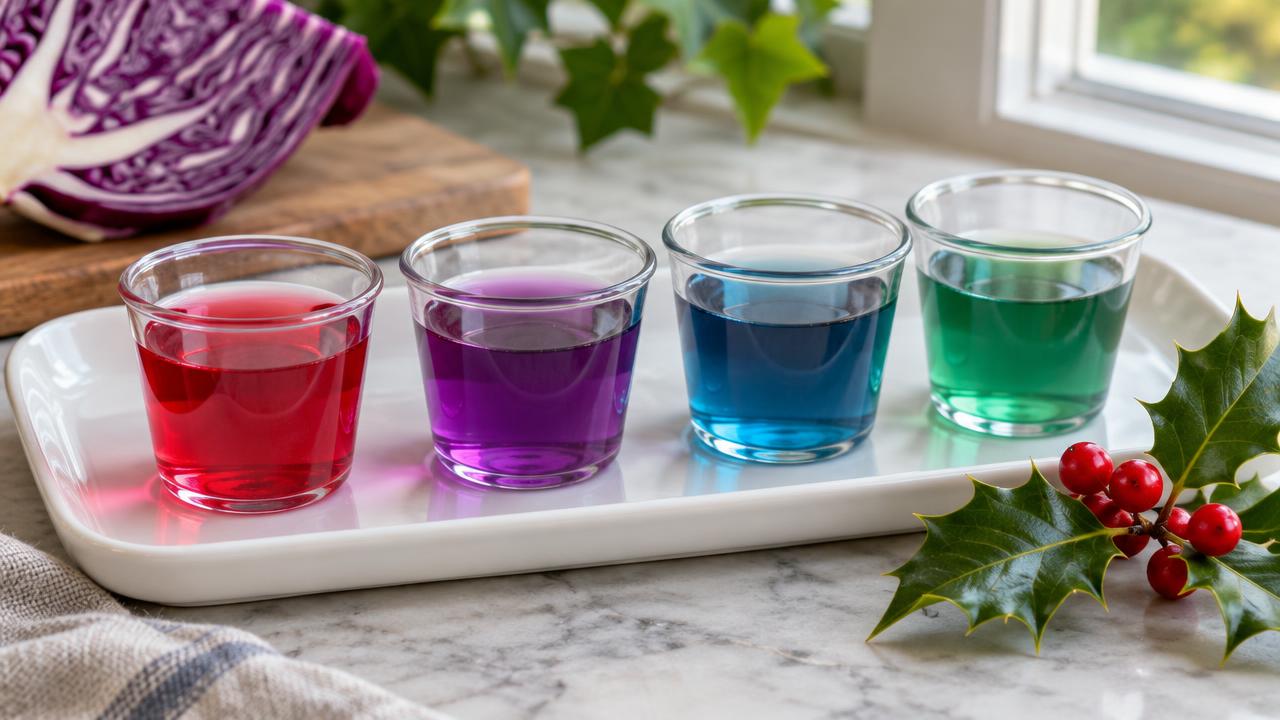
Set out small clear cups and add a splash of indicator to each. Then test, one at a time:
- Vinegar or lemon juice: the juice turns pink to red.
- Tap water: it stays roughly purple.
- Bicarbonate of soda dissolved in water: it shifts to blue or green.
Red and green on the same tray makes a surprisingly festive display. The Royal Horticultural Society uses the same activity in its school gardening resources because it links plants directly to chemistry. For a child who catches the bug, the Chemistry and Crystals range offers the next step up, with proper test tubes and safer reagents.
Supervision note: stick to food ingredients for younger children. Strong alkalis such as oven cleaner or bleach must never be tested; they are corrosive and give dangerous fumes when mixed with acids.
Do candy canes dissolve faster in hot or cold water?
Yes, they dissolve much faster in hot water. Warmer water molecules move faster, so they pull sugar away from the surface of the sweet more quickly than cold water does. This is a perfect fair-test experiment for primary school age. Fill three identical clear glasses with the same amount of water: one cold from the fridge, one at room temperature and one warm from the tap (not boiling). Drop an identical candy cane or striped peppermint sweet into each at the same moment and start a timer.
Within a few minutes the warm glass shows red stripes bleeding into the water and the cane starting to thin. The cold glass barely changes. Encourage your child to write down what they see every two minutes, because recording results is half of real science.
The science: dissolving happens at the surface, where water molecules surround sugar molecules and carry them away. Heat gives water molecules more energy, so they collide with the sweet more often and more forcefully. Stirring has a similar effect, which makes a good second experiment.
Ask your child to predict before each test. Predicting and then checking is the habit that turns a fun trick into a scientific method, and it costs nothing more than a few sweets.
Supervision note: keep water warm rather than hot, and let an adult fill the warm glass.
How do you grow salt crystal snowflakes for Christmas?
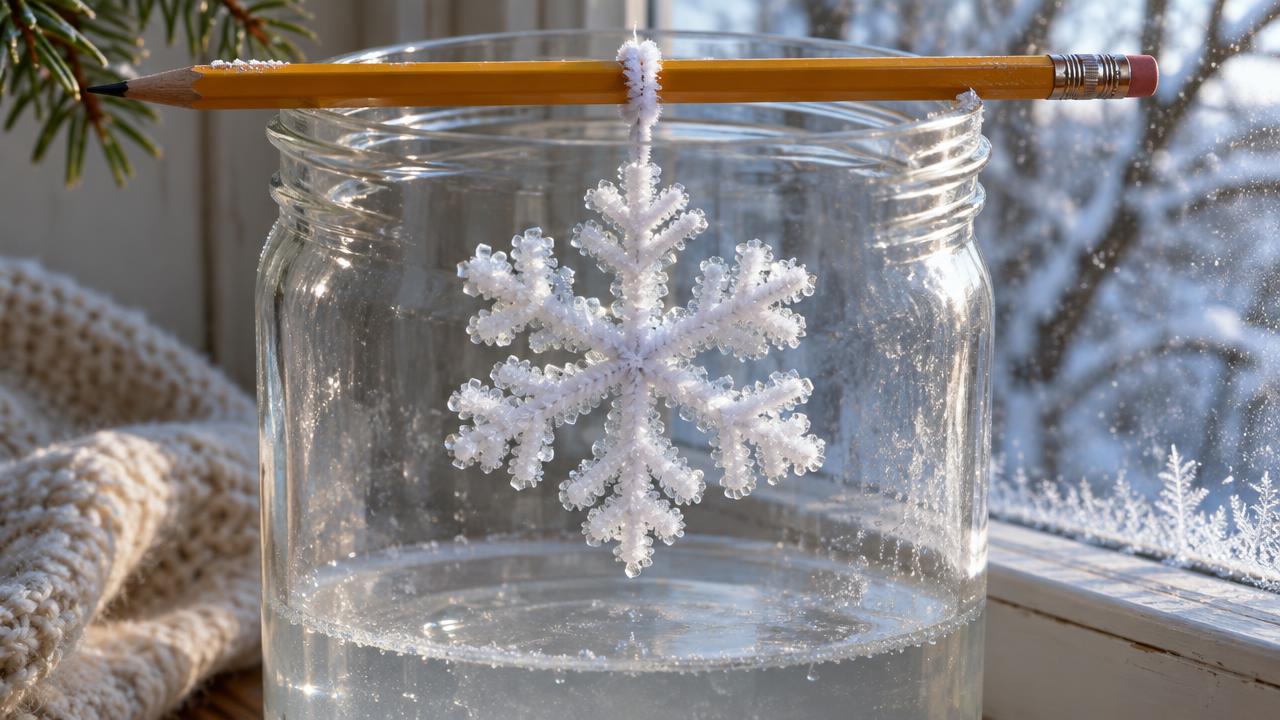
Dissolve as much salt as possible in hot water, hang a pipe-cleaner snowflake in the solution and leave it somewhere still. As water evaporates, salt comes out of solution and builds crystals on the pipe cleaner over several days. Bend white pipe cleaners into a six-armed snowflake and tie it to a pencil with thread so it can hang inside a jar without touching the sides. An adult then pours hot water into the jar and stirs in table salt a spoonful at a time until no more dissolves. At 20°C, about 35.7 g of salt dissolves in 100 ml of water, so expect to use a lot.
Lower the snowflake in, rest the pencil across the rim and put the jar somewhere it will not be knocked. As the solution cools and slowly evaporates, it holds less salt than it did, so the extra salt settles onto the fuzzy fibres as tiny cubes. Salt crystals are cubic because sodium and chloride ions stack in a cubic lattice.
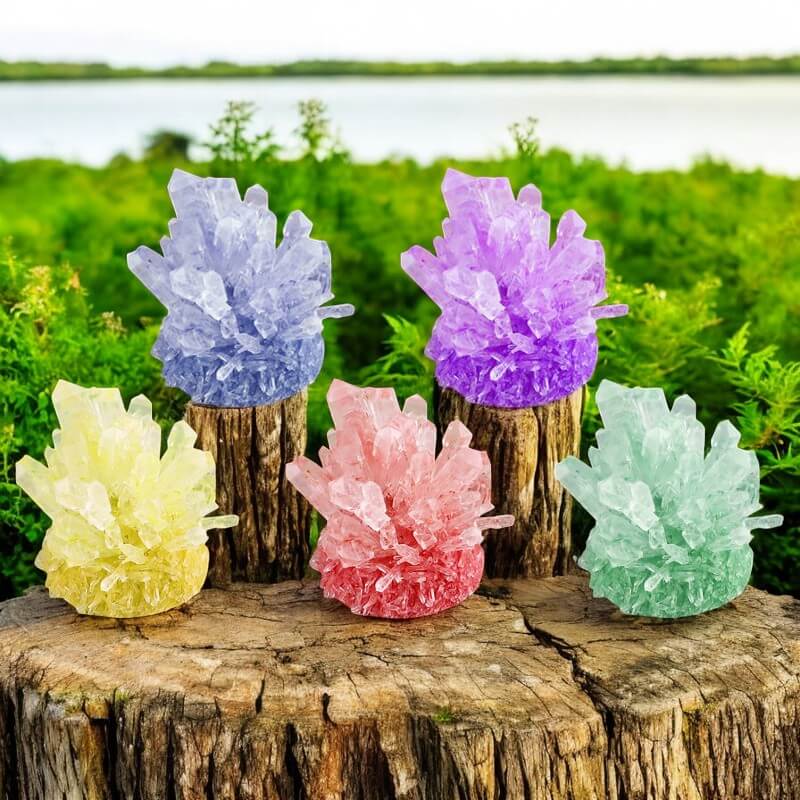
Results appear in a day and keep improving for a week. If you want sharper, larger and coloured crystals, the Crystal Growing Kit gives reliable clusters in five colours, and the Magic Crystal Tree Kit grows feathery crystals on a paper tree in a few hours, ideal for impatient scientists.
Supervision note: an adult handles the hot water. Some online recipes use borax; skip it with children, as table salt works well enough.
🛍️ Our pick
Crystal Growing Kit
Everything you need to grow your own crystals over a few days, with step-by-step instructions: an easy win for a festive science afternoon.
£12.49 Discover →
Which festive STEM experiments explore physics?
Three good physics experiments for Christmas are lifting an ice cube with salted string, floating a peeled versus unpeeled satsuma, and making tinsel jump with a statically charged balloon. Ice fishing: lay a piece of string across an ice cube and sprinkle a pinch of salt over it. Wait about a minute and lift. Salt lowers the freezing point of water, so the surface melts slightly, then refreezes around the string as the meltwater loses heat to the cold cube. The same principle explains why councils grit roads in winter.
Floating satsumas: put an unpeeled satsuma in a bowl of water and it floats. Peel it and it sinks. The peel is full of tiny air pockets that act like a life jacket, lowering the fruit’s overall density below that of water.
Jumping tinsel: cut tiny pieces of tinsel or tissue paper snowflakes and place them on a table. Rub a balloon on a woolly jumper and hold it just above. Electrons transfer to the balloon, giving it a negative charge that attracts the light paper. Dry winter air makes this work especially well.
For more hands-on physics, the Electricity and Circuits collection shows how charge turns into current. Building a light-up Christmas card with a coin cell, copper tape and an LED is the natural tenth experiment; the Electric Circuit Kit does the same with snap-together modules and no loose batteries.
Supervision note: button batteries are extremely dangerous if swallowed. An adult should keep them, fit them and store spares out of reach.
| Experiment | Main ingredients | Time | Best age | Science idea |
|---|---|---|---|---|
| Fizzing snow | Bicarbonate of soda, vinegar | 10 minutes | 3+ | Acid and base reaction |
| Dancing raisins | Fizzy water, raisins | 5 minutes | 3+ | Density and gas bubbles |
| Cabbage indicator | Red cabbage, vinegar, bicarb | 40 minutes | 5+ | pH and pigments |
| Salt snowflakes | Salt, hot water, pipe cleaner | 3 to 7 days | 6+ | Saturation and crystals |
| Pine cone weather station | Pine cone, jar | 1 to 2 days | 4+ | Humidity and plant tissue |
How do you turn Christmas science experiments into science advent activities?
Spread the experiments across December and pair each one with a small question for the day. Slow experiments such as crystals and pine cones run in the background while quick ones fill the gaps. A science advent calendar does not need 24 different experiments. It needs a rhythm. Many families find that two or three hands-on sessions a week, plus small observation tasks in between, keeps enthusiasm high without turning December into homework.
- Week one: start the salt snowflakes and the pine cone weather station. Check them daily and note changes.
- Week two: fizzing snow, dancing raisins and the cabbage indicator, all quick wins after school.
- Week three: candy canes, ice fishing and floating satsumas, each with a written prediction first.
- Christmas week: the light-up card, made as a gift for a grandparent.
Pine cone weather station: put a closed cone somewhere dry and warm for a day and it opens. Put it in a damp place and it closes again. The scales have two layers of tissue that absorb water differently, so they bend as humidity changes; a study published in Nature in 1997 described exactly this mechanism.
Short on time? The guide to stocking fillers for science lovers lists small gifts that work as daily advent surprises.
⭐ Key takeaway
Write a one-line question on each advent day, such as “Why did the raisin sink again?”. The question, not the experiment, is what builds scientific thinking.
Our take: which experiments are worth your December afternoons?
If you only do three, choose fizzing snow for the wow factor, red cabbage indicator for real chemistry, and salt snowflakes for patience and a keepsake. Together they cover reactions, pH and crystals. After years of running family workshops, I have learned that children remember the experiments where they were in charge of the final step: pouring the vinegar, lifting the string, hanging the snowflake. So give them the step that matters, and keep the risky bits (hot water, batteries, cutting) for the adult.
I would also resist the temptation to explain everything at once. Let the raisins dance for a full minute before asking why. The best explanations come after a child has had time to form a theory of their own, even a wrong one.
Finally, think about what happens after Christmas. A child who enjoyed the cabbage indicator is ready for proper chemistry, and the chemistry gifts guide explains how to choose a set by age and safety level. A child who loved the circuit card might enjoy a soldering-free electronics project next. The point of Christmas science experiments is not the tray of foam on 20 December; it is the curiosity that is still there in February.
Keep a small notebook for the whole season. Drawing what happened, with the date, turns ten separate tricks into one real investigation that children are proud to show off.
FAQ
Sources
- Royal Institution of Great Britain, history of the Christmas Lectures
- Royal Horticultural Society, School Gardening: red cabbage indicator lesson
- Royal Society of Chemistry, Education: red cabbage pH indicator experiments
- Dawson, Vincent and Rocca, How pine cones open, Nature (1997)