
The essential:
- A mineral is a natural solid with a defined chemistry and crystal structure; a rock is a mixture of one or more minerals.
- The International Mineralogical Association list counted 6,226 valid mineral species as of August 2026.
- The Mohs scale, devised by Friedrich Mohs in 1812, ranks hardness from talc (1) to diamond (10).
- A fingernail scratches at 2.5, a copper coin at 3.5 and window glass at about 5.5, so three household objects cover most home tests.
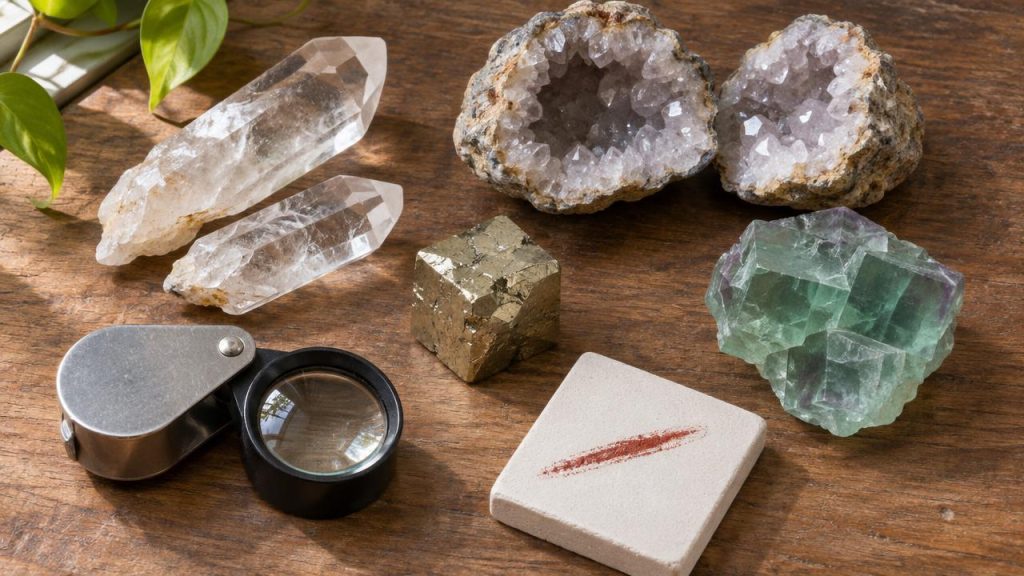
Rocks and minerals are the first scientific collection many of us ever start: a pebble from a beach in Cornwall, a sparkly lump from a school trip, a geode on a bedroom shelf. Most collectors, though, never learn how to say what they are actually holding, and that is a shame, because the tools needed fit in a pencil case.
This guide sets out the difference between a rock and a mineral, then walks through the tests geologists still use in the field: colour and lustre, the Mohs hardness scale, the streak test, cleavage and a few special tricks. By the end you will be able to sort a mixed box of specimens into confident names and honest question marks.
📋 Table of contents
- What is the difference between rocks and minerals?
- How many minerals are there?
- How to identify minerals by colour, lustre and crystal shape
- What is the Mohs hardness scale and how do you use it?
- What is the streak test?
- Which other tests help identify rocks and minerals at home?
- How do you start a rocks and minerals collection?
- Our take: what matters most when identifying rocks and minerals
- FAQ
What is the difference between rocks and minerals?
A mineral is a naturally occurring solid with a defined chemical composition and an ordered crystal structure. A rock is an aggregate of one or more minerals, so granite is a rock while the quartz inside it is a mineral. Think of minerals as ingredients and rocks as the finished recipe. Quartz is always silicon dioxide, arranged in the same repeating pattern of atoms wherever it forms. Granite, on the other hand, is a mixture of quartz, feldspar and mica, and the proportions change from one quarry to the next.
Geologists usually require five things before calling something a mineral:
- it forms naturally;
- it is solid at ordinary temperatures;
- it is generally inorganic;
- it has a definite chemical formula, within a small range;
- its atoms sit in an ordered crystal lattice.
That definition rules out some popular “crystals”. Glass and obsidian have no ordered lattice, and amber is fossilised tree resin, so none of them is a true mineral. The rainbow-coloured Bismuth Crystal is a nice borderline case: native bismuth is a recognised mineral, but those stepped iridescent shapes are grown in a laboratory by slowly cooling molten metal, and the colours come from a thin film of bismuth oxide on the surface.
Rocks are grouped by how they formed: igneous rocks cooled from molten material, sedimentary rocks built up from particles or chemical deposits, and metamorphic rocks were transformed by heat and pressure.
⭐ Key takeaway
If you can see different grains or colours mixed together, you are probably holding a rock. If the whole specimen is one substance with flat crystal faces or a single consistent colour, you may be holding a mineral.
How many minerals are there?
The official list kept by the International Mineralogical Association counted 6,226 valid mineral species as of August 2026, and the list grows every year as new species are approved. New minerals are approved by the IMA Commission on New Minerals, Nomenclature and Classification, which reviews chemistry, crystal structure and physical data before a name becomes official. The list includes more than a thousand “grandfathered” species described before the commission existed in its current form.
The good news for beginners is that you will meet only a tiny fraction of those thousands. A handful of rock-forming minerals make up most of the ground beneath your feet. Feldspars alone make up more than half of Earth’s crust, and quartz is the most common mineral in many sands and in granite.
A sensible starter list for a home collection looks like this:
- Quartz, including amethyst, rose quartz and rock crystal;
- Feldspar, often pink or white blocks in granite;
- Calcite, the main mineral in limestone and chalk;
- Fluorite, cubic and often purple or green;
- Pyrite, the brassy “fool’s gold”;
- Haematite and magnetite, two iron oxides.
A boxed Gemstones Set is a practical shortcut here, because it puts a dozen labelled specimens side by side, which trains your eye far faster than photographs.

🛍️ Our pick
Gemstones Set
A labelled set of real gemstone and mineral specimens to compare colour, lustre and hardness, just like a beginner's geology collection.
£21.49 · ★ 66 sold
Discover →How to identify minerals by colour, lustre and crystal shape
Start by looking, not scratching: note colour, lustre (how the surface reflects light), transparency and crystal shape. These first observations narrow the field, but colour alone is the least reliable clue. Many minerals come in several colours because tiny impurities tint them. Quartz can be clear, purple, pink, smoky brown or milky white. Fluorite ranges from purple to green to yellow. So write colour down, then move quickly to more reliable clues.
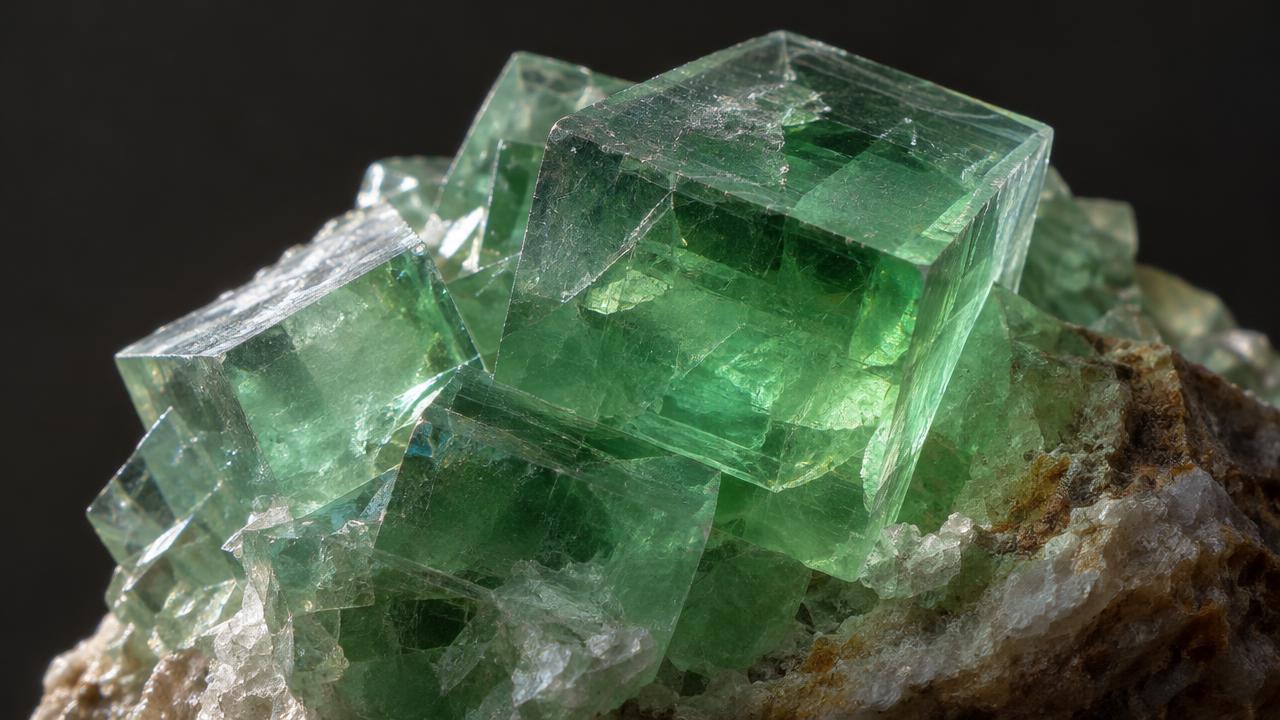
Lustre describes the way light bounces off a fresh surface. Pyrite and galena look metallic; quartz looks glassy (vitreous); some gypsum looks silky or pearly; earthy minerals look dull. Hold the specimen under a desk lamp and turn it slowly.
Crystal shape (or habit) reflects the internal arrangement of atoms. Halite and pyrite often grow as cubes, quartz forms six-sided prisms ending in a point, and fluorite produces cubes or octahedra. A Green Fluorite Crystal is a lovely specimen to practise on, as you can often spot both its glassy lustre and its tendency to split along flat planes.
A cheap hand lens with ten times magnification makes a huge difference here. Use it in good daylight and look at broken edges rather than polished faces, because polishing hides the natural lustre and texture.
💡 Did you know?
Fluorite gave its name to an entire branch of physics. In 1852 the physicist George Gabriel Stokes coined the word “fluorescence” from fluor-spar, because some fluorite glows under ultraviolet light.
What is the Mohs hardness scale and how do you use it?
The Mohs scale ranks minerals from 1 (talc) to 10 (diamond) by which ones scratch which. It was devised by the German mineralogist Friedrich Mohs in 1812 and is still the quickest hardness test in the field. The ten reference minerals, from softest to hardest, are talc, gypsum, calcite, fluorite, apatite, orthoclase feldspar, quartz, topaz, corundum and diamond. Any mineral scratches those below it and is scratched by those above.
The scale is relative, not linear. Britannica notes that the step from corundum (9) to diamond (10) represents an increase in hardness of more than 300 percent, far more than the step from talc to gypsum.
You do not need the ten minerals to use it. Everyday objects give reliable reference points, set out in the table below. To test, press a sharp edge of your specimen firmly across a flat, clean surface of the reference, then wipe away the powder with a finger. A real scratch stays as a groove; a mark that rubs off is just powder left by the softer material.
Always test on a hidden corner of a specimen, never on a polished face, and never test a gem you want to keep pristine.
| Reference object | Approximate Mohs hardness | What it tells you |
|---|---|---|
| Fingernail | 2.5 | Scratches gypsum and talc; not calcite |
| Copper coin | 3.5 | Scratches calcite; not fluorite |
| Window glass or knife blade | about 5.5 | Quartz and feldspar scratch it; fluorite does not |
| Unglazed porcelain tile | about 6.5 to 7 | Harder minerals leave no streak |
| Quartz crystal | 7 | Scratches glass easily |
What is the streak test?
The streak test rubs a mineral across unglazed white porcelain to reveal the colour of its powder. Streak colour is far more consistent than surface colour, so it separates look-alike minerals quickly. Turn over a white bathroom tile and you will usually find an unglazed back: that is a perfectly good streak plate. Draw the specimen firmly across it in a short line and look at the colour of the powder.
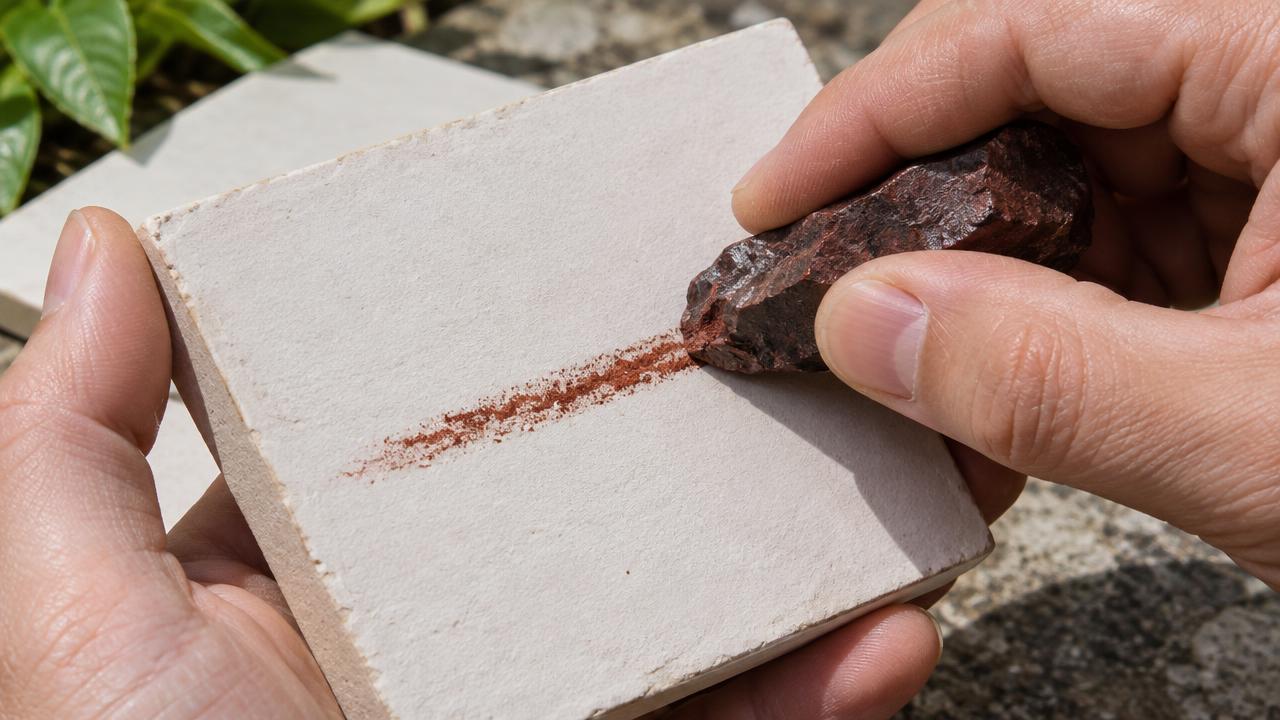
The results can be surprising. According to Geology.com, haematite always leaves a red to reddish-brown streak, even when the specimen itself looks black or silver. Pyrite, despite its brassy gold appearance, leaves a greenish-black to brownish-black streak, while real gold leaves a gold-yellow one. That single test separates “fool’s gold” from the real thing in seconds.
A few limitations to keep in mind:
- porcelain plates are about 6.5 to 7 on the Mohs scale, so quartz, topaz and other hard minerals leave no streak at all;
- many light-coloured minerals leave a white streak, which is less helpful;
- always wipe the plate clean between specimens.
For a family project, the streak test is one of the most satisfying activities in the Christmas science experiments spirit: one tile, a handful of stones and an afternoon of genuine discovery.
Which other tests help identify rocks and minerals at home?
Beyond hardness and streak, check cleavage (flat breaking planes), weight in the hand, magnetism with a fridge magnet and, for calcite, a gentle fizz with vinegar. Combined, these tests identify most common specimens.
- Cleavage and fracture: mica peels into thin sheets, calcite breaks into rhombs, and fluorite splits into octahedral corners. Quartz has no cleavage and breaks with curved, shell-like fractures.
- Heft: compare two specimens of similar size. Galena and barite feel unexpectedly heavy because their density is much higher than quartz.
- Magnetism: hang a small magnet on a thread. Magnetite pulls it strongly; most other minerals do not.
- Acid reaction: a drop of household vinegar on calcite or limestone produces slow bubbles of carbon dioxide. Geologists use dilute hydrochloric acid, which is not suitable at home.
- Ultraviolet light: some fluorite and calcite glow under a UV torch. Never look into the beam.
Geodes deserve a mention here. A geode is a hollow rock, often formed in a gas bubble in volcanic rock or a cavity in sediment, whose inner walls are lined with crystals, very often quartz. Splitting a Break Your Own Geode lets you test those freshly exposed crystals on a glass surface yourself, and the clean inner faces make lustre easy to judge.
Safety note: wear safety glasses when breaking rocks, and supervise children with hammers and magnets.

🛍️ Our pick
Break Your Own Geode
Unopened geodes to crack yourself: the moment you split one and see the crystals inside never gets old.
£26.49 · ★ 37 sold
Discover →How do you start a rocks and minerals collection?
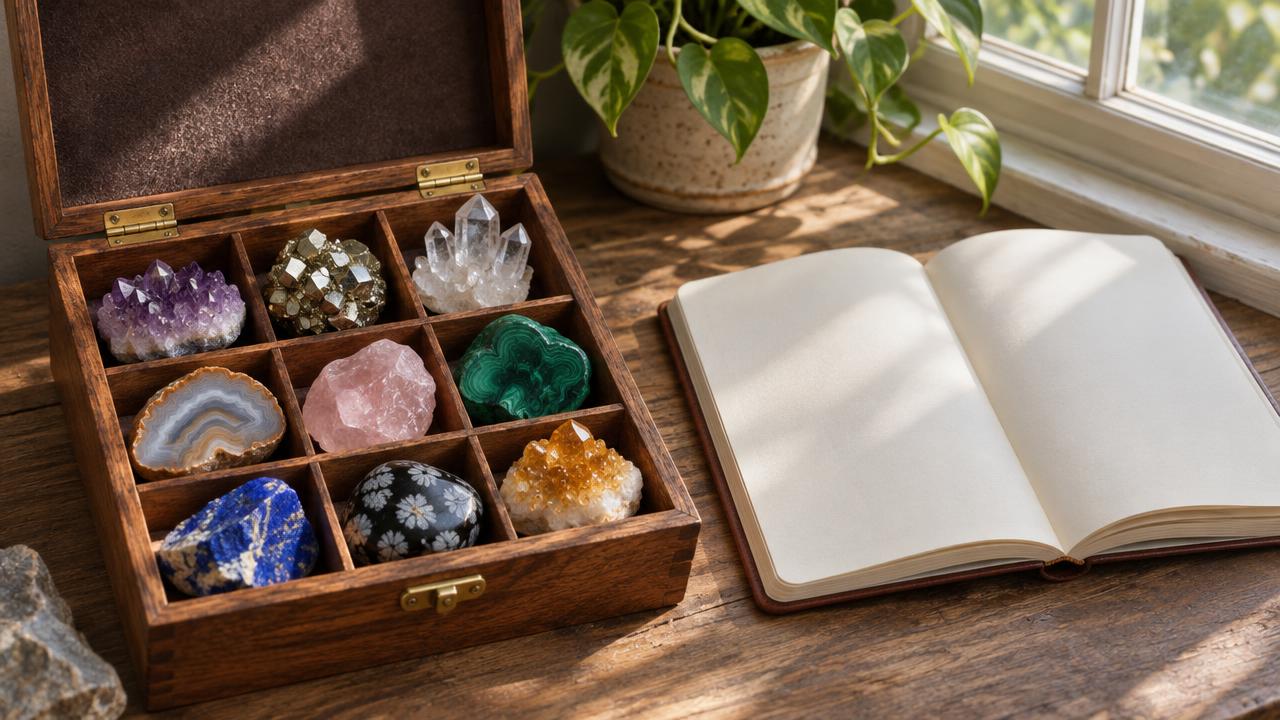
Begin with a dozen common specimens, a hand lens, a streak tile and a notebook. Label each specimen with a number, where it came from, and the results of your tests. A collection becomes scientific the moment it has records. Give each specimen a small number with a dot of correction fluid and a fine pen, then write a matching entry in a notebook: name, date, locality, colour, lustre, hardness and streak.
Where to find specimens in Britain:
- beaches with shingle, where flint, quartz and jasper pebbles are common;
- old spoil heaps at former mining areas, with permission from the landowner;
- museum shops, mineral fairs and reputable sellers for specimens you cannot collect yourself.
Always follow the Countryside Code, leave protected sites alone and never hammer at cliffs, which is both dangerous and often prohibited.
For displaying the results, a simple divided box or a shelf in good daylight works. The specimen and gemstone range includes geodes and single crystals that make strong centrepieces, while the Nature and Dig Kits suit younger collectors who enjoy excavating their finds. If you want to test what you have learned, the crystals quiz is a good check.
Our take: what matters most when identifying rocks and minerals
Trust tests, not colour. Hardness and streak, done carefully and written down, will teach you more about rocks and minerals than any amount of browsing photos online. From years of museum handling sessions, the pattern is always the same: visitors guess by colour, and the guess is usually wrong. As soon as they scratch glass with a crystal or draw a red line with a black stone, the penny drops. Minerals are defined by chemistry and structure, and physical tests are a window onto both.
I would also be clear about one thing many shops blur. Crystal healing, or lithotherapy, has no scientific validation. Enjoy your specimens for what they genuinely are: records of temperature, pressure and chemistry, sometimes hundreds of millions of years old. That story is more than enough.
Finally, accept question marks. Professional mineralogists use X-ray diffraction and chemical analysis for difficult specimens. If your tests leave two possible names, write both in your notebook. Honest uncertainty is good science.
For a broader geology refresher, the volcanoes and geology quiz covers how igneous rocks form, which links nicely back to the crystals in your box.
To turn this curiosity into a collection, our geology gifts page lists mineral sets, geodes and dig kits.
⭐ Key takeaway
The three most useful tools for identifying minerals at home cost almost nothing: a copper coin, a piece of glass and the unglazed back of a white tile.
FAQ
Sources
- International Mineralogical Association, CNMNC List of Minerals
- Encyclopaedia Britannica, Mohs hardness
- The Open University, OpenLearn: Minerals and the crystalline state
- Natural History Museum, London, mineral collections