
The essential:
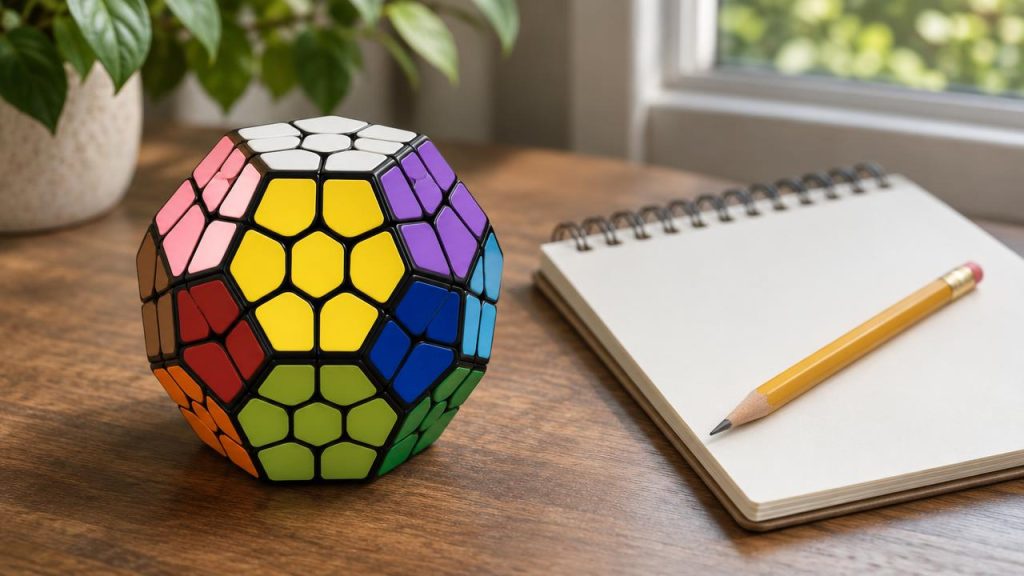
- A Megaminx is a 12-faced dodecahedron with 50 moving pieces: 20 corners and 30 edges, plus 12 fixed centres.
- The standard 12-colour Megaminx has roughly 1.0067 x 10^68 possible positions, against about 4.3 x 10^19 for a 3×3 cube.
- A beginner method solves it face by face, then finishes the last face with 6 short algorithms in 4 steps.
- The official world record single was 21.04 seconds as of mid-2026, set by Ziyu Wu at a competition in Quanzhou on 30 May 2026.
If you are wondering how to solve a Megaminx, here is the reassuring news: it is far less frightening than its twelve shining faces suggest. The puzzle is a dodecahedron, and almost every step reuses an idea you would meet on an ordinary 3×3 cube, simply applied around five sides instead of four.
In museum workshops, the moment people realise that a pentagonal face is just a 3×3 face with one extra side, their shoulders drop. This guide follows that route: a white star, the white corners, the middle of the puzzle in rings, then the last face with six short algorithms written in standard notation. Every last-layer sequence below has been checked move by move on a simulated puzzle, so you can trust the notation.
📋 Table of contents
- What is a Megaminx and how does it differ from a Rubik’s cube?
- How do you read Megaminx notation?
- Step 1: how do you solve the first face of a Megaminx?
- How do you solve the middle layers of a Megaminx?
- How do you make the star on the last face?
- Which Megaminx algorithms put the last edges in place?
- How do you finish the last corners of a Megaminx?
- How long does it take to learn how to solve a Megaminx?
- Our take: is learning how to solve a Megaminx worth it?
- FAQ
What is a Megaminx and how does it differ from a Rubik’s cube?
A Megaminx is a dodecahedron puzzle with 12 pentagonal faces. Each face turns in fifths of a full rotation, and the puzzle has 50 moving pieces instead of the cube’s 20. Each face carries one fixed centre, five edges and five corners. Corners show three colours, edges show two, exactly as on a cube. The difference is the geometry: because every face is a pentagon, one turn moves a face by 72 degrees, and five turns bring it home.
- Pieces: 12 centres, 30 edges and 20 corners.
- Colours: the common version uses 12 distinct colours, one per face, which is the only version allowed in official competition.
- Positions: roughly 1.0067 x 10^68, an almost absurd number next to the cube.
The upside of all that size is that the Megaminx is surprisingly forgiving. There is lots of free space to park pieces while you work, so the early stages are more relaxed than on a cube. If you have not yet mastered the classic puzzle, a 3×3 Rubik’s Cube Original is the natural warm-up, because the Megaminx method below borrows its logic directly. You can browse the wider family of twisty puzzles in our Rubik’s Cube collection.
| Feature | 3×3 cube | Megaminx |
|---|---|---|
| Number of faces | 6 squares | 12 pentagons |
| Moving pieces | 20 (8 corners, 12 edges) | 50 (20 corners, 30 edges) |
| One face turn | 90 degrees | 72 degrees |
| Possible positions | about 4.3 x 10^19 | about 1.0067 x 10^68 |
| World record single (mid-2026) | 2.76 s | 21.04 s |
How do you read Megaminx notation?
Megaminx notation borrows the cube letters: U is the top face, F the front, R and L the faces to the right and left of the front. A plain letter means one clockwise fifth, and an apostrophe means anticlockwise. Hold the puzzle with one face on top and one face pointing at you. The top face is U, the face towards you is F, and the faces either side of it, still in the upper half, are R and L. The face just below and to the right of the front is called DR; some guides simply write it as D.
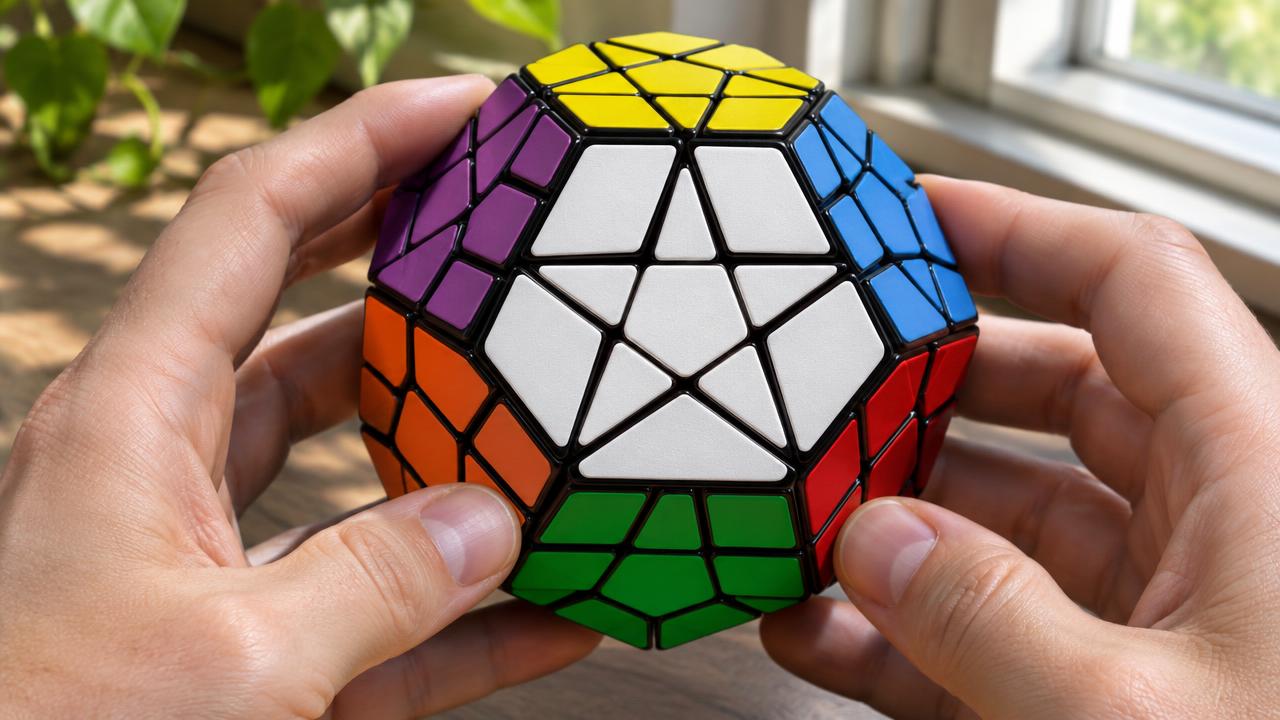
- R turns the right face clockwise by one fifth, as seen when you look straight at that face.
- R’ turns it one fifth anticlockwise.
- U2 means two clockwise fifths, and U2′ means two anticlockwise fifths.
That last point trips people up. On a cube, U2 and U2′ land in the same place. On a Megaminx they do not, because two fifths one way equals three fifths the other way. Read every 2 and every apostrophe carefully, especially in the corner algorithms later on. Megaminx algorithms also tend to be shorter than you expect, because the size of the puzzle gives pieces room to move without disturbing your work.
💡 Did you know?
Did you know? A Megaminx face is back where it started after 5 turns, not 4, so U2 and U2′ are genuinely different moves. That single fact explains most of the beginner confusion when people first try cube algorithms on it.
Step 1: how do you solve the first face of a Megaminx?
Build a white star first by placing the five white edges around the white centre, matching each edge’s second colour to the neighbouring centre. Then insert the five white corners with a short repeated trigger. The star. This is intuitive, just like the white cross on a cube. Find a white edge, turn its other colour to sit beside the matching side centre, then bring it up into the white face. Work slowly: there are only five edges and plenty of space.
The corners. Keep white on top. Find a corner with white on it, turn the lower part of the puzzle until that corner sits directly underneath the gap where it belongs, in the spot between the front face, the right face and the DR face. Then repeat this trigger:
- R’ DR’ R DR
Repeat it once, three times or five times, until the corner rises into place with white facing up. It never disturbs your star, so you can experiment freely. If a white corner is already in the top face but in the wrong spot or twisted, use the same trigger once to pop it out, then insert it properly.
Many people find the first face takes as long as everything else at the start. That is normal: you are learning to see the puzzle as rings of pieces around a centre.

🛍️ Our pick
Hexagon Rubik's Cube Megaminx
A twelve-sided Megaminx with smooth turning and bright colours: the natural next puzzle once the 3×3 is mastered.
£18.49 · ★ 31 sold
Discover →How do you solve the middle layers of a Megaminx?
Turn the puzzle so the white face points down, then fill each ring of corners and edges around it, one slot at a time, always keeping an unsolved face on top as your working area. The middle of the puzzle is solved in rings. With white at the bottom, the first ring is five edges that hang below the white corners, then a ring of corners and edges above them, and so on until only the top face remains. The trick is always the same: choose an unsolved face as your temporary top, hold the empty slot at the front, and bring pieces down into it.
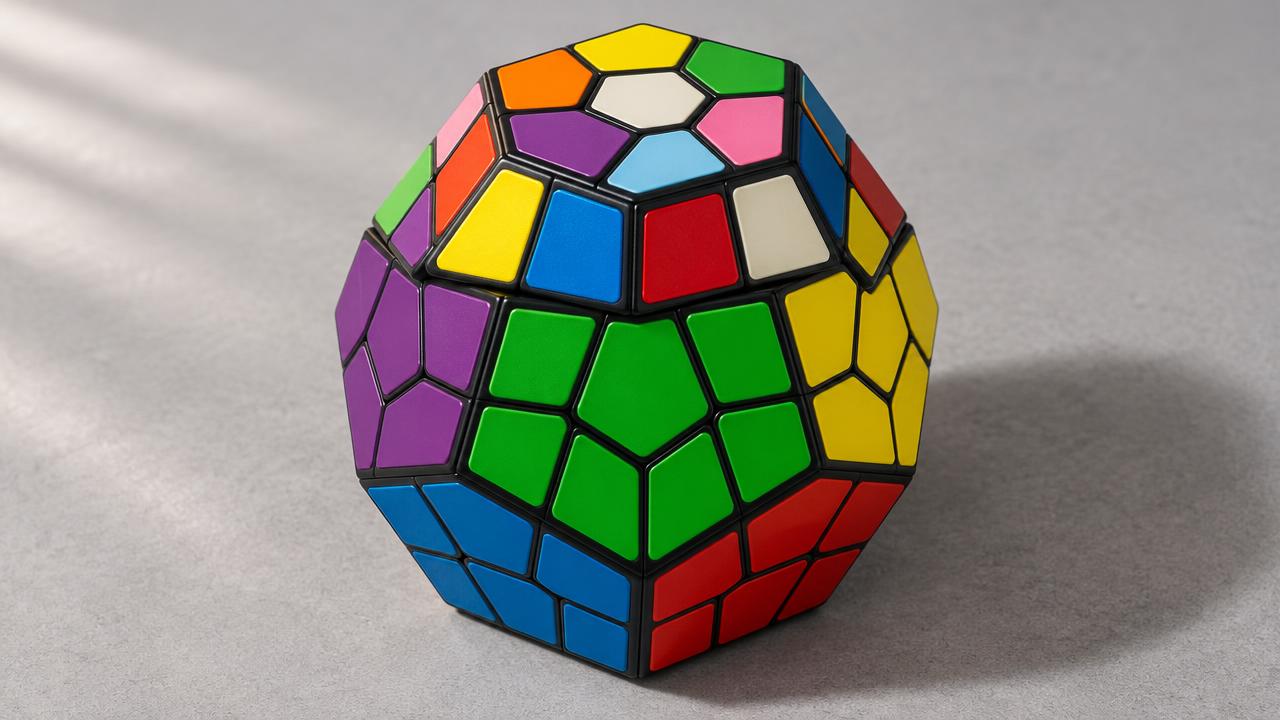
Edges. Put the edge in the top layer so its front colour matches the front centre, then:
- Slot at front-right: U R U’ R’ U’ F’ U F
- Slot at front-left: U’ L’ U L U F U’ F’
Both sequences only touch the top face and the target slot, so nothing you have solved below is broken.
Corners. Hold the slot at the lower right of the front face, with the corner directly above it in the top-right position, and repeat R U R’ U’ once, three times or five times until it drops in correctly. Insert each corner before the edge that sits above it.
If an edge sits in its slot but flipped, insert any top edge into that slot with the same algorithm to kick it out, then reinsert it the right way round.
⭐ Key takeaway
Key takeaway: in the middle layers, pick an unsolved face as your top and treat the slot at the front as a little 3×3 problem. The algorithms only disturb the top face, which is exactly where you do not mind a mess.
How do you make the star on the last face?
Orient the five last-face edges so the top colour shows on all of them. Flipped edges always come in pairs, and two six-move algorithms handle every case. Once ten or eleven faces are done, only the top face remains, and this is where the Megaminx last layer method resembles the yellow cross step on a cube. Count the edges whose top colour is not facing up. You will see 0, 2 or 4 of them, never an odd number.
- Two flipped edges next to each other: hold them at the front and the right, then do F U R U’ R’ F’.
- Two flipped edges apart: hold one at the front and the other at the back-right, then do F R U R’ U’ F’.
- Four flipped edges: hold the only correct edge at the back-left and do F U R U’ R’ F’. You will be left with two flipped edges, which you then solve with the matching case above.
These two sequences scramble the top corners a little, but that does not matter yet. When the star is done, you have the top colour shining in a five-pointed shape, a satisfying halfway mark for any Megaminx last layer.
Which Megaminx algorithms put the last edges in place?
Two eight-move Megaminx algorithms cycle three top edges while keeping the right and back-right edges fixed. Turn the top face until two neighbouring edges match their side centres, then choose the right one. Turn U until as many edges as possible match the centre beside them. If two neighbouring edges match, hold them at the right and the back-right, then use one of these:
- R U R’ U R U2′ R’ U cycles the front, back-left and left edges one way.
- U’ R U2 R’ U’ R U’ R’ cycles the same three edges the other way.
Note the U2′ in the first algorithm: two anticlockwise fifths, not two clockwise ones. If one sequence makes things worse, undo it and try the other. Neither disturbs the star you built in the previous step.
If no two neighbouring edges match after turning U, perform the first algorithm, turn U to check again, and if needed repeat it from a different angle: within a few attempts you will reach the neighbouring case. For a hands-on challenge with a satisfying feel, our Hexagon Rubik’s Cube Megaminx turns smoothly enough for practising these sequences at speed.
How do you finish the last corners of a Megaminx?
First put each corner in its correct spot with a three-corner cycle, then twist the corners one at a time with the R’ DR’ R DR trigger, turning only the top face between corners. Placing the corners. A corner is in the right spot if its three colours match the three faces around it, even if it is twisted. If two neighbouring corners are correct, hold them at front-right and right-back, then use:
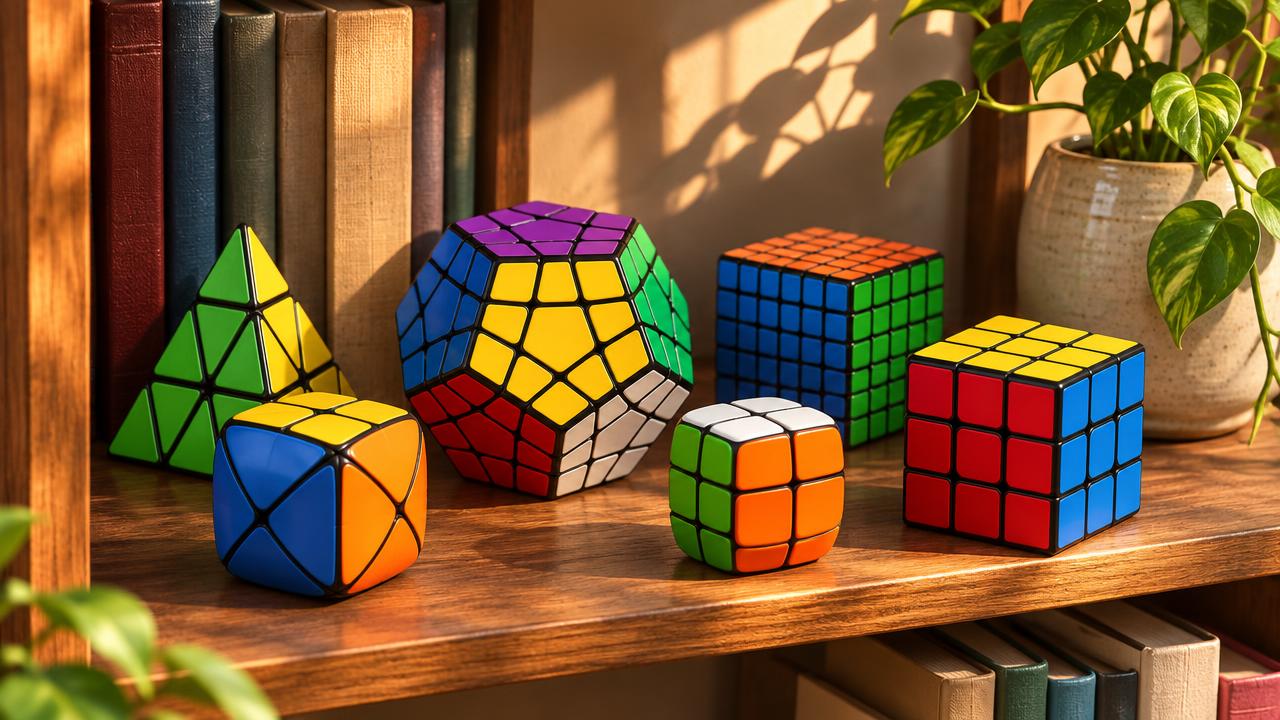
- L’ U2 R U2′ L U2 R’ U2′
- or its reverse: U2 R U2′ L’ U2 R’ U2′ L
Each cycles the other three corners while leaving the two front-right corners and all edges untouched. If you cannot find two neighbouring correct corners, apply the first one, then check again, holding the puzzle at a different angle each time you repeat it.
Twisting the corners. Hold the puzzle with a twisted corner at the top front-right. Repeat R’ DR’ R DR two or four times, until its top colour faces up. The lower part of the puzzle will look wrecked: do not panic and do not rotate the puzzle. Turn only U to bring the next twisted corner to the front-right, and repeat. When the last corner is fixed, the lower layers fall back into place and a final U turn finishes the solve.
How long does it take to learn how to solve a Megaminx?
If you already solve a 3×3 cube, expect a first full Megaminx solve within a few practice sessions. First solves are slow, but times fall quickly once the six last-face algorithms become automatic. The learning curve has three phases. The first face feels slow because you are still reading the shape. The middle layers then become rhythmic, since you repeat the same two edge insertions dozens of times. The last face is where the six algorithms matter, and it is worth writing them on a card until your fingers remember them.
- Learn the notation first, especially the difference between U2 and U2′.
- Drill the last face separately: scramble only the top and solve it again and again.
- Keep the colour scheme in your head: knowing which colour sits opposite which saves a surprising amount of searching.
Official competition has included the Megaminx since 2003, when the first official record single was 2 minutes 12.82 seconds. By mid-2026 the record single had fallen to 21.04 seconds, which shows how far practice and better puzzles can take you. If you already enjoy a cube with magnets for crisp turning, such as our Magnetic Rubik’s Cube, you will notice the same smoothness is what makes long Megaminx sessions comfortable. For more puzzles that reward patience, look at our brain teasers.

🛍️ Our pick
3×3 Rubik's Cube Original
The classic 3×3 cube: master it first, as the Megaminx method builds directly on its layer-by-layer logic.
£10.49 · ★ 18 sold
Discover →Our take: is learning how to solve a Megaminx worth it?
Yes, especially for anyone who already solves a 3×3 cube. The Megaminx teaches you to transfer a method to a new shape rather than memorise a new one, which is the most valuable puzzle skill there is. From a science communication point of view, the Megaminx is a wonderful lesson in generalisation. You do not learn a new puzzle from scratch: you notice that a pentagon is a square with an extra side and adapt what you know. That habit of asking which ideas carry over is exactly how scientists approach a new problem.
It is also a lovely object to have on a desk. The twelve colours, the regular geometry of a Platonic solid and the soft click of the faces make it a puzzle people pick up even without intending to solve it. If you have just finished our guide on how to solve a 4×4 Rubik’s cube, the Megaminx is a natural next step: bigger in pieces, but kinder in method, since it has none of the parity traps of even-sized cubes.
Choosing your first puzzle carefully helps; our guide on what to look for when buying a puzzle cube covers turning quality and stability. And if you want to test your general puzzle reflexes first, try our brain teasers quiz.
If you are buying for a puzzle fan, our maths gifts selection goes well beyond the classic cube.
FAQ
Sources
- World Cube Association, official regulations and records
- Jaap Scherphuis, Jaap’s Puzzle Page: Megaminx
- David Singmaster, Notes on Rubik’s Magic Cube (Penguin, 1981)
- Speedsolving.com wiki: Megaminx notation and methods