
The essentials:
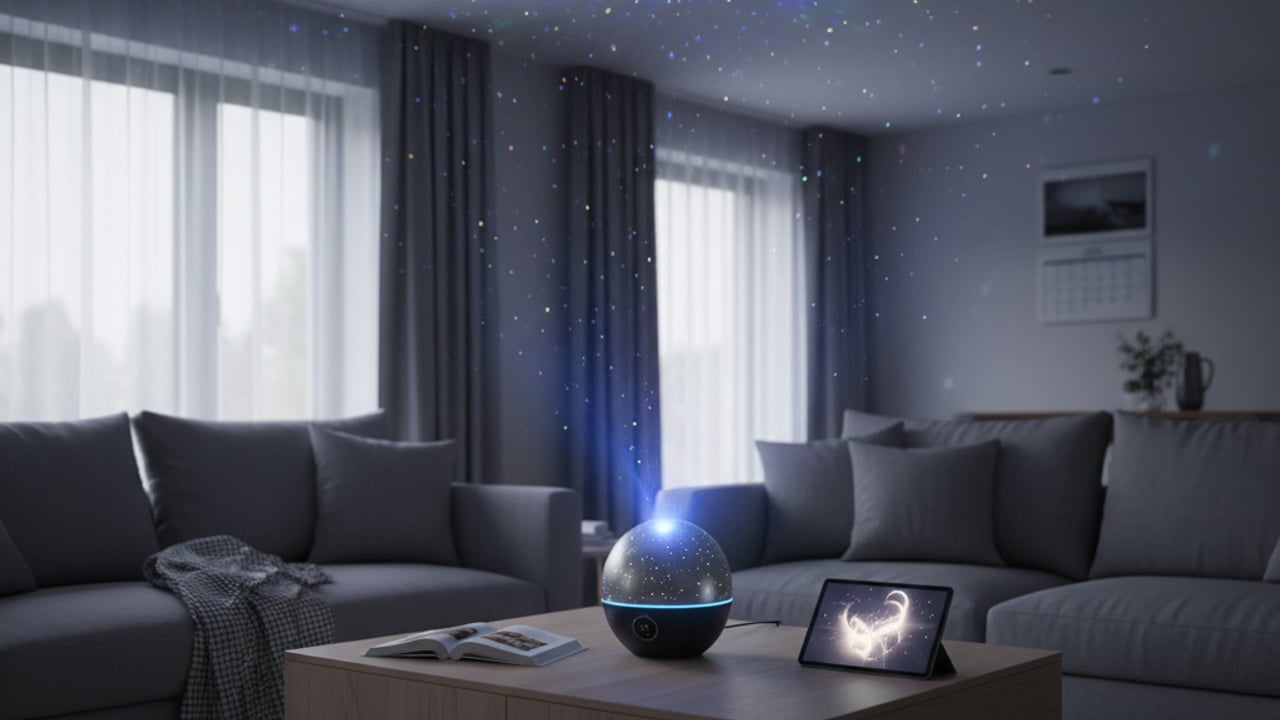
- A galaxy projector uses LEDs, laser diodes and a rotating lens to scatter stars, nebula clouds and aurora-style light across your ceiling.
- Prices in the UK typically range from £15 for basic models to £80+ for app-controlled, multi-effect versions.
- Most units run on 5V USB power, consume under 10 watts, and use LEDs rated for 20,000 to 50,000 hours of use.
- They are decorative light gadgets, not scientifically accurate star charts, though the better models base their patterns on real constellations.
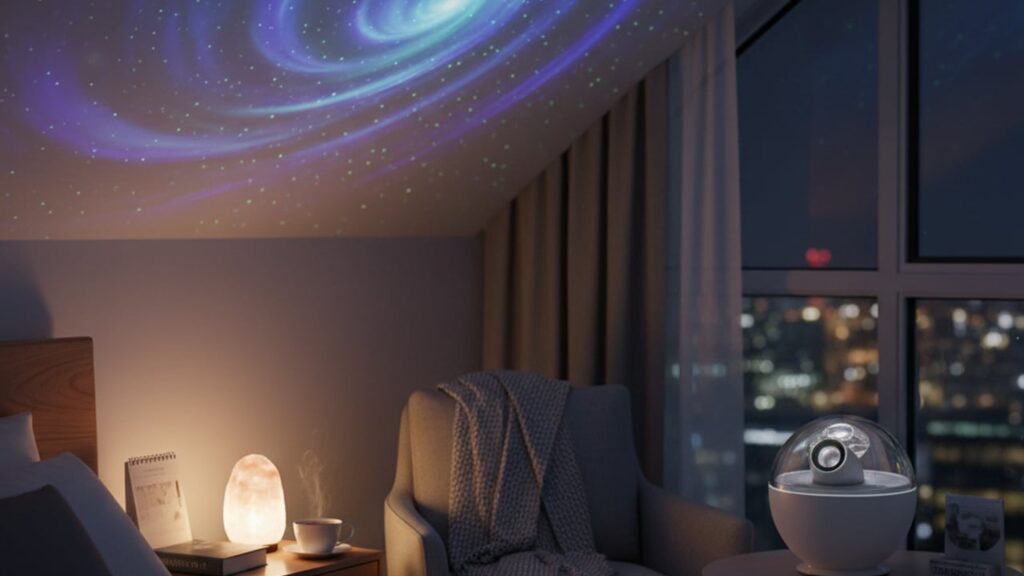
Walk into almost any UK home this winter and you’ll spot one: a small dome quietly turning a bedroom ceiling into a swirl of stars and green nebula haze. The galaxy projector has become one of the most gifted gadgets in Britain, sitting somewhere between a mood light, a piece of kinetic decor and a pocket planetarium. As someone who has spent years explaining optics in museum galleries before curating science-themed homeware, I get asked the same four questions constantly: is it worth the money, which one should I buy, how much should I pay, and is it safe near a cot. Let’s answer all four properly, with the physics behind the light show explained along the way.
📋 Table of contents
- What exactly is a galaxy projector?
- How do galaxy projectors work, technically?
- Types of effects: stars, nebulae, auroras and ocean waves
- Is a galaxy projector worth it?
- Which is the best galaxy projector to buy?
- What is the price of a galaxy projector in the UK?
- Are galaxy projectors safe for babies and children?
- Real astronomy or decorative effect: how accurate is the star pattern?
- Our verdict
- FAQ
What exactly is a galaxy projector?
A galaxy projector is a small tabletop or ceiling-mounted device that uses LEDs or laser diodes shone through a patterned lens to cast moving star and nebula patterns across a room. Most units combine a fixed star-field layer, created by tiny etched dots on a rotating disc, with a coloured cloud effect produced by a separate diode, usually green and blue to mimic nebula gas. The rotation is handled by a small internal motor, typically turning the star disc once every 90 to 180 seconds, which is what creates the gentle drifting effect rather than a static image. Higher-end models add Bluetooth speakers, app control and adjustable brightness, following the same wave of smart-home features seen in general ambient lighting.
💡 Did you know?
Did you know? The first true optical planetarium projector, the Zeiss Model I, was unveiled at the Deutsches Museum in Munich in 1923. It could project around 4,500 stars, roughly double what a good amateur astronomer can spot with the naked eye from a genuinely dark sky.
How do galaxy projectors work, technically?
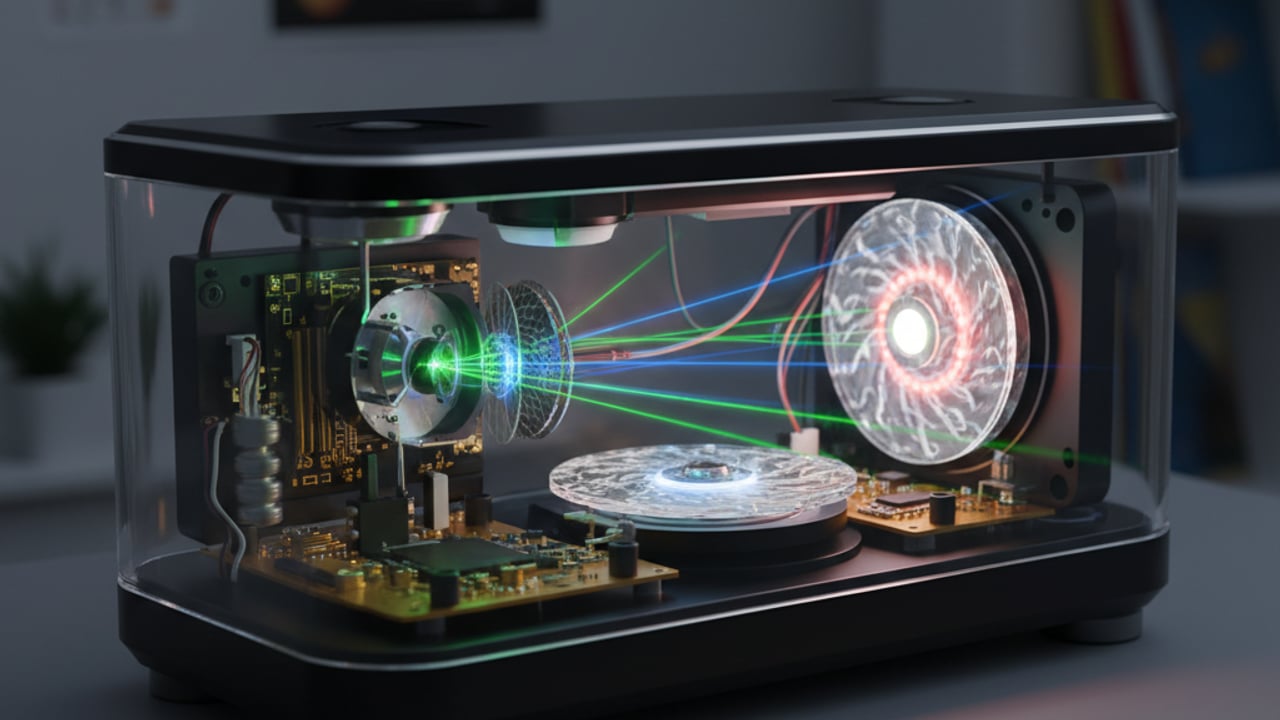
The core mechanism relies on simple, well-understood optics rather than anything exotic. A high-output LED or laser diode passes light through a small disc etched with thousands of microscopic holes; each hole becomes a point of light projected onto the ceiling, exactly like a pinhole camera in reverse. Nebula colours come from a second coloured LED shone through a textured or holographic film that scatters light unevenly, similar to the way the Triangular Glass Prism splits white light using dispersion, just achieved electronically instead of with glass. Most consumer units run on 5V via USB, drawing between 3 and 10 watts depending on how many LEDs are active, which is why they’re cheap to leave running overnight, typically costing under £1 in electricity per month at UK average rates.
⭐ Key takeaway
To retain: if a listing doesn’t state the LED lifespan, assume the lower end of the standard range, around 20,000 hours, which still equates to more than a decade of nightly two-hour use before noticeable dimming.
Types of effects: stars, nebulae, auroras and ocean waves
Not every galaxy projector produces the same light show, and the differences matter more than the marketing photos suggest.
🛍️ Our pick
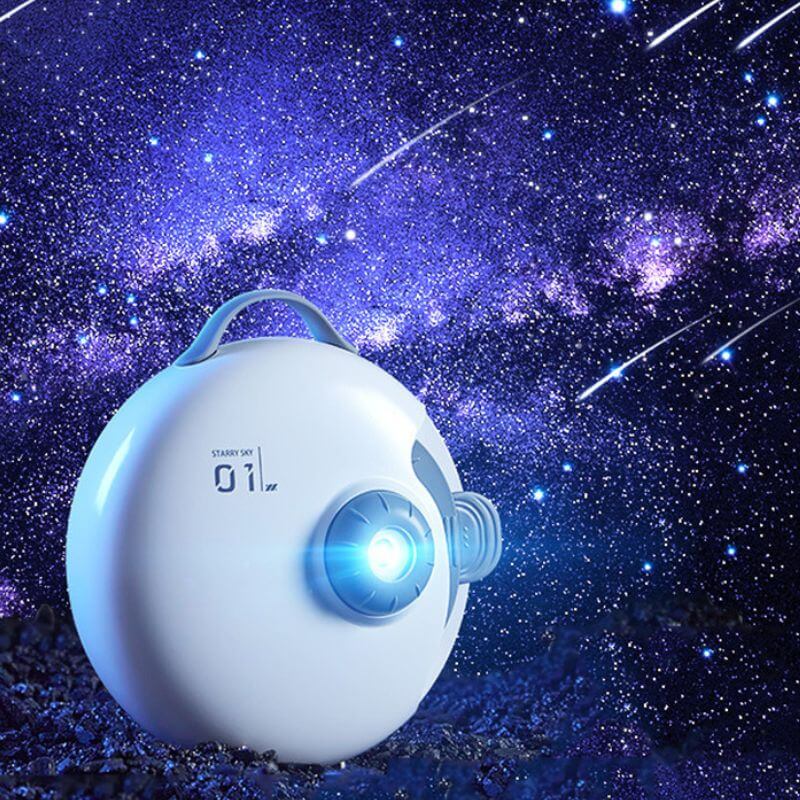
Galaxy Night Light Projector Infinity
Cette lampe Galaxy Night Light Projector Infinity projette des motifs infinis de nébuleuses, étoiles et galaxies pour créer une ambiance magique parfaite pour la relaxation.
89,99 £
Shop now →| Effect type | How it’s created | Best for |
|---|---|---|
| Static star field | Fixed pinhole disc, no motor | Budget bedrooms, kids’ rooms |
| Rotating galaxy/nebula | Motorised disc plus coloured diode | Living rooms, relaxation, gifting |
| Aurora wave | Diffused LED strip with slow colour cycling | Meditation spaces, evening wind-down |
| Ocean wave projection | Water-ripple lens filter over white LED | Bathrooms, coastal-themed decor |
Multi-mode units, the kind ranking highest on UK retail sites, usually combine at least two of these in one housing, controlled via a remote or smartphone app.
Is a galaxy projector worth it?
Yes, for the price bracket it sits in, most decent galaxy projectors deliver noticeably more visual impact per pound than standard mood lighting. A £30 to £50 galaxy projector covers an entire ceiling in moving light, something that would otherwise require multiple smart bulbs and a lighting scene setup costing considerably more. The value drops sharply below £15, where units often use a single static LED with no rotation, essentially a torch with a filter. If you want genuine atmosphere rather than a novelty that gets switched off after a week, spend at least £25 to £30 and check the listing specifies a motorised star disc.
💡 Did you know?
Le savais-tu? Under a genuinely dark, light-pollution-free sky, the human eye can distinguish roughly 2,500 to 4,500 individual stars, a figure astronomers use as a benchmark, and it’s this exact density that better galaxy projectors try to replicate on your ceiling rather than the sparse handful visible from most UK city gardens.
Which is the best galaxy projector to buy?
The best galaxy projector for most UK buyers is a multi-effect, app-controlled model priced between £30 and £60, offering star, nebula and colour-cycling modes with an auto-off timer. Look specifically for a stated LED lifespan above 20,000 hours, a rotation speed adjustable between 90 and 180 seconds per cycle, and a build that clips or sits securely rather than balancing on a narrow base. If your priority leans towards genuine astronomy education rather than pure ambience, pairing a projector with something like the Magnetic Solar System gives a far more scientifically grounded sense of scale and structure than the projected star field alone, which is decorative rather than a precise star chart.
For anyone drawn to the wider science-decor world rather than a single gadget, browsing the full Cool Gadgets range shows how a galaxy projector fits alongside other conversation-piece objects, and something like the Tesla Coil Music device makes a fun companion piece for anyone who enjoys light-and-electricity demonstrations rather than light alone.
What is the price of a galaxy projector in the UK?
UK galaxy projector prices in 2026 range from around £15 for a basic static single-colour model to £80 or more for premium app-controlled versions with speakers and adjustable brightness zones. Mid-range units, generally £25 to £45, cover the sweet spot most reviewers and buyers land on, offering a motorised star disc, two to four colour modes and a remote control. Anything marketed as a full home planetarium with speaker integration and Wi-Fi app control tends to sit above £50, closer to premium ambient-lighting brands rather than novelty gadgets.
Are galaxy projectors safe for babies and children?
Most reputable galaxy projectors sold in the UK meet standard consumer electrical safety requirements under UKCA or CE marking, and manufacturers generally recommend them for children aged three and above rather than newborns. Always check the manufacturer’s stated age guidance on the packaging, since small detachable parts, remote control batteries and cable length are the main practical risks, not the light itself. Brightness on most LED units is low enough not to cause discomfort, but as with any light source in a nursery, official guidance recommends avoiding direct eye-level placement and using the auto-off timer rather than leaving any device running unsupervised overnight. This is general product safety practice, not medical advice, so always defer to the specific manufacturer’s instructions for the model you buy.
Real astronomy or decorative effect: how accurate is the star pattern?
Galaxy projectors are decorative, not astronomically precise, and none of the mainstream consumer models claim to replicate genuine constellations or star magnitudes. The etched discs inside are designed for even, pleasing coverage across a ceiling rather than matching the actual position of Orion or the Plough on any given night. For genuine constellation accuracy, dedicated planetarium software or a real telescope remains the only reliable option, though the projector’s swirling nebula colours do loosely echo real astrophotography of objects like the Orion Nebula, roughly 1,344 light years from Earth according to measurements published by the European Space Agency.
Our verdict
Having tested and gifted several of these over the years, my honest take is that a well-made galaxy projector earns its place as one of the most reliably delightful low-cost gifts in the science-decor category, provided expectations stay realistic. It won’t teach anyone the constellations and it isn’t a scientific instrument, but as an atmosphere piece for a bedroom, home office or reading nook, it consistently outperforms its price tag. Skip anything under £15 with no rotation, and you’ll likely be very happy with the result.
FAQ
If you’re passionate about integrating tech into your lifestyle, you might also enjoy our detailed geek watches guide.
Sources
- Deutsches Museum, Munich, history of the Zeiss Model I planetarium projector (1923)
- European Space Agency, distance measurements for the Orion Nebula
- British Standards Institution (BSI) and UKCA marking requirements for consumer electronics