
The essentials:
- A sunset lamp is a small LED projector that mimics the warm orange-to-pink gradient of golden hour, using a coloured bulb or gel filter rather than any real weather phenomenon.
- The colours you see mimic Rayleigh scattering, the same optical effect first described mathematically by Lord Rayleigh in 1871 that explains why real sunsets turn red and orange.
- Sunset lamps differ from lava lamps (which use heated wax convection) and Himalayan salt lamps (solid carved stone), so pick based on the mood and movement you actually want.
- If you want an object with genuine scientific pedigree rather than a purely decorative LED gimmick, several real physics-based light pieces make excellent alternatives or companions.
Every fortnight or so, someone in my flat asks where they can buy ‘that lamp that makes the ceiling look like a sunset’. It is a fair question, and, delightfully, one that Google itself seems to be rather confused by. Search ‘sunset lamp’ today and you will find lava lamps from Poole, a Catholic literary journal, and several YouTube tutorials about replacing tail lights on a Ford Mondeo. None of that helps anyone who simply wants a bit of golden hour glow in their bedroom in September 2026. So let us sort this out properly, with the physics explained the way I used to explain it to school groups in the planetarium.
📋 Table of contents
What Is a Sunset Lamp?
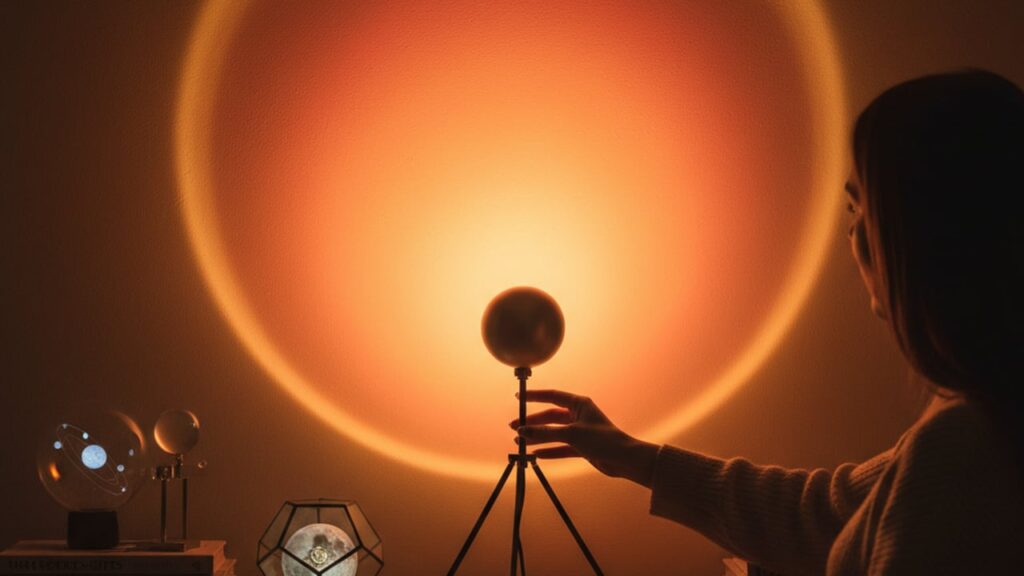
A sunset lamp is a small lighting device, usually LED, that projects a warm gradient of red, orange, and pink light onto a wall or ceiling to recreate the look of a setting sun indoors. Most models on the market use a single coloured or filtered bulb mounted at an angle, sometimes on a rotating head, so the light spreads as a soft circular or elliptical glow rather than a sharp beam. Unlike a table lamp meant to illuminate a room for reading or working, a sunset lamp exists purely for atmosphere and photography backdrops, which is exactly why it exploded on social media from around 2020 onward. There is no official technical standard defining a ‘sunset lamp’, so quality and colour accuracy vary enormously between brands, from cheap plastic units under £15 to sturdier designs with adjustable angles and remote dimming.
💡 Did you know?
The warm colour of a real sunset comes from sunlight travelling through far more atmosphere at a low angle. Blue light (roughly 450 to 495 nanometres) scatters away first, leaving the longer red and orange wavelengths, around 620 to 750 nanometres, to reach your eyes. This is called Rayleigh scattering, named after physicist Lord Rayleigh, who published the mathematical explanation in 1871.
How Does a Sunset Lamp Actually Work?
A sunset lamp works with a coloured LED or a white LED passed through an amber or red gel filter, positioned so the beam grazes a nearby wall at a low angle, exactly as low-angle sunlight does in the real sky. There is no scattering happening inside the lamp itself, it is simply coloured light aimed cleverly. Many models add a slow rotation or dimming cycle so the gradient shifts subtly over minutes, imitating the way an actual sunset changes over roughly twenty to thirty minutes near the equator, and considerably longer at higher UK latitudes in summer. The effect is entirely optical and decorative, so treat any claims about mood-boosting or therapeutic light wavelengths with healthy scepticism, since no sunset lamp on the consumer market is medically calibrated light therapy equipment.
⭐ Key takeaway
To remember: a sunset lamp recreates the look of golden hour through coloured LEDs and clever angling, not through any genuine atmospheric or scattering process happening inside the device.
Sunset Lamp vs Lava Lamp vs Himalayan Salt Lamp: What Is the Difference?
These three lamps get lumped together online because they all create ambient, non-functional light, but the physics behind each is completely different.

🛍️ Our pick
Sunset Projector
Un projecteur de coucher de soleil est un appareil conçu pour récréer les teintes chaudes et relaxantes d’un coucher de soleil dans votre intérieur.
42,49 £
- Sunset lamp: static or slow-rotating coloured LED projection, no moving liquid, no heat needed, colour gradient mimics dusk.
- Lava lamp: a heated wax bubble rises and falls through liquid via convection and density changes, a design patented by Edward Craven Walker and manufactured by Mathmos in Poole since 1963. It needs 15 to 45 minutes to warm up before the wax starts moving properly.
- Himalayan salt lamp: a solid carved block of halite lit from within by a small bulb, valued purely for its warm glow and texture as a decorative mineral piece, not for any verified air-purifying or therapeutic effect.
If you want gentle, ever-changing motion, a lava lamp remains the original and the most mesmerising. If you want a warm, textural glow from real rock, a salt lamp does that job. If you specifically want the flat orange-pink wash of a sunset on your wall for photos or evening wind-down, the sunset lamp format is the right tool.
Why Buy a Sunset Lamp? The Real Benefits
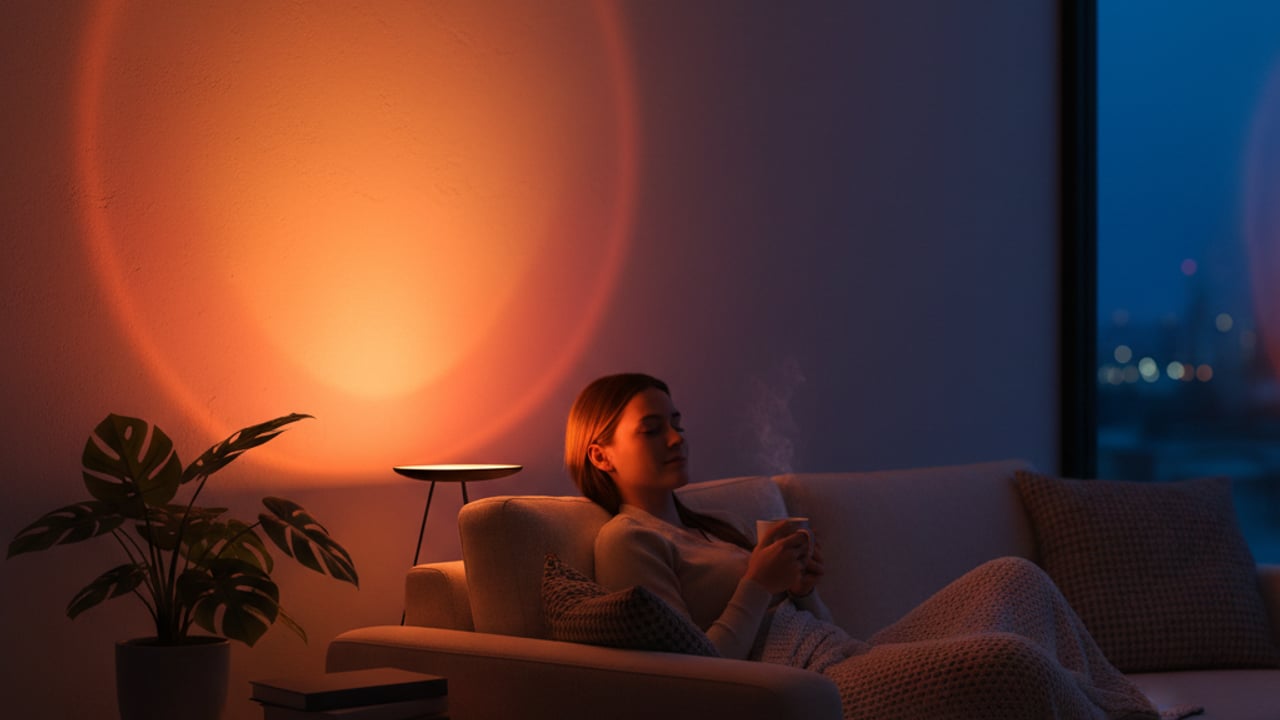
People buy sunset lamps mainly for mood lighting during evening downtime and as a backdrop for photos and video calls. The gentle amber tone is also visually calmer than harsh white LED light in the hour before bed, since warm light contains less of the blue wavelength that daylight-mimicking bulbs use to keep you alert. That said, this is a general observation about colour temperature and comfort, not a medical claim about sleep quality, so treat it as a nice-to-have rather than a cure for insomnia.
How to Choose the Right Sunset Lamp
- Bulb type and lifespan: LED units typically last 15,000 to 30,000 hours, far longer than halogen equivalents.
- Adjustability: a swivel head or rotating base lets you aim the gradient exactly where you want it on the wall.
- Power source: USB-powered models are more flexible for desks and shelves than mains-only designs.
- Colour range: some units offer only warm orange, others include a dial or remote for pink, purple, or blue tones.
- Build quality: check the housing material, cheap plastic tends to yellow and crack within a year of daily use.
💡 Did you know?
The visible light spectrum humans perceive spans roughly 380 to 750 nanometres, and a genuine sunset compresses most of what you see into the narrow 590 to 700 nanometre orange-red band, which is why sunset lamps rely so heavily on that specific colour range to look convincing.
Sunset Lamp Alternatives Rooted in Real Physics
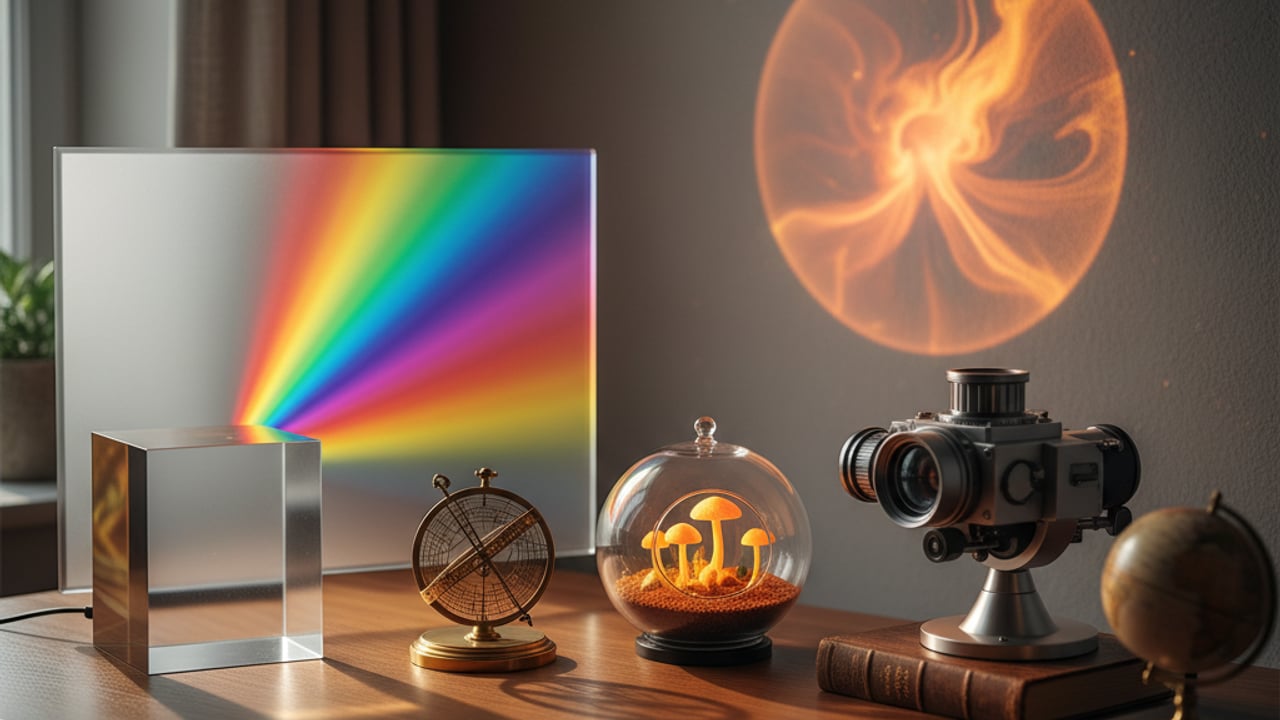
If part of the appeal for you is the science story behind an object rather than just the colour, there are pieces that deliver genuine optical phenomena rather than a filtered LED. A triangular glass prism splits white light into a full spectrum through actual refraction and dispersion, the same principle Isaac Newton demonstrated with prisms in 1666. A storm glass weather predictor uses a sealed chemical solution that forms crystal patterns as temperature and pressure shift, giving you an ever-changing, genuinely reactive display rather than a fixed colour wash. For something more theatrical, a Tesla coil music device produces real arcs of electricity synced to sound, referencing Nikola Tesla’s 1891 coil design. And if you simply want a rotating browse through atmospheric, light-focused decor pieces, our cool gadgets collection covers everything from kinetic sculptures to optical curiosities.
⭐ Key takeaway
Worth remembering: a sunset lamp is about colour and mood, while prisms, storm glasses, and Tesla coils give you an object with a documented physical principle behind every flicker or gradient, which tends to make for a better conversation piece and a more durable gift.
Our Verdict
I like sunset lamps for what they are, an affordable, cheerful bit of mood lighting, and I would never pretend otherwise. But after years of curating objects that carry a genuine scientific story, I always nudge undecided customers toward pieces where the physics is the actual selling point, not a marketing afterthought. My honest recommendation is to keep a sunset lamp for casual evening ambiance and pair it with one properly scientific object, like a prism or a storm glass, so your shelf has both the mood and the substance. That combination photographs just as well and ages considerably better once the social media trend has moved on.
Sunset Lamp FAQ
Sources
- Lord Rayleigh, ‘On the Light from the Sky, its Polarization and Colour’, Philosophical Magazine, 1871
- Mathmos company history, Poole, England, founded 1963 by Edward Craven Walker
- Isaac Newton, ‘Opticks’, experiments on light dispersion through prisms, 1666 to 1704