
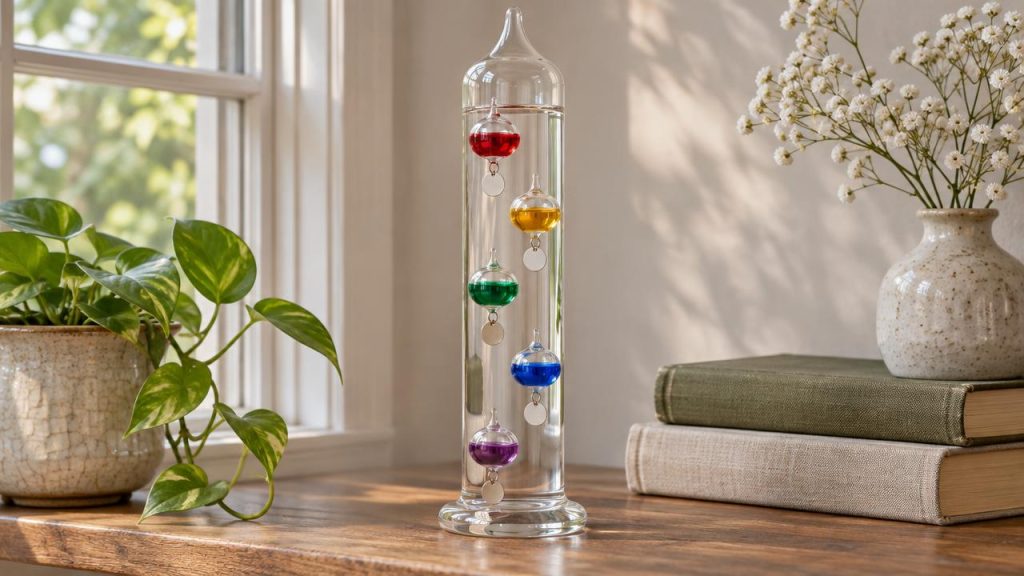
The essential:
- The instrument works because the clear liquid in the tube becomes less dense as it warms, while each sealed glass bulb keeps an almost fixed density.
- Each bulb is adjusted with a small metal tag so it floats or sinks at a specific temperature, usually spaced 2 degrees apart.
- To read it, look at the lowest bulb in the floating group at the top: its tag gives the approximate temperature.
- The design comes from the Accademia del Cimento in Florence, whose experiments were published in 1666, building on Galileo’s discovery that liquid density changes with temperature.
How does a Galileo thermometer work, with no electronics, no mercury and no needle? The answer is a quiet demonstration of buoyancy: a column of clear liquid, a handful of sealed glass bulbs, and a few small tags that turn changes in density into a temperature reading you can see from across the room.
As a former museum science communicator, I rate this as one of the best instruments for explaining physics without a single equation. This guide covers the principle behind it, what the bulbs and liquid contain, how to read the tags, how accurate it is, its real history in 17th-century Florence, and simple tips for placing and caring for one at home.
📋 Table of contents
- How does a Galileo thermometer work, in simple terms?
- Buoyancy and density: how does a Galileo thermometer work at the physical level?
- What liquid is inside the tube and the bulbs?
- How to read the tags on the floating bulbs
- How accurate is this kind of floating bulb thermometer?
- Did Galileo really invent it?
- Where should you place one at home?
- Our take: why the floating bulb thermometer is worth having
- FAQ
How does a Galileo thermometer work, in simple terms?
As the room warms, the clear liquid in the tube expands and becomes less dense, so bulbs that were floating sink one by one. As it cools, the liquid becomes denser again and the bulbs rise. Everything rests on one rule discovered more than two thousand years ago by Archimedes: an object in a liquid is pushed upwards by a force equal to the weight of liquid it displaces. If the object is denser than the liquid, it sinks; if it is less dense, it floats.
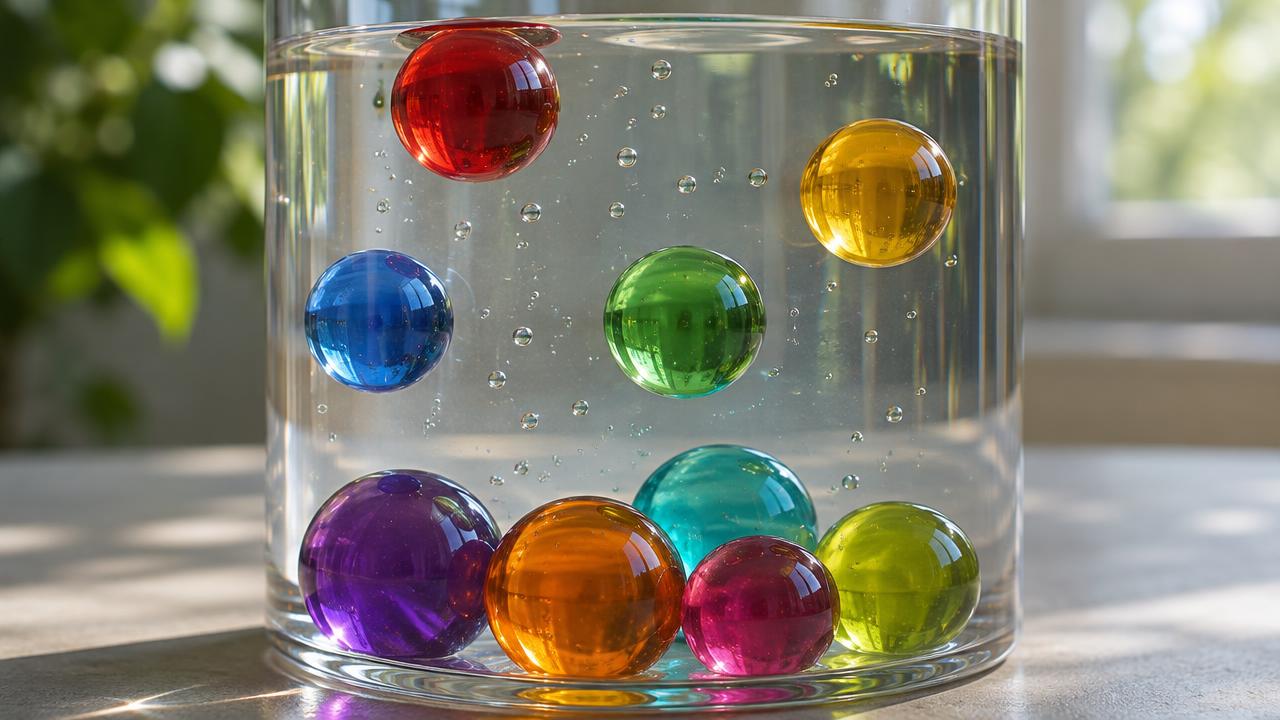
Inside the tube, two things react very differently to heat:
- The clear liquid expands noticeably when it warms, so the same mass takes up more space and its density drops.
- The sealed glass bulbs barely change. Glass expands far less than the liquid, and each bulb is closed, so its mass and volume stay almost constant.
Each bulb is made with a slightly different density, fine-tuned by the small metal tag hanging beneath it. When the liquid becomes less dense than a given bulb, that bulb loses its buoyancy and sinks. When the liquid cools and becomes denser than the bulb, the bulb floats back up.
The result is a slow, silent sorting of the bulbs: the light ones float at the top, the heavy ones rest at the bottom, and the boundary between the two groups moves with the temperature of the room.
⭐ Key takeaway
The bulbs do not react to temperature; the liquid around them does. Warmer liquid is thinner, so it holds up fewer bulbs, and that is the whole trick.
Buoyancy and density: how does a Galileo thermometer work at the physical level?
Density is mass divided by volume. A bulb floats when it is less dense than the surrounding liquid and sinks when it is denser, because buoyancy depends on the weight of liquid it pushes aside. Picture a single bulb in the tube. Gravity pulls it down with a force equal to its weight. The liquid pushes it up with a force equal to the weight of liquid it displaces. Since the bulb’s volume does not change, the upward push depends entirely on the liquid’s density.
On a cool morning the liquid is slightly denser, so each bulb displaces a slightly heavier amount of liquid, and more bulbs float. As the afternoon warms the room, the liquid expands, the upward push weakens, and the heaviest of the floating bulbs drops to the bottom.
The differences involved are tiny. Neighbouring bulbs differ only very slightly in density, which is why manufacturers adjust them with precisely weighed tags rather than relying on glass-blowing alone.
This is exactly the kind of buoyancy and density effect you can feel in everyday life:
- a boat sits slightly higher in salty sea water than in a freshwater lake;
- a hot-air balloon rises because heated air is less dense than the cooler air around it;
- an egg sinks in fresh water but floats in strong brine.
The same family of slow, visible physics appears in a storm glass, explained in our guide to how storm glass crystals form.
What liquid is inside the tube and the bulbs?
The tube holds a clear liquid chosen because its density changes strongly with temperature, usually an oil such as paraffin or an alcohol-based fluid. The bulbs contain mostly water with dye, purely for colour. The clear liquid is the working part of the instrument, so makers choose a fluid that expands much more than water when heated. The table below compares published values for volumetric expansion at room temperature.
The original instruments built in 17th-century Florence used “spirits of wine”, a strong ethanol solution. Modern versions typically use a clear oil such as paraffin oil or another organic liquid. These fluids react to heat several times more strongly than water, which makes the bulbs respond to smaller changes in temperature.
The coloured liquid inside each bulb is decorative. It is usually water with a little dye, sometimes with some alcohol added. Because each bulb is sealed, the coloured liquid inside does not influence the reading; what matters is the bulb’s total mass and volume.
A practical safety note: the clear liquid is not something to drink or handle. If a tube ever breaks, keep children and pets away, ventilate the room, wear gloves to collect the glass, and wash any skin contact with soap and water.
| Liquid | Volumetric expansion (per °C, approx.) | Relative to water | Use |
|---|---|---|---|
| Water (about 20 °C) | 0.00021 | 1 times | Inside the coloured bulbs |
| Paraffin oil | 0.00076 | about 3.6 times | Common modern filling |
| Kerosene | 0.00099 | about 4.6 times | Alternative clear filling |
| Ethanol | 0.00109 | about 5 times | Historic spirits of wine |
How to read the tags on the floating bulbs
Look at the group of bulbs floating at the top and read the tag on the lowest one: that is the approximate temperature. If one bulb hovers alone in the middle, read that one instead. Most instruments have between 5 and 11 bulbs, each with a small tag stamped with a temperature, typically spaced 2 degrees apart. Reading one takes a few seconds once you know the rule:
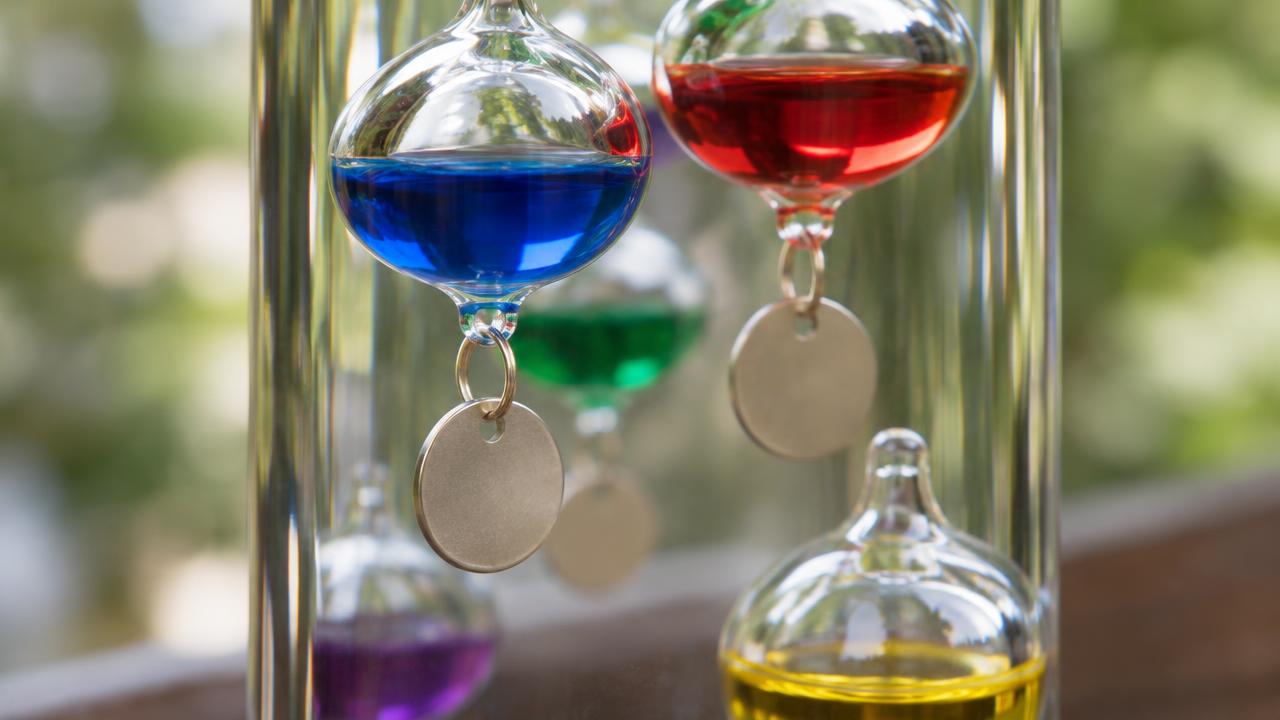
- Normal case: some bulbs float at the top, others rest at the bottom. The lowest bulb of the top group shows the current temperature.
- One bulb in the middle: if a bulb hovers on its own between the two groups, its tag is the closest reading, because the liquid’s density almost exactly matches it.
- A clear gap: if there is no bulb in between, the true temperature lies between the lowest floating tag and the highest sunken tag. Taking the average of the two is a reasonable estimate.
- All bulbs at the top: the room is colder than the lowest tag.
- All bulbs at the bottom: the room is warmer than the highest tag.
Notice the counterintuitive part: the bulbs marked with low temperatures sink last, so the cool-weather tags are near the top of the stack. When the room warms, the reading moves upwards through the floating group as bulbs drop away.
A model with 11 bulbs, such as this large 64 cm floating bulb instrument, covers a wider range of temperatures in smaller steps than compact 5-bulb versions.
💡 Did you know?
The bulbs marked with the coldest temperatures are the lightest ones, which is why they float at the very top. On a chilly day, almost the whole set clusters against the cap.
How accurate is this kind of floating bulb thermometer?
It gives a good approximate reading, usually to within the spacing between two tags, often 2 degrees. It reacts slowly, so it shows the general temperature of a room rather than quick changes. Accuracy depends on how carefully each bulb has been calibrated and how many bulbs share the range. With tags every 2 degrees, you can read the temperature to within roughly that step, and a little better when one bulb hovers in the middle.
Three factors limit precision:
- Step size: the instrument can only tell you which pair of tags the temperature lies between.
- Response time: a large volume of liquid takes a while to warm or cool all the way through, so the reading lags behind sudden changes such as a radiator switching on.
- Range: most models are designed for indoor comfort temperatures. Outside that window, all bulbs sit at the top or bottom and the instrument simply tells you it is too cold or too warm.
For a precise measurement, a calibrated digital thermometer will always win. But that is not really the point. Like a storm glass, this instrument is an invitation to watch physics happen in slow motion, and it is accurate enough to tell you whether the living room has warmed up since breakfast.
Its tempo is part of its charm, rather like the steady swing of a pendulum or a ball in Newton’s cradle.

🛍️ Our pick
Black Galileo Thermometer
A Galileo thermometer with seven spheres and a sleek black stand, showing temperature through changes in liquid density.
£49.99 · ★ 19 sold
Discover →Did Galileo really invent it?
Not exactly. Galileo discovered that the density of liquids changes with temperature and built an air thermoscope, but the floating-bulb instrument was developed by the Accademia del Cimento in Florence and described in 1666. Galileo Galilei experimented with temperature around the end of the 16th century. His own device, a thermoscope, used a column of air trapped in a glass bulb over water: as the air warmed and expanded, the water level moved. It had no fixed scale and also reacted to air pressure, so it showed changes in temperature rather than measuring them.
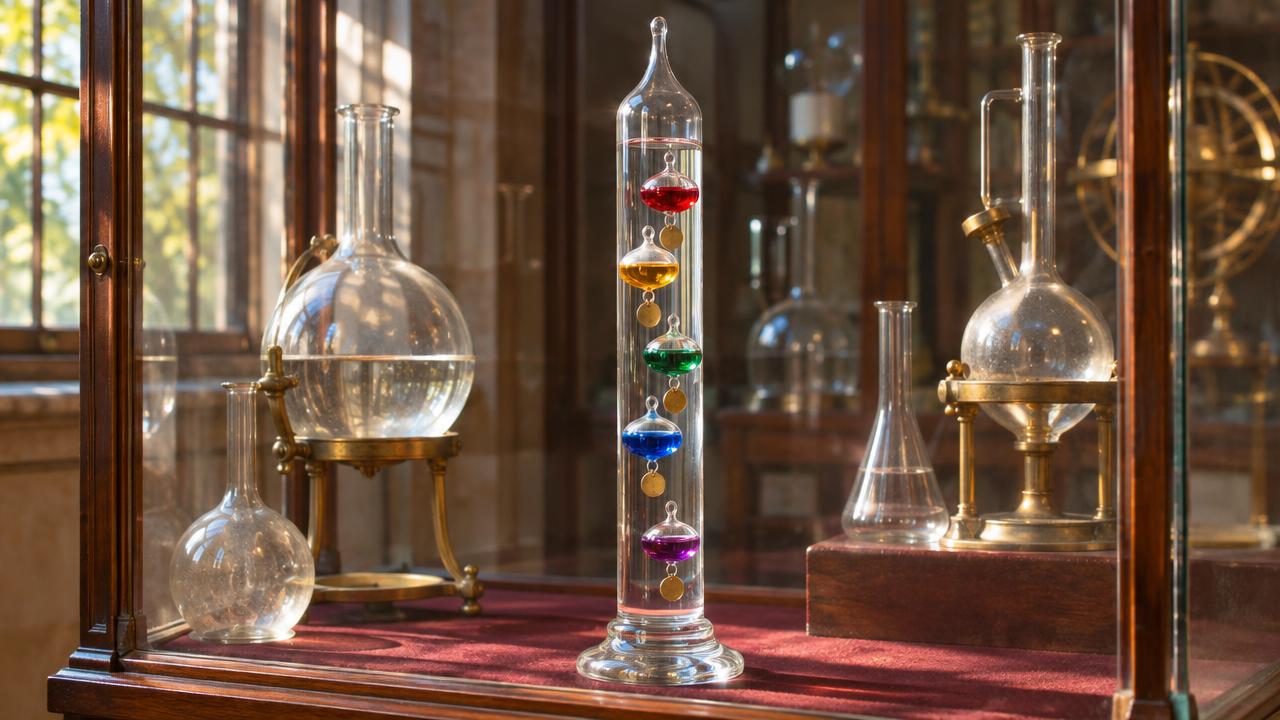
The floating-bulb design came later, from the Accademia del Cimento, an experimental academy founded in Florence under the patronage of the Medici family, whose members included Galileo’s pupil Vincenzo Viviani. Its experiments were published in 1666 in the Saggi di naturali esperienze. The academy’s makers used “spirits of wine” and small glass bubbles of carefully adjusted weight, exactly the principle still in use.
The name honours Galileo because the instrument relies on his insight about liquid density. Modern decorative versions became popular in the late 20th century, and it is now one of the classic gifts for anyone who loves elegant scientific objects. Browse our full range of floating bulb instruments or the wider science decor collection.
Where should you place one at home?
Choose a stable shelf away from direct sunlight, radiators, draughts and appliances. Sunlight or a nearby heat source warms the liquid unevenly and makes the reading unreliable. Because the instrument measures the temperature of its own liquid, anything that heats or cools the tube more than the room will distort the reading. A few simple rules help:
- Avoid direct sunlight: a sunny windowsill can warm the liquid well above room temperature and send every bulb to the bottom. It may also fade some dyes over time.
- Stay clear of heat sources: radiators, fireplaces, lamps, televisions and kitchen appliances all create local hot spots.
- Avoid draughts: doors and windows that open often cause the bulbs to shuffle constantly.
- Keep it stable: a heavy base or wall bracket away from busy corridors and young children reduces the risk of breakage.
- Let it settle: after moving it, allow some time for the liquid to reach room temperature before reading it.
Cleaning is easy: dust the glass with a soft dry cloth and avoid moving the instrument more than necessary. Pair it with other slow-motion objects from our science gadgets range for a small physics corner at home. A classic piece such as the Galileo Glass Thermometer fits neatly on a bookshelf or a desk.

🛍️ Our pick
Galileo Glass Thermometer
A classic Galileo thermometer whose glass spheres rise and fall with the temperature: buoyancy you can read at a glance.
From £31.49 · ★ 72 sold
Discover →Our take: why the floating bulb thermometer is worth having
It is not the most precise way to measure temperature, but it is one of the best ways to see density and buoyancy at work, every single day, on a shelf. In family workshops, the question “why do the balls move?” opens a conversation that touches on Archimedes, expansion, density and the history of science in under ten minutes. Few household objects do that. Here is how we suggest using one:
- Watch it across a day: note which bulb is lowest in the floating group at breakfast, lunch and evening. Children quickly spot the pattern.
- Compare with a digital thermometer: a simple way to discuss accuracy, steps and response time.
- Link it to the weather: on a cold snap, see how long the room takes to cool, then think about the clouds outside with our guide to types of clouds.
- Choose the style you will enjoy seeing: colourful bulbs are fun for children, while sober versions blend into a study.
For a minimalist look, the Black Galileo Thermometer uses seven dark bulbs that read clearly without visual noise. It sits well alongside a storm glass, whose own physics is covered in how the storm glass barometer works. Once you understand the principle, you will never glance at those drifting bulbs in quite the same way again.
Like the Galileo thermometer, many of our physics gifts show a law of physics at work every day.
FAQ
Sources
- Accademia del Cimento, Saggi di naturali esperienze (Florence, 1666)
- Museo Galileo, Florence, collections on the Accademia del Cimento and early thermometers
- The Engineering ToolBox, volumetric expansion coefficients of liquids
- Western Washington University, Department of Physics, Galileo’s thermometer demonstration