
The essential:
- A catapult is powered by stored tension or torsion, while a counterweight trebuchet is powered by gravity acting on a falling mass.
- Human-powered traction trebuchets are described in the Mozi, a text compiled in the 4th century BC; counterweight trebuchets spread around the Mediterranean in the 12th century.
- Large counterweight trebuchets could hurl stones of around 86 kg roughly 200 to 275 metres.
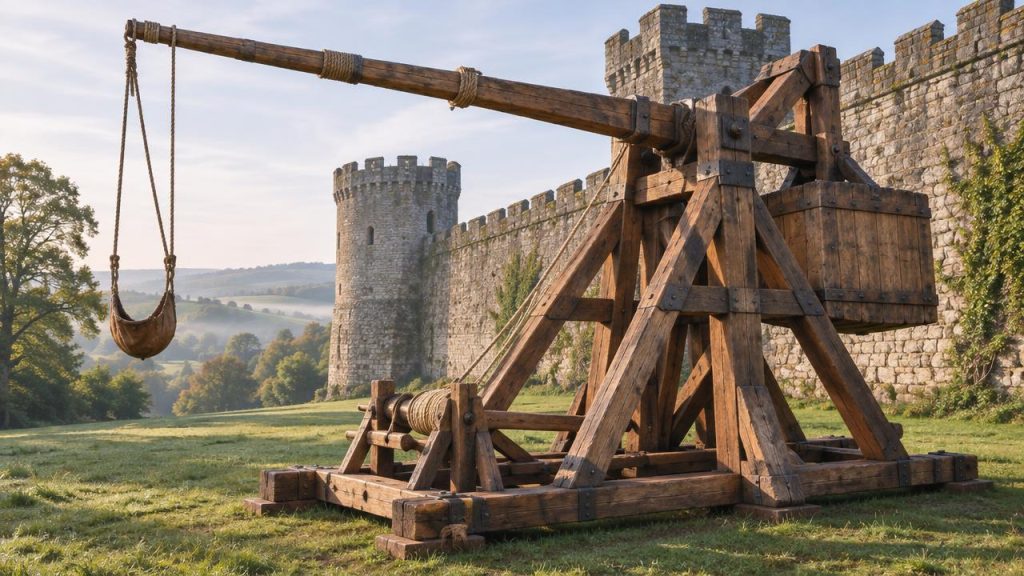
- Warwick Castle’s reconstruction, built in 2005, weighs about 22 tonnes, stands 18 metres tall and throws 36 kg projectiles up to 300 metres.
The trebuchet vs catapult question comes up in almost every school workshop on levers and simple mechanisms, usually from a child who has just watched a siege scene in a film. The short answer: a catapult throws by releasing energy stored in a twisted or bent material, while a trebuchet throws by letting a heavy counterweight fall.
That distinction sounds technical, but it shaped centuries of military history and makes a wonderful lesson in physics. Below you will find how each engine works, where they came from, which one throws further and why, and what a desktop model can teach you about energy, levers and projectiles.
📋 Table of contents
- Trebuchet vs catapult: what is the main difference?
- What is a trebuchet?
- How does a trebuchet work?
- How did Roman and ancient catapults work?
- What is a Da Vinci catapult?
- Trebuchet vs catapult: which throws further?
- Why did medieval siege engines disappear?
- Our take: which is better for learning physics, a trebuchet or a catapult?
- FAQ
Trebuchet vs catapult: what is the main difference?
The difference is the energy source. A catapult stores energy in twisted rope, sinew or bent wood and releases it in a snap, while a trebuchet converts the potential energy of a falling counterweight into motion. Strictly speaking, catapult is an umbrella term for any device that throws a projectile without explosives. In everyday use, though, people mean the classic arm-and-bucket device powered by tension or torsion, such as the Roman onager, which is why the comparison is so common.
- Torsion catapult: a bundle of rope or animal sinew is twisted tight. The throwing arm sits inside the bundle, and when released, the untwisting rope flings the arm forward until it hits a padded crossbar.
- Tension catapult: a bent wooden or composite spring, rather like a giant bow, stores the energy.
- Counterweight trebuchet: a long beam pivots on an axle. A heavy weight on the short end falls, the long end whips upward and a sling releases the stone.
The practical consequence is huge. Twisted rope loses strength in damp weather and over time, while gravity is constant and free. A bigger trebuchet simply needs a heavier box of stones or earth.
| Feature | Torsion catapult (onager) | Counterweight trebuchet |
|---|---|---|
| Energy source | Twisted rope, sinew or horsehair | Gravity acting on a falling counterweight |
| Release | Arm stops against a crossbar | Sling opens near the top of the swing |
| Main period of use | Roman era, roughly 4th to 6th century AD | 12th century to the mid 15th century |
| Sensitivity to weather | High: rope and sinew weaken when wet | Low: a weight weighs the same in rain |
| Typical projectile | Smaller stones | Heavy stones, often tens of kilograms |
What is a trebuchet?
A trebuchet is a siege engine built around a long pivoting beam with a sling at one end. Early versions were pulled by teams of people; later versions used a heavy counterweight to swing the beam. There are two main families, and the distinction matters for history:
- Traction trebuchet: a crew pulls ropes attached to the short end of the beam. The Mozi, a philosophical and technical text of the Warring States period compiled in the 4th century BC, already describes such engines, and they reached the Byzantine, Persian and Arab worlds by the 6th and 7th centuries AD. Historians often call this type a mangonel.
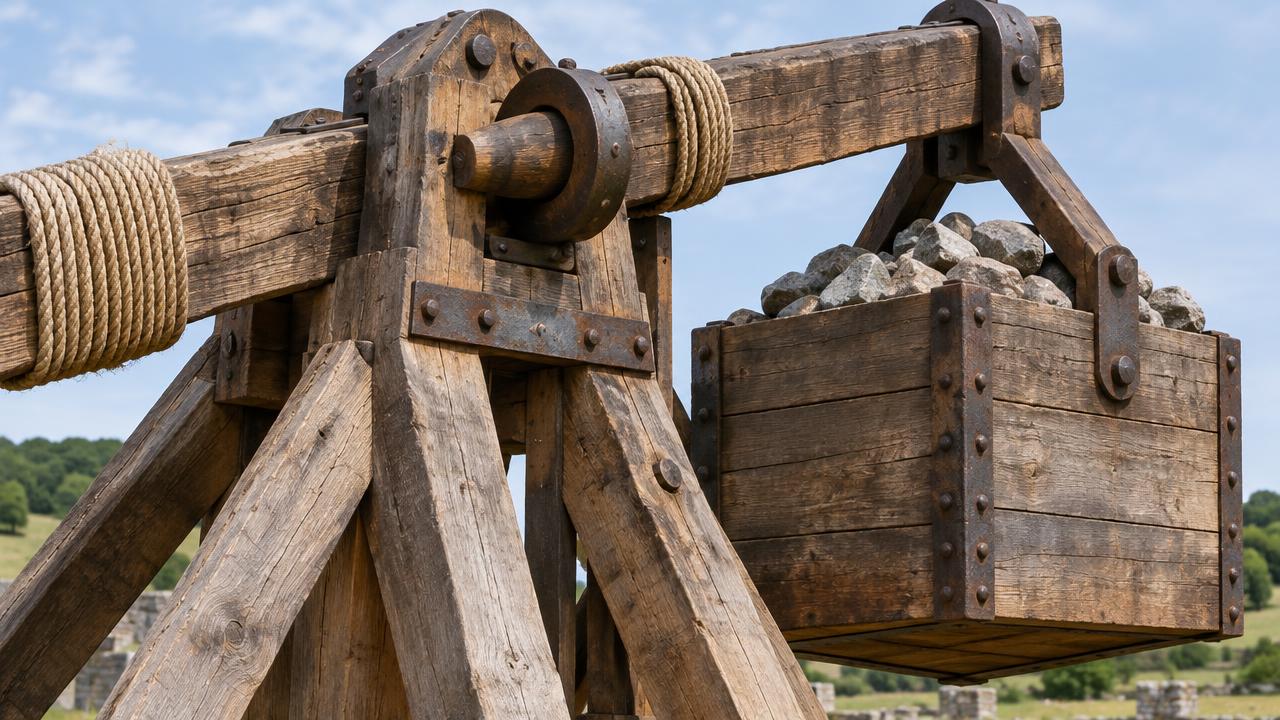
- Counterweight trebuchet: a heavy box replaces the human crew. It appears around the Mediterranean in the 12th century; the earliest known description, by al-Tarsusi, dates to 1187. It was later carried east, and Persian engineers built such engines for the Mongol siege of Xiangyang in 1268.
The word trebuchet comes from Old French, linked to the verb meaning to stumble or overthrow, and entered English in the 14th century. A neat image for a device designed to bring walls down.
If you like seeing mechanisms in action, our range of engineering and construction kits lets you build levers, gears and linkages with your own hands.
💡 Did you know?
Did you know? Edward I’s giant trebuchet, the Warwolf, was reportedly finished at Stirling Castle in 1304 after the garrison had already offered to surrender. Edward is said to have refused to let anyone leave until he had seen the trebuchet fire.
How does a trebuchet work?
As the counterweight drops, its potential energy turns the beam. The long arm moves much faster than the short one, and the sling adds extra length, so the projectile leaves at high speed near the top of the swing. A counterweight trebuchet is a lever with unequal arms. The counterweight sits close to the pivot; the sling hangs from the far end of a much longer arm. When the weight falls a short distance, the tip of the long arm travels a long distance in the same time, so it moves much faster.
- Energy in: the potential energy of the counterweight, its mass times gravitational acceleration times the height it drops.
- Speed multiplier: the ratio between the long and short arms, plus the sling, which acts like an extra hinged arm and whips round at the end.
- Release: one end of the sling hangs on a hook or prong. When the sling swings past a certain angle, that loop slides off and the stone flies free. Adjusting the prong tunes the launch angle.
Engineers improved the design further by hanging the counterweight on a hinge so it could fall more nearly straight down, which wastes less energy in swinging sideways. This is why a trebuchet launch looks so smooth compared with the violent kick of a torsion engine.
For a broader look at how stored energy becomes motion, our article on the physics and history of Newton’s cradle follows the same thread of energy and momentum.
How did Roman and ancient catapults work?
Ancient torsion catapults stored energy in tightly twisted bundles of sinew, horsehair or rope. Winding the arm down with a windlass twisted the bundles further, and releasing it let them spring back violently. The best known example is the Roman onager, used roughly from the 4th to the 6th century AD. Its name means wild ass in Latin, because Roman writers compared its violent backward kick to the animal’s hooves.
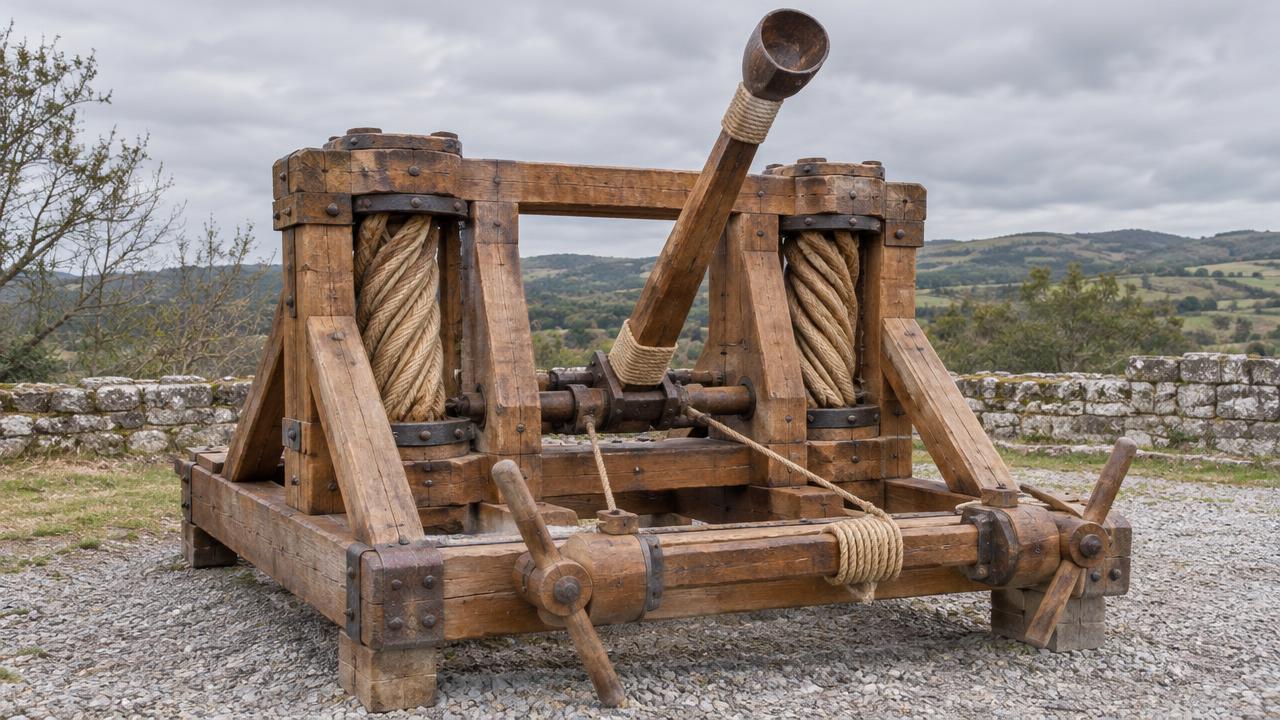
- Loading: soldiers used a windlass to pull the throwing arm down against the twisted skein.
- Firing: a release pin let the arm swing up until it slammed into a padded crossbeam, flinging the stone from a cup or sling.
- Limits: one modern reconstruction in 2002 threw a 26 kg ball about 82 metres before its timber broke, a reminder of how much strain these engines endured.
Torsion engines were powerful for their size, but they relied on carefully prepared sinew and constant maintenance. That is one reason why, from the late 6th century onwards, the simpler traction trebuchet replaced them around the Mediterranean.
If you enjoy devices driven by stored energy and clever linkages, a working Robotic Hand Kit uses hydraulics in a similar spirit of force transmission.
What is a Da Vinci catapult?
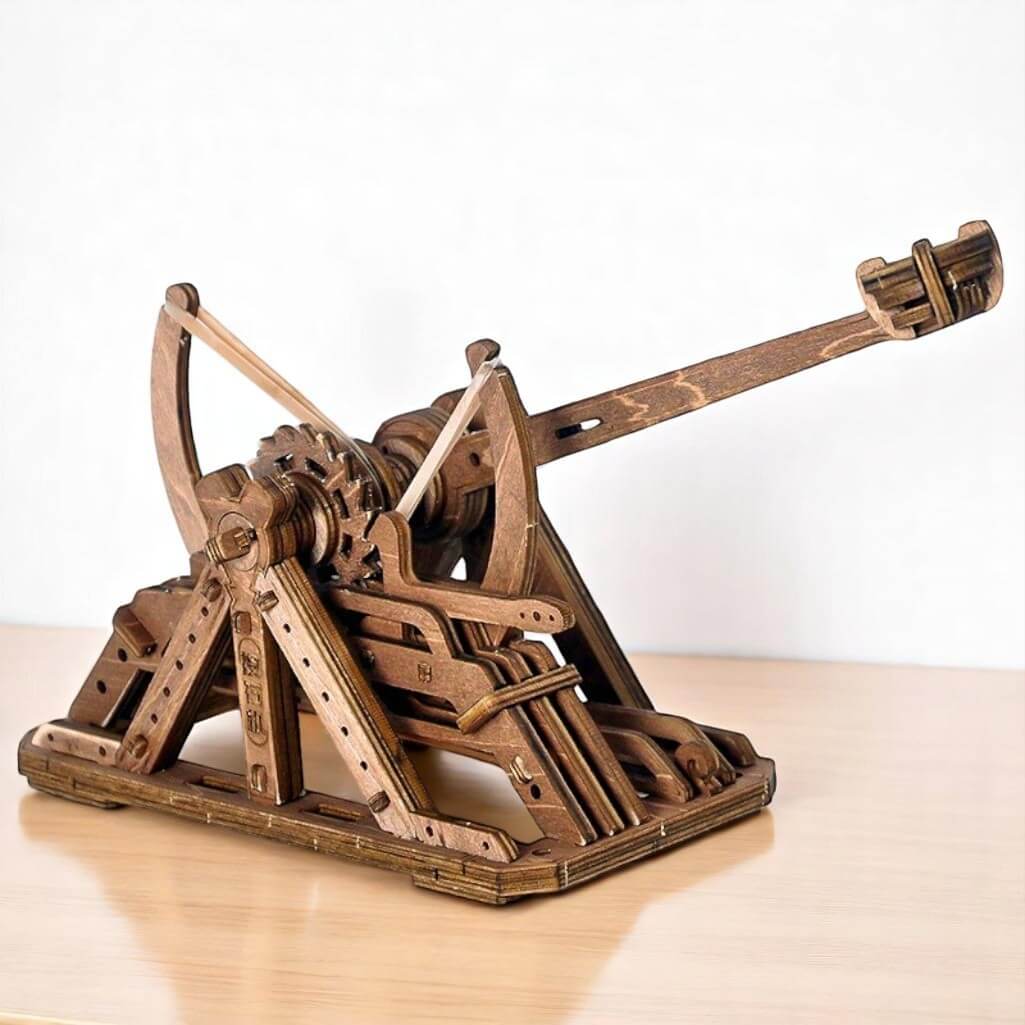
Leonardo da Vinci sketched catapults powered by bent wooden springs, wound up with a gear and drum. His drawings in the Codex Atlanticus refine an older idea rather than invent a new device. Leonardo filled notebooks with siege engines while seeking employment as a military engineer. One of his best known designs, recorded in the Codex Atlanticus, uses a large bow-shaped spring. Cords from both ends of the bow wind onto a central drum, and a worm gear provides the mechanical advantage to load it. When the gear is disengaged, the bow snaps back, swinging the throwing arm.
- Energy source: tension in bent wood, making it a true catapult rather than a trebuchet.
- Clever detail: the gearing lets one person store a large amount of energy slowly and safely.
- Legacy: the design is a favourite for model makers, because it shows springs, gears and levers working together in one mechanism.
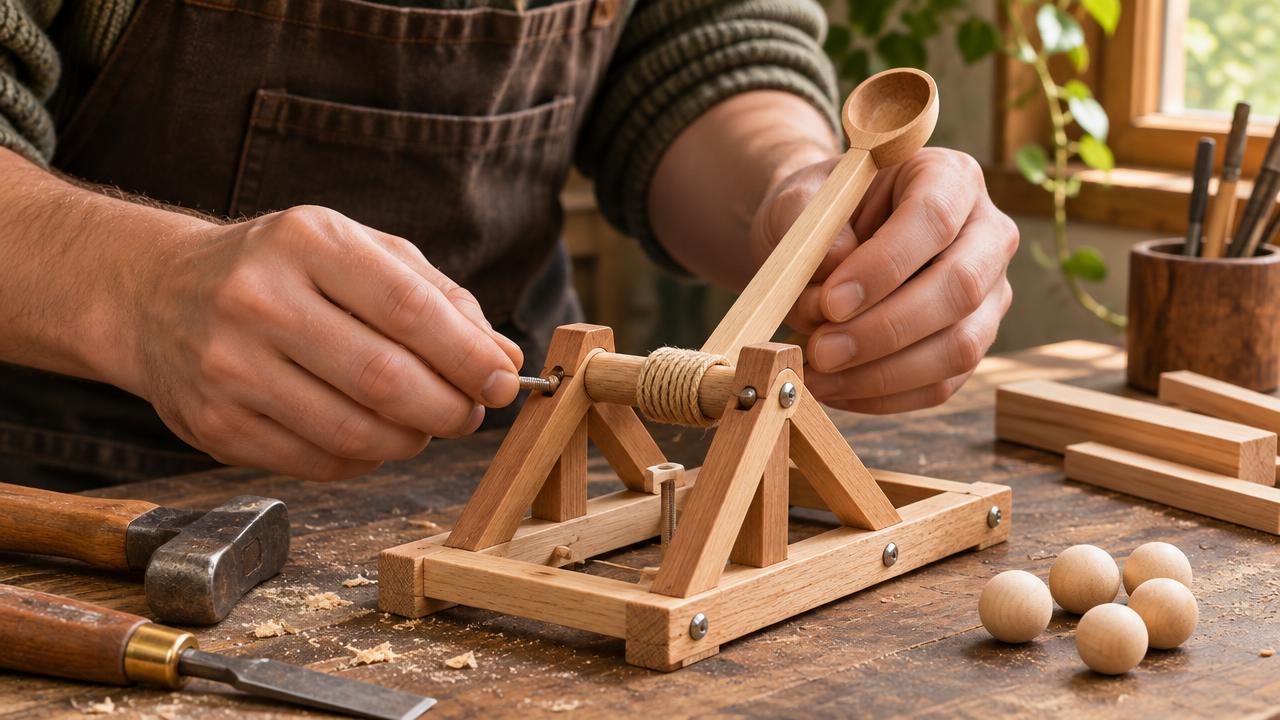
Building one yourself is the quickest way to feel the physics. Our wooden Da Vinci catapult assembles from slotted pieces and throws small projectiles across a room, which is ideal for testing how arm angle changes the range.
🛍️ Our pick
Da Vinci Catapult Kit
A wooden catapult kit inspired by Leonardo da Vinci's sketches: build it, adjust the tension and test how far it throws.
£29.99 Discover →
Trebuchet vs catapult: which throws further?
A large counterweight trebuchet generally throws heavier stones further. Historical estimates put roughly 86 kg stones at 200 to 275 metres, while torsion catapults threw lighter projectiles over shorter or comparable distances. Range always depends on size, so the fair comparison is between engines of their era. The counterweight trebuchet’s great advantage was not raw distance but the combination of heavy projectiles, reasonable range and repeatable accuracy.
- Traction trebuchets: the Mozi lists ranges of about 37 to 91 metres for different sizes.
- Counterweight trebuchets: projectiles of around 86 kg are estimated to have reached about 200 to 275 metres; the very largest trebuchets, with counterweights of many tonnes, perhaps 365 to 400 metres.
- Torsion catapults: ancient accounts make large claims, but modern estimates for the onager’s useful range are closer to 130 metres.
Why does the trebuchet win? Gravity scales simply: double the counterweight and you roughly double the energy available. Twisted rope does not scale so easily, because thicker bundles are harder to twist and more prone to failure. The trebuchet also delivers its push smoothly, so less energy is lost in shock and vibration.
⭐ Key takeaway
Key takeaway: in the trebuchet vs catapult contest, the trebuchet wins for heavy, accurate, repeatable shots because a bigger counterweight gives more energy without stressing the frame the way twisted rope does.
Why did medieval siege engines disappear?
Gunpowder artillery replaced them. Cannon became more effective against walls through the 15th century, and both trebuchets and torsion engines were largely out of use by the middle of that century. Medieval siege engines had a long and successful career. The counterweight trebuchet dominated sieges in Europe and the Middle East for around three centuries, and some were still built after cannon arrived, for instance at the siege of Rhodes in 1480.
- Cannon advantages: smaller crews, faster set-up and flatter trajectories that could batter the base of a wall.
- Trebuchet advantages: high, arcing shots over walls and no need for expensive gunpowder.
- Final cameo: Hernán Cortés reportedly ordered a trebuchet built at Tenochtitlán in 1521; according to accounts, its first stone went straight up and smashed the trebuchet itself.
Today, the trebuchet lives on in reconstructions and competitions. Warwick Castle’s trebuchet, built in 2005, is one of the largest working examples, weighing about 22 tonnes and standing 18 metres tall. Engineering students still build trebuchets to explore levers, energy and projectile motion, which says a lot about how elegantly the design captures basic physics.
Curious about other inventions that changed the world? Our inventions quiz is a fun way to test yourself.
Our take: which is better for learning physics, a trebuchet or a catapult?
Build both if you can. A catapult teaches elastic energy and sudden release, while a trebuchet teaches gravitational potential energy, levers and timing. Together they cover most of a secondary school mechanics syllabus. In a workshop setting, the catapult usually wins the first round because it is satisfying immediately: wind, release, flight. The trebuchet wins the second round, once people start asking why changing the sling length or the release prong makes such a difference. That is where real experimenting begins.
- Try this: measure range while changing one thing at a time, such as counterweight, arm angle or projectile mass.
- Record results: a simple table soon shows that range does not grow in a straight line with energy.
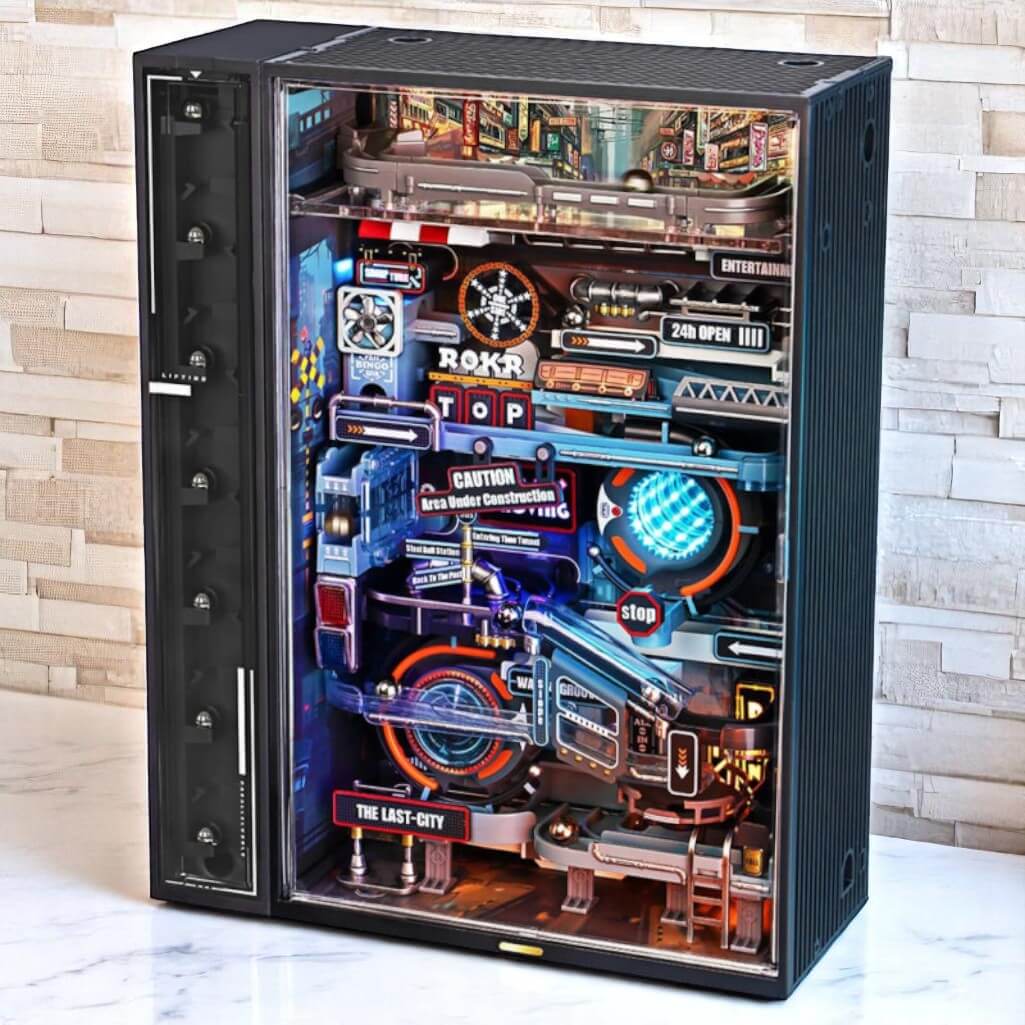
- Explore further: a Wooden Marble Run Mechanical Puzzle 130 Pieces turns potential energy into motion along a whole track, a lovely companion to a launcher.
For more hands-on projects, browse our physics experiments and 3D puzzles. If you enjoy mechanical brain-work in a different shape, our guide on how to solve a Megaminx offers a twelve-sided challenge of another kind. And for a related physics favourite, read our explainer on how a gyroscope works.
For more objects that put physics on a desk, see our physics gifts.
🛍️ Our pick
Wooden Marble Run Mechanical Puzzle 130 Pieces
A 130-piece wooden marble run to assemble: gears, ramps and gravity working together, much like a medieval engineer's workshop.
£87.49 Discover →
FAQ
Sources
- Joseph Needham and Robin Yates, Military Technology: Missiles and Sieges (Cambridge University Press, 1994)
- Peter Purton, A History of the Early Medieval Siege, c.450 to 1220 (Boydell Press)
- Royal Armouries, Leeds: medieval siege warfare collections
- Biblioteca Ambrosiana, Milan: Leonardo da Vinci, Codex Atlanticus